home/ plants/ wild-bergamot

// SPECIES PROFILE · PERENNIAL · NATIVE

Wild Bergamot

Monarda fistulosa

Wild Bergamot is the lavender-pink, oregano-scented prairie perennial that powers the midsummer pollinator scene across NE Oklahoma. A square-stemmed, opposite-leaved member of the mint family (Lamiaceae), it carries a single spherical head of tubular flowers on every shoot — a landing-deck for bumblebees, leaf-cutter bees, hummingbird clearwing moths, swallowtails and ruby-throated hummingbirds. Crush a leaf and you smell thymol and carvacrol: the same essential oils that put oregano and thyme on the spice rack and that gave Plains tribes a powerful antiseptic poultice. One of THE great Oklahoma-native perennials — the backbone of any prairie-style or pollinator garden in the Tulsa region.

// QUICK FACTS
Family
Lamiaceae (mint family)
Native range
Most of N. America: Quebec → BC, south to GA, TX & N. Mexico
In Oklahoma
Statewide; abundant in tallgrass prairie remnants & roadsides
USDA hardiness
Zones 3–9 (Tulsa = 7a/7b)
Mature size
2–4 ft tall · 2–3 ft spread
Habit
Clump-forming herbaceous perennial; slow rhizomatous spread
Bloom
Late June – August (NE OK)
Flower color
Pale pink to lavender (rarely white)
Sun
Full sun → light shade (6+ hrs ideal)
Soil
Average to dry, well-drained; tolerates clay, rocky, alkaline
Water
Low to medium; xeric once established
Wildlife
Bumblebees · hummingbirds · clearwing moths · butterflies · deer-resistant
Aromatics
Thymol, carvacrol, geraniol, p-cymene (Earl-Grey/oregano scent)
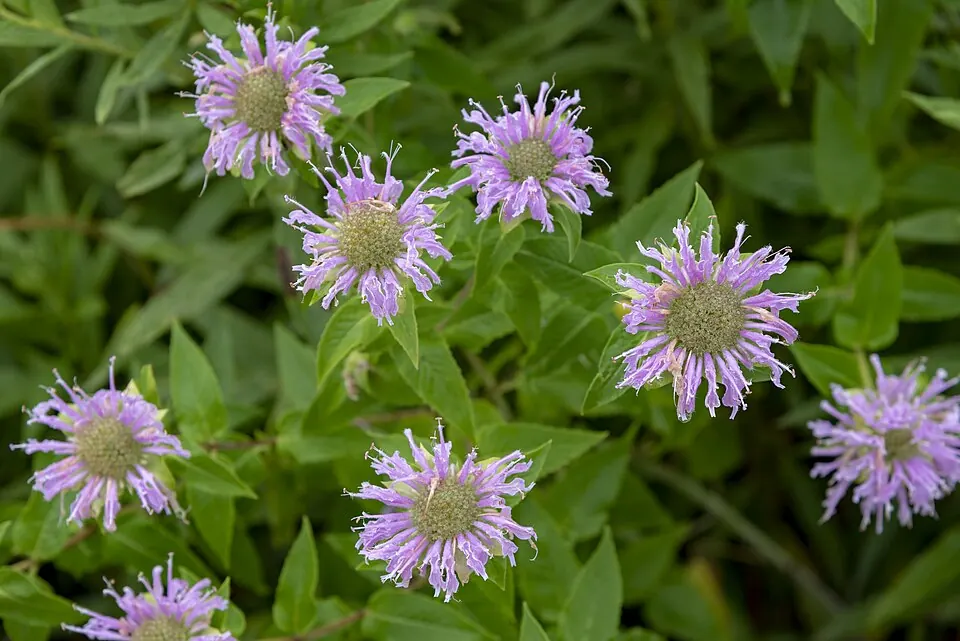
Wild Bergamot (Monarda fistulosa) lavender-pink flower head with exserted stamens
Monarda fistulosa in midsummer bloom — a single spherical head of tubular pink-lavender flowers atop a square stem. Photo: Rooted Revival.

Identification

[ field key — stem · leaf · flower · winter form ]

Habit & Stem

Erect, clump-forming herbaceous perennial 2–4 ft tall, occasionally to 5 ft on rich sites. Stems are distinctly square in cross-section — the unmistakable hallmark of the mint family (Lamiaceae) — usually unbranched below the inflorescence, sometimes with a few opposite branches above. Spreads slowly by shallow rhizomes into a tidy expanding clump; never aggressive in the way that the related M. didyma can be in moist gardens.

Leaves

Opposite, lance-shaped (lanceolate to ovate-lanceolate), 5–10 cm long, with a serrated (toothed) margin, a tapered tip and a short petiole. Surface is finely hairy and dull grey-green. Crushed foliage is strongly aromatic — a complex of oregano, thyme and Earl-Grey (bergamot) notes driven by the volatile oils thymol, carvacrol, geraniol and p-cymene. The chemistry is the same family as culinary oregano.

Flowers

A single terminal spherical head 4–6 cm across at the top of every flowering shoot, subtended by a whorl of pink-tinged bracts. Each head is packed with 20–50 narrow, tubular, two-lipped flowers, pale pink to lavender, with a long arched upper lip, a distinctly reflexed lower lip, and prominently exserted stamens that arch out beyond the corolla — perfectly engineered for long-tongued bees and hovering moths. Blooms in NE OK from late June through August.

Winter Form & Seed

After bloom, each flower head matures into a tan, persistent winter seedhead — a hard rounded knob of nutlets surrounded by the dried bracts — that stays on the stem well into January and is a useful winter ID feature on roadsides and prairies. Seeds are tiny 4-parted nutlets typical of mints: 1–2 mm long, dark brown, easily collected by snipping heads into a paper bag in late fall.

Habitat & Range in NE Oklahoma

Monarda fistulosa is one of the most widespread native plants in North America, occurring from Quebec to British Columbia and south to Georgia, Texas and northern Mexico — a continental distribution unmatched by most prairie forbs. In NE Oklahoma it is abundant in tallgrass prairie remnants (Tallgrass Prairie Preserve, Joseph H. Williams Tallgrass; the Osage; the prairie patches of the Cross Timbers), in woodland edges & openings along the Arkansas, Verdigris and Caney rivers, and conspicuously along road right-of-ways from June through August where mowing is light.

Its niche is dry-mesic to dry, full-sun openings on a wide range of soils — limestone glades, sandstone uplands, deep prairie loam, and even compacted clay road shoulders. It is notably more drought-tolerant than its eastern cousin scarlet bee balm (M. didyma), which is why M. fistulosa is the right Monarda for Oklahoma summers.

Ecology & Wildlife Value

[ pollinators · larval hosts · vertebrate visitors · aromatic defense ]

Pollinators

The Xerces Society lists wild bergamot among the highest-value native pollinator perennials of the central US. Long-tongued bees dominate the floral visitor list: bumblebees (Bombus spp., including B. pensylvanicus and B. griseocollis), leaf-cutter bees (Megachile), mining bees (Anthophora), and the Monarda-specialist Dufourea monardae. Short-tongued bees and syrphid flies rob nectar through holes cut at the base of the corolla. Ruby-throated hummingbirds work the heads in mornings and evenings.

Hummingbird Moths & Butterflies

Two species of hovering hummingbird clearwing mothsHemaris thysbe (hummingbird clearwing) and Hemaris diffinis (snowberry clearwing) — are stereotypical daytime visitors and often the easiest way to find a bergamot patch from a distance. Butterfly visitors include the great spangled fritillary, eastern tiger and pipevine swallowtails, monarchs, and a long list of skippers.

Lepidoptera Hosts

Wild bergamot is a larval host plant for several Monarda-feeding moths, most notably the hermit sphinx (Lintneria eremitus), the raspberry pyrausta (Pyrausta signatalis) and the orange mint moth (Pyrausta orphisalis). Modest amounts of leaf-feeding are normal and ecologically valuable — do not spray.

Aromatic Defense & Deer

The thymol-and-carvacrol-rich essential oil that makes bergamot smell so good to humans makes the foliage taste terrible to deer and rabbits, and gives the plant strong antifungal and antibacterial surface chemistry. As a result, M. fistulosa is one of the reliably deer-resistant herbaceous perennials available for Oklahoma gardens — useful information at the Cross Timbers / suburban edge.

Pollinator-garden role: A backbone summer-bloom perennial. In Tulsa-region prairie plantings, pair Monarda fistulosa with butterfly milkweed (Asclepias tuberosa), black-eyed Susan (Rudbeckia hirta), purple coneflower (Echinacea purpurea), and indiangrass (Sorghastrum nutans) for a mid-summer to early-fall pollinator sequence that needs almost no irrigation once established.

Horticulture & Care

[ planting · soil · water · pruning · division · powdery mildew ]

Site selection & planting

Plant in fall (best for Tulsa — cool soil, winter rain to establish roots) or in early spring. Choose the sunniest, driest, leanest spot you have: full sun (6+ hrs), average to dry well-drained soil, with good air circulation. Wild bergamot tolerates clay, rocky, and alkaline soils as long as drainage is adequate. Avoid rich, heavily mulched, frequently irrigated borders — soft, lush growth flops and is far more susceptible to powdery mildew.

Powdery mildew — the one real problem

In Oklahoma's humid summers, Erysiphe and Golovinomyces powdery mildew can coat lower leaves with white powder by mid-July. Susceptibility is highly genetic: wild seed-strain plants vary widely, and cultivar choice matters enormously. Cultural controls that actually work:

Pruning & cut-back

Cut every stem to 4–6" immediately after the main bloom finishes (typically late August in Tulsa). This single step does three things: removes mildewed foliage, encourages a clean fresh basal flush for fall, and on many plants triggers a light second bloom in September. Leave the final autumn growth standing through winter for seedheads, structure, and overwintering insect habitat; cut to the ground in late February before new growth resumes.

Division & propagation

Notable cultivars for NE Oklahoma

Cultivar Species / parentage Distinguishing feature Notes for Tulsa
'Claire Grace' M. fistulosa Strong lavender-pink flowers; excellent powdery-mildew resistance The standout straight-species selection for Oklahoma. Hardy, xeric, butterfly magnet.
'Marshall's Delight' M. didyma hybrid Bright pink, mildew-resistant, ~36" Wants a touch more moisture than straight fistulosa; afternoon shade helps.
'Jacob Cline' M. didyma Tall (~48") deep scarlet-red flowers; very mildew-resistant The hummingbird cultivar. Needs steadier moisture than fistulosa; plant in part shade in OK.
'Raspberry Wine' M. didyma hybrid Wine-red flowers, ~36", good resistance Bold border color; treat as didyma — medium moisture.
'Petite Delight' M. fistulosa hybrid Compact (~15"), lavender-pink, very mildew-resistant Excellent for small pollinator beds and the front of borders.
Tulsa cultivar pick: If you want one mildew-resistant Monarda for an Oklahoma prairie-style planting, choose 'Claire Grace'. It is a selection of straight M. fistulosa, so it keeps the species' xeric tolerance and pollinator value, while shrugging off the humid-summer mildew that flattens average wild seed strains. Then cut it hard after bloom for clean fall foliage.

Companion planting in a prairie / pollinator garden

Pairs naturally with: butterfly milkweed (Asclepias tuberosa), black-eyed Susan (Rudbeckia hirta), purple coneflower (Echinacea purpurea), little bluestem (Schizachyrium scoparium), indiangrass (Sorghastrum nutans), blazing star (Liatris spp.) and aromatic aster (Symphyotrichum oblongifolium) for an uninterrupted June–October bloom sequence under the dappled shade of an eastern redbud.
Edible, Medicinal & Cultural Uses

Few prairie natives have as deep a documented human-use history as wild bergamot. The same volatile oils that make it a powerful pollinator plant make it a culinary herb, a fragrant tea, and a traditional medicine.

Why "bee balm" worked: The folkloric use of crushed bergamot leaves to soothe bee stings — and as a wound poultice — is consistent with modern pharmacology. Thymol and carvacrol, the dominant essential oils of M. fistulosa, have well-documented broad-spectrum antibacterial and antifungal activity at surface (topical) concentrations. As with all herbal preparations, this is supportive home-use information, not a substitute for medical care.

Photo Reference

Monarda fistulosa — close-up of pink-lavender tubular flowers with exserted stamens
// Flower head · tubular two-lipped corolla · exserted stamens
Wikimedia Commons
Wild bergamot habit — clump of square-stemmed plants in flower
// Habit · 2–4 ft clumps · square stems · opposite leaves
Wikimedia Commons
Whole wild bergamot plant in prairie habitat
// Prairie habitat · Lamiaceae · widespread N. American native
Wikimedia Commons
Hummingbird clearwing moth (Hemaris) feeding at wild bergamot flower
// Hemaris clearwing moth · daytime hovering pollinator
Wikimedia Commons
Wild Bergamot, Bee Balm, Oswego Tea — flowering stand
// "Oswego Tea" · cultural / ethnobotanical staple
Wikimedia Commons

Sources & Further Reading

Strip photos courtesy of Wikimedia Commons contributors under their respective licenses (linked under each image). Hero photo by Rooted Revival.