home/ plants/ eastern-redbud

// SPECIES PROFILE · TREE · NATIVE

Eastern Redbud

Cercis canadensis

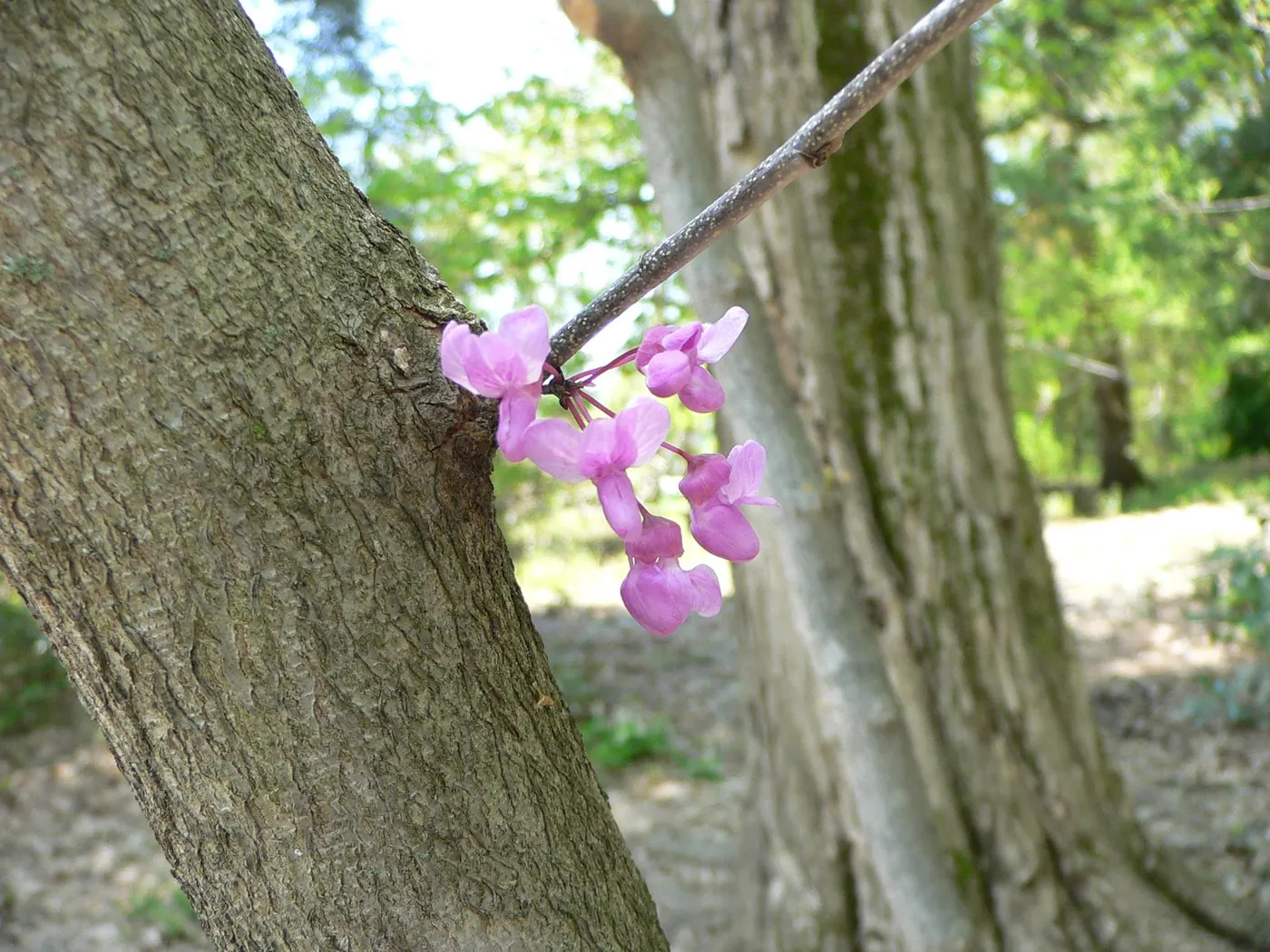
Adopted as the state tree of Oklahoma in 1937, the Eastern Redbud is the small understory tree that turns every wood-edge, fence-line and Cross Timbers ravine bright magenta in late March. A legume that flowers on bare branches before its leaves emerge — sometimes directly out of the trunk — Cercis canadensis is one of the first significant nectar sources of the Tulsa-region year for native bees, and a host plant for Henry's elfin butterfly. The Texas/Oklahoma subspecies texensis has glossier, leathery leaves and is what most local nurseries actually sell as "Oklahoma Redbud."

// QUICK FACTS
Family
Fabaceae (legume)
Native range
E. North America: S. Michigan → C. Mexico, west to NM
Subspecies in OK
ssp. canadensis, ssp. texensis (Oklahoma Redbud)
USDA hardiness
Zones 4–9 (Tulsa = 7a/7b)
Mature size
20–30 ft tall · 26–33 ft spread
Growth rate
Moderate; ~5 m at 10 yrs
Lifespan
50–70 yrs typical
Bloom
Late March – mid April (NE OK)
Flower color
Magenta-pink (also white & lavender cultivars)
Sun
Full sun → part shade (4–8 hrs)
Soil
Well-drained loam, clay, or rocky; pH 6.0–8.0
Water
Medium; drought-tolerant once established
Wildlife
Long-tongued bees · Henry's elfin host · songbird seed
Eastern Redbud (Cercis canadensis) in full magenta bloom against a clear sky
Cercis canadensis in full flower — the moment that announces spring across NE Oklahoma. Photo: USDA-NRCS PLANTS Database (Wikimedia Commons, public domain).

Identification

[ field key — bark · leaf · flower · pod · habit ]

Habit & Bark

Small, multi-stemmed tree or large shrub, typically 20–30 ft with a broad, often irregular crown. Trunk usually short and twisted; canopy spreads as wide as it is tall. Bark on young trees is smooth and reddish-brown; with age it becomes scaly and deeply fissured into thin, flaking plates, occasionally with maroon patches. Branchlets are slender, visibly zigzagged, dark brown to nearly black, dotted with pale lenticels.

Leaves

Alternate, simple, distinctly heart-shaped, 7–12 cm long and about as wide, with a smooth (entire) margin and 5–7 prominent palmate veins from the base. Thin and papery on ssp. canadensis; glossier and more leathery on ssp. texensis (the "Oklahoma Redbud"). Emerge folded along the midrib, mature dark green above / paler beneath, and turn clear yellow in October.

Flowers

Showy, magenta-pink, pea-like (papilionaceous) flowers, ~1.5 cm long, in dense clusters of 4–8 directly on bare twigs, branches and even the trunk — a phenomenon called cauliflory. Open before the leaves in early spring (late March in Tulsa, often several weeks before the canopy oaks leaf out). Pollinated by long-tongued bees including blueberry bees and carpenter bees; short-tongued bees can't reach the nectaries.

Fruit (Pods) & Seeds

Flat, dry, brown legume pods 5–10 cm long, mature August–October and persist on the tree well into winter, a useful off-season ID feature. Each pod contains 6–12 hard, flat, elliptical chestnut-brown seeds about 6 mm long. Seeds have a dual dormancy (impermeable seed coat + chilling requirement) — this is why redbud seedlings appear in random, often surprising places.

Habitat & Range in NE Oklahoma

Eastern Redbud is a frequent native understory tree across virtually all of NE Oklahoma — the Cross Timbers oak-hickory mosaic, the western edge of the Ozark Highlands, riparian gallery forests along the Arkansas, Verdigris and Caney rivers, and brushy fence rows and old pastures statewide. It tolerates the full range of regional soils: rocky chert & sandstone ridges, deep alluvial bottoms, even compacted suburban clay. It is naturally absent only from the most arid far western parts of the state.

What you usually see at Tulsa-area garden centers labeled "Oklahoma Redbud" is Cercis canadensis subsp. texensis, the Texas/Oklahoma subspecies native from central OK south through the Edwards Plateau. Its leaves are smaller, thicker, more heat-resistant, and a glossy dark green — ideally adapted to our summers. Cultivars selected from this subspecies ('Oklahoma', 'Texas White') are the most reliable performers in the region.

Ecology & Wildlife Value

[ pollinators · larval hosts · seed predators · trophic role ]

Pollinators

Redbud is one of the first major nectar sources of the Tulsa spring, blooming in the gap between the earliest willows and the main flush of fruit-tree bloom. Specialist pollinators include the Habropoda laboriosa (Southeastern blueberry bee) and Xylocopa virginica (eastern carpenter bee), both of which are large enough to access the keeled flowers. Honeybees and short-tongued native bees visit but cannot reach the nectaries; they often steal nectar through side-slit flowers cut by carpenter bees.

Lepidoptera Hosts

Larval host plant for Henry's elfin butterfly (Callophrys henrici), the redbud leaffolder (Fascista cercerisella), red-humped caterpillar (Schizura concinna), fall webworm, the white flannel moth, American dagger moth, and Io moth. Late-season defoliation by webworms is cosmetic and rarely harms a healthy tree — do not spray.

Birds & Mammals

Seeds are eaten by Northern bobwhite, mourning doves, and several finches and sparrows; the heavy persistent pod crop is a winter food source. Deer browse leaves and twigs lightly — redbud is fairly deer-resistant compared to most natives. Cavity-nesting birds use older trunks once heart-rot establishes.

Soil & Forest Function

Although in the legume family, Cercis canadensis has lost the genes required to form root nodules and does not fix nitrogen — a common misconception in permaculture literature. Its real ecological role is as an early-spring nectar pulse, a light-feeding understory tree that thrives in the gaps between bigger oaks and pecans, and a leaf-litter contributor that decomposes quickly into mild, near-neutral mulch.

Permaculture role: Layer 3 (small tree / large shrub) in a 7-layer food forest. Plant in the gaps between canopy oaks, hickories or pecans, where it gets dappled-to-half-day sun. Pairs naturally with serviceberry, dogwood, chickasaw plum and witch hazel for an indigenous early-spring flower sequence.

Horticulture & Care

[ planting · soil · water · propagation · pruning · pests ]

Site selection & planting

Plant in fall through early spring, while dormant. Redbuds resent transplanting once established because of a deep, sparse, brittle taproot, so install young (1–5 gallon) container or B&B stock and don't move them later. Choose a site with at least 4 hours of sun (more flowers in more sun, but afternoon shade extends bloom and prevents leaf-scorch on ssp. canadensis) and well-drained soil. Will tolerate compacted clay if drainage is adequate; will not tolerate standing water. pH range 6.0–8.0.

Water & soil after establishment

After 2 full growing seasons, mature redbuds are notably drought-tolerant in the Tulsa region, but they look much better and bloom more heavily with one deep soak during August–September dry spells. Avoid frequent shallow irrigation, which promotes shallow roots and worsens drought response.

Pruning

Prune in late spring immediately after flowering, before the tree sets next year's flower buds on this season's new wood. Remove dead, crossing or rubbing branches; thin to a single leader if grown as a small tree, or maintain multi-stem form. Avoid heading cuts — redbud responds with weak watersprouts. Trees over ~30 years often develop heart-rot from old pruning wounds; keep pruning cuts small and clean.

Propagation

Pests & diseases

Notable cultivars for NE Oklahoma

Cultivar Subspecies Distinguishing feature Notes for Tulsa
'Oklahoma' texensis Glossy dark-green leathery leaves, deep wine-red flowers Most reliable cultivar for our heat & clay; OK State Fair selection.
'Texas White' texensis Pure-white flowers, glossy leaves Pairs with 'Oklahoma' for striking contrast plantings.
'Forest Pansy' canadensis Burgundy-purple new foliage, fades green by mid-summer Likes afternoon shade; leaf color holds longest in cooler years.
'Rising Sun' canadensis Apricot-orange new growth aging to gold then green Specimen tree; needs protection from hot western sun.
'Ruby Falls' canadensis Weeping habit, purple foliage, pink flowers Patio specimen; small (6–8 ft).
'Hearts of Gold' canadensis Bright golden-yellow leaves all season Needs afternoon shade or scorches by July in OK.
'Lavender Twist' (Covey) canadensis Strongly weeping form, lavender-pink flowers Small (~5–6 ft); full sun; striking winter silhouette.

Companion planting in a food forest

Pairs naturally with: serviceberry (Amelanchier arborea) for simultaneous bloom and fruit, chickasaw plum for thicket structure, fragrant sumac as a low groundcover guild, wild bergamot and purple coneflower in the herbaceous layer beneath, and any of the larger oaks or pecans as the upper canopy. Avoid planting directly under black walnut (juglone-sensitive).
Edible & Cultural Uses

Every part of an Eastern Redbud that flowers or fruits is edible, with caveats:

Caution: Pods of Cercis are not related to the edible legumes (peas/beans) most people know — they belong to the basal Cercidoideae subfamily. Mature brown, dry pods are not edible; stick to flowers, very young green pods, and roasted mature seeds.

Photo Reference

Eastern carpenter bee (Xylocopa virginica) on redbud flower
// Xylocopa virginica · the primary pollinator
Wikimedia Commons
Wikimedia Commons

Sources & Further Reading

  • USDA NRCS PLANTS Database — Cercis canadensis: plants.usda.gov/plant-profile/CECA4
  • USDA Forest Service Fire Effects Information System (FEIS): fs.usda.gov/database/feis/plants/tree/cercan
  • Lady Bird Johnson Wildflower Center — Native Plant Database: wildflower.org — CECA4
  • Oklahoma State University Extension — Selecting Trees for Oklahoma Landscapes (HLA-6414).
  • Missouri Botanical Garden Plant Finder — Cercis canadensis cultivar profiles.
  • Wikipedia — Cercis canadensis: en.wikipedia.org/wiki/Cercis_canadensis (CC BY-SA 4.0; portions of the description, ecology and uses sections summarize Wikipedia content).
  • Griesmann et al. (2018), Phylogenomics reveals multiple losses of nitrogen-fixing root nodule symbiosis, Science 361:eaat1743 — documents loss of N-fixing nodulation in Cercis.

Photos courtesy of Wikimedia Commons contributors under their respective licenses (linked under each image). Hero photo USDA NRCS PLANTS Database, public domain.