home/ plants/ black-eyed-susan

// SPECIES PROFILE · ANNUAL · NATIVE

Black-Eyed Susan

Rudbeckia hirta

The flagship golden composite of the North American tallgrass prairie and the most recognizable wildflower on any NE Oklahoma roadside in midsummer, Rudbeckia hirta is technically a short-lived perennial or biennial that behaves like an annual in drier years and persists in stands by reseeding prolifically. Its specific epithet hirta — Latin for "hairy" — refers to the bristly trichomes on its stems and leaves, the single most reliable field character separating it from its smoother cousin R. fulgida. Adopted as the state flower of Maryland in 1918, it is also a critical larval host for the silvery checkerspot butterfly and one of the easiest natives in the region to establish from seed.

// QUICK FACTS
Family
Asteraceae (composite / sunflower)
Tribe
Heliantheae
Native range
Eastern & central N. America; naturalized in all 48 contiguous states & 10 Canadian provinces
USDA hardiness
Zones 3–9 (Tulsa = 7a/7b)
Lifespan
Annual / biennial / short-lived perennial (variety-dependent)
Mature size
1–3 ft tall (30–100 cm) · 12–18 in spread
Bloom
June – September (NE OK), often into October
Flower
Golden-yellow ray florets · dark brown-black domed disk · ~5–10 cm across
Sun
Full sun (6+ hrs); tolerates light afternoon shade
Soil
Average to poor; sandy, loamy, or moderate clay; pH 6.0–7.5
Water
Low; very drought-tolerant once established
Wildlife
Bumblebees · sweat bees · syrphid flies · silvery checkerspot host · goldfinch seed
State emblem
State flower of Maryland (1918)
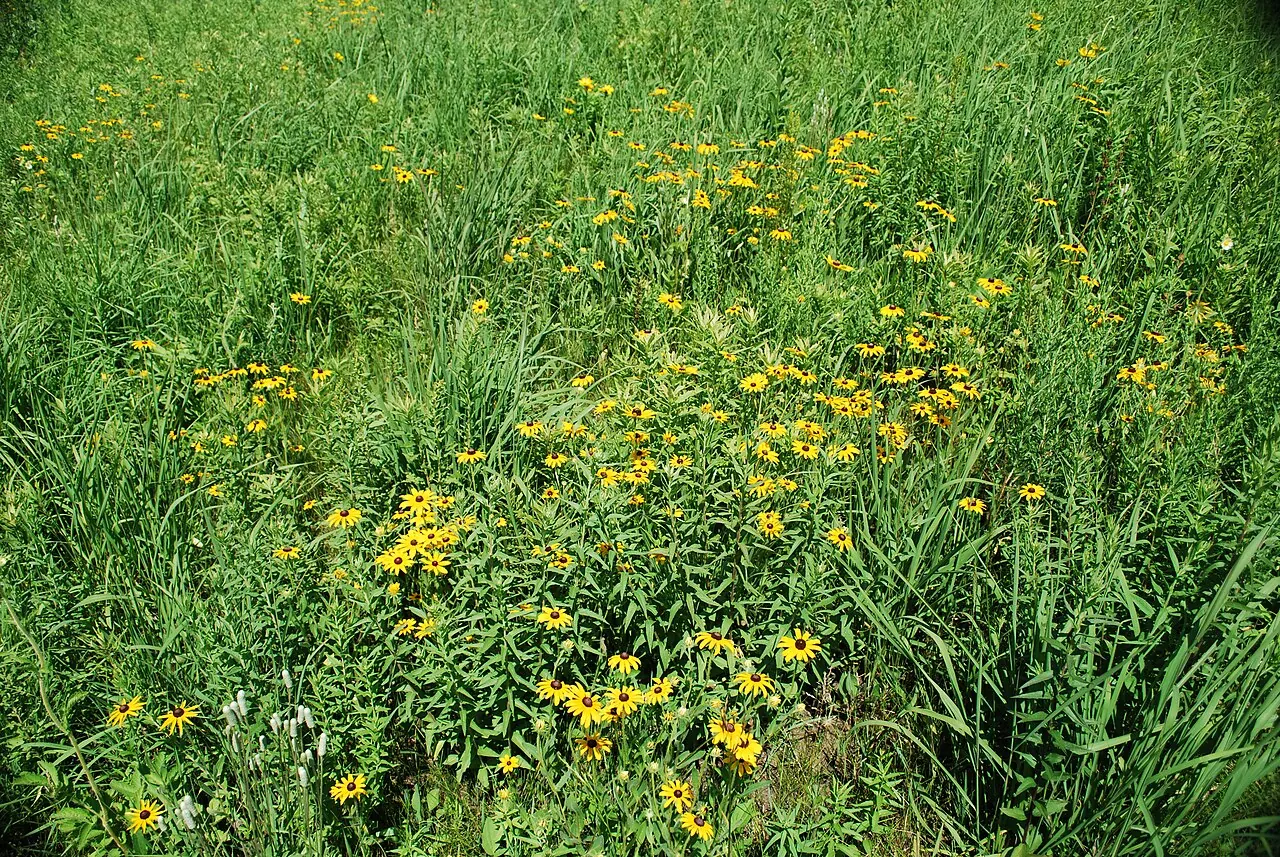
Stand of Black-Eyed Susans (Rudbeckia hirta) in full golden bloom in a summer meadow
Rudbeckia hirta in mid-summer bloom — the prairie's defining color signal from late June through September. Photo: Wikimedia Commons.

Identification

[ field key — habit · leaf · flower head · seedhead ]

Habit & Stems

Upright, openly branched herb 1–3 ft (30–100 cm) tall, arising from a basal rosette in its first year and bolting to flower in its second (or, in var. pulcherrima, often within a single season). Stems are stout, ridged, and densely covered in stiff white bristly hairs — run a finger up the stem and you'll feel the sandpapery roughness that gives the species its name. Stems often branch in the upper third, each branch terminating in a single flower head.

Leaves

Alternate, mostly basal, 10–18 cm long, lance-shaped to oblong, with entire to slightly toothed margins and three prominent veins. The whole leaf surface is covered in coarse, bristly hairs — the diagnostic feature distinguishing R. hirta from the smoother-leaved true perennial R. fulgida. Basal leaves have winged petioles; upper stem leaves are sessile and progressively smaller.

Flower Heads

Classic composite (capitulum): 8–16 brilliant golden-yellow ray florets (often with a faint orange wash at the base) circling a conspicuous, raised, dark brown-to-black domed disk of dense, tubular disk florets. Heads typically 5–10 cm across on the wild species; cultivars push 10–15 cm. Bloom runs late June through September in NE Oklahoma, extending into October on cool, wet years.

Seedheads & Reseeding

After bloom, the dark central disk hardens into a persistent, conical seedhead packed with hundreds of small, dark, four-angled achenes. Seedheads persist black and upright through winter, an important winter ID feature and a key food source for goldfinches and juncos. Seeds shed gradually over fall and winter; expect volunteer seedlings the following spring wherever soil is bare. This self-sowing is how the species persists in a planting.

R. hirta vs. R. fulgida: The two are constantly confused in the nursery trade. Rudbeckia hirta is annual / biennial / short-lived perennial, with hairy stems and leaves and slightly larger, looser-petalled heads. Rudbeckia fulgida is a true long-lived perennial that spreads by rhizomes, with smooth or only slightly hairy darker-green leaves and tighter, deeper-orange heads. The famous cultivar 'Goldsturm' is R. fulgida var. sullivantii — not R. hirta, despite frequently being sold and labeled as a black-eyed Susan.

Habitat & Range in NE Oklahoma

Rudbeckia hirta is native to most of North America and is one of the most abundant native wildflowers across NE Oklahoma: tallgrass prairie remnants, the Cross Timbers oak-savanna openings, road edges, ditches, old pastures, recently disturbed soils, and any open ground that gets full sun. The widespread variety in our region is var. pulcherrima, ranging from Newfoundland to British Columbia south to Alabama and New Mexico. It is the quintessential pioneer of disturbed open ground — grading, burning, mowing, or tilling that leaves bare mineral soil will, given a nearby seed source, produce a flush of black-eyed Susans within one or two growing seasons.

For Tulsa-area restoration work, this is one of the easiest natives in the region to establish from seed. It is a standard component of nearly every commercial tallgrass-prairie seed mix sold for this latitude, and it pulls its weight in year-one color while slower-establishing perennials like Echinacea, Liatris and the warm-season grasses build root systems underground.

Ecology & Wildlife Value

[ pollinators · larval hosts · seed predators · trophic role ]

Pollinators

The flat, open composite head is a pollinator buffet: a huge range of native bees work it through the long bloom window, including bumblebees (Bombus spp.), sweat bees (Halictidae — especially the metallic green Agapostemon), mining bees (Andrenidae), and the small Rudbeckia specialist Andrena rudbeckiae. Add syrphid (hover) flies, soldier beetles, scarab beetles, and a steady stream of butterflies (sulphurs, swallowtails, pearl crescents, painted ladies) nectaring on the disk florets.

Lepidoptera Hosts

Critically, Rudbeckia hirta is a larval host plant for three checkerspot butterflies: the silvery checkerspot (Chlosyne nycteis), the gorgone checkerspot (Chlosyne gorgone), and the bordered patch (Chlosyne lacinia). Of these, the silvery checkerspot is the most common in NE Oklahoma and depends on Rudbeckia and a handful of related composites for reproduction. Caterpillars feed in groups on the leaves — the chewed leaves are a feature, not a problem.

Birds & Mammals

The persistent winter seedheads are a key food source for American goldfinches, juncos, and several native sparrows — you'll see goldfinches clinging upside-down to the dried disks November through February. White-tailed deer occasionally browse the foliage but tend to avoid it because of the bristly hairs, so it ranks as moderately deer-resistant. Rabbits will sample seedlings.

Food Web Function

Alongside Echinacea purpurea (purple coneflower) and Asclepias tuberosa (butterfly milkweed), R. hirta is a food-web workhorse of the eastern tallgrass prairie: a long bloom window for adult insects, dependable larval forage for specialist Lepidoptera, and a winter seed bank for finches. Its rapid establishment after disturbance also makes it a key pioneer in ecological succession, holding bare soil and feeding pollinators while later perennials catch up.

Larval damage is the goal: If you find a leaf shredded by a cluster of small spiny black caterpillars, you are very likely looking at silvery checkerspot larvae. Do not spray. Leave those chewed-up leaves alone — that is the entire point of planting native host species. Likewise, allow some self-sowing: the population persists by reseeding into bare patches, so resist the urge to deadhead every spent flower or to mulch every square inch of soil.

Horticulture & Care

[ planting · soil · water · propagation · reseeding management · cultivars ]

Site selection & planting

Plant in full sun for best bloom — six or more hours of direct light. Tolerates a few hours of afternoon shade in our climate but flowers noticeably less. Will grow in poor, dry, sandy, gravelly, or moderate clay soils; resents only soggy, waterlogged ground. pH 6.0–7.5 is ideal but it tolerates the alkaline edge of Tulsa-area soils without complaint. Set transplants on 12–18 in centers; sow seed in fall (preferred) or very early spring directly onto bare, raked soil — seed needs light to germinate, so press in but do not bury.

Water & soil after establishment

Notably drought-tolerant once established. Overwatering and over-rich soil push lush, floppy growth and shorten the plant's already brief life. In the Tulsa region a planting will normally need supplemental water only during establishment and during severe summer drought. Avoid heavy mulching directly over a stand — you will smother the volunteer seedlings the population depends on.

Reseeding management (the key skill)

Because R. hirta is short-lived, the difference between a black-eyed Susan patch that lasts five years and one that lasts twenty-five is entirely about letting it set seed and giving the seedlings somewhere to land:

Propagation

Pests & diseases

Notable cultivars for NE Oklahoma

Cultivar Species / origin Distinguishing feature Notes for Tulsa
'Goldsturm' R. fulgida var. sullivantii True perennial; tight, deep-orange-yellow heads ~3 in; rhizomatous The most famous "black-eyed Susan" cultivar — but botanically not R. hirta. Reliable long-lived perennial in our zone; 1992 PPA Plant of the Year.
'Indian Summer' R. hirta Massive 4–5 in golden flowers on 3 ft stems 2003 All-America Selections (AAS) winner; RHS Award of Garden Merit. Treat as annual / short-lived perennial; reseeds.
'Cherokee Sunset' R. hirta Mixed double & semi-double flowers in gold, bronze, mahogany, rust 2002 AAS winner. Striking color mix; behaves as biennial in OK; reseeds true-ish.
'Prairie Sun' R. hirta Pure-yellow rays with chartreuse-green central disk (no black) 2003 AAS winner. Glows in evening light; pairs well with deeper-eyed wild stands.
'Toto' R. hirta Compact 8–12 in dwarf with classic black-eyed gold flowers RHS Award of Garden Merit. Useful at the front of borders or in containers.
'Marmalade' R. hirta Deep-orange to mahogany flowers, ~4 in, on 18–24 in stems Long-bloomer; old reliable cultivar still widely sold.
'Cherry Brandy' R. hirta Cherry-red rays, dark brown disk — first true red Rudbeckia from seed Striking color break; treat strictly as annual; does not come true from saved seed.

Companion planting in a prairie meadow

Pairs naturally with: purple coneflower (Echinacea purpurea), butterfly milkweed (Asclepias tuberosa), blazing star (Liatris spp.), wild bergamot (Monarda fistulosa), and the warm-season bunchgrasses little bluestem (Schizachyrium scoparium) and side-oats grama (Bouteloua curtipendula). For restoration work, broadcast it as a quick-color "first-year" component in a tallgrass-prairie seed mix — it bloom in year one while perennials build root systems.
Cultural Uses

Black-eyed Susan has a long ethnobotanical record across eastern North America. The Ojibwa used a poultice of the root for snakebite and an infusion for treating colds and intestinal worms in children; several other nations used root decoctions for sores, swelling and earache. The roots have a mild echinacea-like reputation in folk practice (the genera are closely related), though no clinical evidence supports the traditional immunological claims.

Culturally, the species is the state flower of Maryland (designated 1918) and gives the Preakness Stakes its nickname "the Run for the Black-Eyed Susans." It also supplied the school colors (black and gold) of the University of Southern Mississippi. In the cut-flower trade R. hirta cultivars are a midsummer staple; the petals hold color well when dried, and the black seedheads are popular in winter arrangements.

Caution: The species is toxic to cats if ingested. It is not considered an edible plant. The roots have a long history of medicinal use among Native peoples but should not be experimented with casually — preparation matters and the constituents are not the same as those of true Echinacea.

Photo Reference

Rudbeckia hirta — flowering habit
// Rudbeckia hirta — flowering habit
Rudbeckia hirta — foliage & form
// Rudbeckia hirta — foliage & form

Sources & Further Reading

  • USDA NRCS PLANTS Database — Rudbeckia hirta: plants.usda.gov/plant-profile/RUHI2
  • USDA Forest Service Fire Effects Information System (FEIS) — Rudbeckia hirta: fs.usda.gov/database/feis/plants/forb/rudhir
  • Lady Bird Johnson Wildflower Center — Native Plant Database, Rudbeckia hirta: wildflower.org — RUHI2
  • Flora of North America (eFloras) — Urbatsch & Cox (2006), Rudbeckia hirta: efloras.org
  • Missouri Botanical Garden Plant Finder — Rudbeckia hirta cultivar profiles ('Indian Summer', 'Cherokee Sunset', 'Prairie Sun', 'Goldsturm', 'Toto').
  • Maryland State Archives — State Flower (Black-Eyed Susan, designated 1918): msa.maryland.gov
  • Xerces Society (2016), Gardening for Butterflies, Timber Press — documents Rudbeckia as larval host for silvery checkerspot, gorgone checkerspot and bordered patch.
  • Wikipedia — Rudbeckia hirta: en.wikipedia.org/wiki/Rudbeckia_hirta (CC BY-SA 4.0; portions of the description, ecology, cultivation and cultural-uses sections summarize Wikipedia content).

Photos courtesy of Wikimedia Commons contributors under their respective licenses (linked under each image).