// SPECIES PROFILE · PERENNIAL · NATIVE
The backbone of any prairie-style or pollinator garden in NE Oklahoma, Purple Coneflower is the iconic Asteraceae composite whose drooping pink-purple rays surround a spiny, copper-orange conical disk — the echino (Greek for "hedgehog") that gives the genus its name. Native to open woodlands, glades and tallgrass prairies of the central and eastern US (most common in the Ozarks, just east of us), it tolerates Tulsa's heavy clay and brutal summer heat, blooms midsummer to early fall, and feeds an enormous cast of bees and butterflies followed by goldfinches working the seedheads all winter.

[ field key — habit · leaf · flower head · seed ]
Clump-forming herbaceous perennial, typically 2–4 ft tall and 18–24 in wide at maturity, occasionally to 4 ft in rich soil. Stems are stout, bristly, branching in the upper third, each terminating in a single large flower head. The clump expands slowly outward each year via short rhizomes — spreading but never aggressive — making it well behaved among other perennials in a mixed border.
Basal leaves form a rosette in the first season, then stem leaves are alternate, ovate to lanceolate, 5–30 cm long by 5–12 cm wide, with a coarsely toothed margin and a sandpaper-rough surface from short stiff hairs. Leaves are darker green above, paler beneath, and held on petioles up to 17 cm at the base of the plant, becoming sessile higher up.
The signature feature: a capitulum 7–15 cm across, composed of a prominent domed central disk of many tiny tubular yellow-tipped florets surrounded by a single ring of drooping pink to magenta-purple ray florets. The disk florets are spiny, stiff and copper-orange — the "echino" (Greek for hedgehog/sea urchin) that gives the genus its name. Disk florets are hermaphrodite and fertile; the showy ray florets are sterile and exist purely to attract pollinators.
Each fertile disk floret produces a small dry achene (single seed) topped with a persistent ring of bristles. The cone holds these tightly through fall and winter, slowly releasing them as goldfinches and other finches pry them out. In winter the spent flower head is unmistakable: a blackened spiny cone on a stiff stem, a key ID feature long after the petals have fallen.
Echinacea purpurea is native to the central and eastern US, most common in the Ozarks, the Mississippi Valley, and the Ohio Valley. Its natural habitats are dry open woods, glades, oak savannas, barrens, and the edges of tallgrass prairie. NE Oklahoma sits at the western edge of its native Ozark stronghold; in our region you'll find it in tallgrass prairie remnants, woodland edges, and along county-road right-of-ways where original prairie soil has not been broken.
It is now one of the most widely cultivated native perennials in the world — a staple of European, Japanese and North American garden borders — but home gardeners in Tulsa get the additional benefit of growing a true regional native that supports our native bee and butterfly fauna far better than ornamental substitutes. Tolerates the full range of regional soils including heavy Tulsa clay, provided it doesn't sit in standing water in winter.
[ pollinators · larval hosts · winter seed · trophic role ]
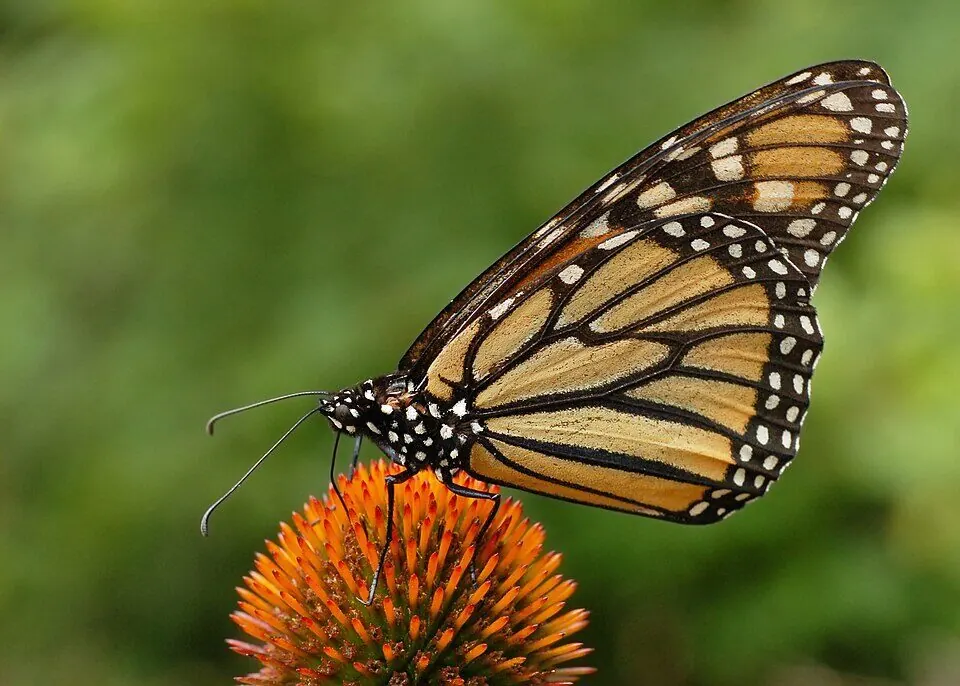
A top-tier pollinator perennial alongside Asclepias and Monarda. The flat landing pad of ray florets and accessible nectaries on the disk make it one of the most-visited summer flowers in any pollinator planting. Visitors include bumblebees (Bombus spp.), the sunflower leaf-cutter bee (Megachile pugnata), sweat bees (Halictidae), the mining bee Andrena helianthiformis, honey bees, and a long list of butterflies including monarchs, swallowtails, sulphurs, fritillaries and skippers, plus hover flies and predatory wasps that help with pest control elsewhere in the garden.
Larval host for several native moths including the Wavy-Lined Emerald (Synchlora aerata), whose caterpillars perform a remarkable bit of natural history: they cut tiny pieces of the host plant's flower petals and stick them to their own backs, perfectly camouflaging themselves as part of the coneflower they're feeding on. If you find a coneflower head with what looks like an animated piece of debris crawling on it, you're looking at a Synchlora caterpillar.
The persistent spiny seedhead is one of the most important winter food sources for American Goldfinches in the Tulsa area, along with house finches, chickadees and sparrows. Birds work the cones from late fall through February, prying achenes out of the dry receptacle. This is why current best practice is to leave seedheads standing through winter and cut back only in late February or early March.
Plant in mass for maximum pollinator value — a single plant is pretty, but a 5- or 7-plant drift is a magnet. Combines beautifully with native grasses (Schizachyrium scoparium, Bouteloua curtipendula), other prairie composites (Rudbeckia, Helianthus, Liatris), and the other top pollinator perennials — Asclepias tuberosa, Monarda fistulosa, and Pycnanthemum.
[ planting · soil · water · propagation · division · pests ]
Plant spring through early fall in NE Oklahoma; container stock establishes fastest in spring after the last frost or in early September with a month of good fall watering. Choose a site with full sun for maximum bloom; coneflowers tolerate light shade but get floppy and bloom less heavily without 6+ hours of direct sun. Soil must be well-drained — that's the only non-negotiable requirement. Heavy Tulsa clay is fine on slopes or raised beds; flat low spots that puddle in winter will rot the crown.
Once established (after one full season), Echinacea purpurea is notably drought-tolerant. Through a typical Tulsa summer it needs no supplemental water; during severe drought (3+ weeks of 100°F+ with no rain) one deep weekly soak keeps blooms going. Avoid overhead irrigation in the evening — wet foliage overnight encourages powdery mildew and aster yellows.
Clumps gradually thin out and bloom less heavily after 4–5 years. Divide every 4–5 years in early spring as new growth emerges: lift the clump, cut into 3–5 sections each with crown buds and roots, and replant immediately. This both rejuvenates the parent plant and gives you free plants to spread or share.
| Cultivar | Type | Distinguishing feature | Notes for Tulsa pollinator gardens |
|---|---|---|---|
| Straight species (E. purpurea) | true species | Classic pink-purple rays, copper disk, fertile | Hands-down best for pollinators & goldfinches. Always start here. |
| 'Magnus' | selection | Stronger, more horizontal (less drooping) rays; deeper rose-purple | Classic Perennial Plant of the Year selection; retains good wildlife value. |
| 'PowWow Wild Berry' | compact selection | Shorter (~20"), deep magenta, blooms first season from seed | Good for small spaces & front of border; still pollinator-friendly. |
| 'Ruby Giant' (RHS AGM) | selection | Large rosy-red flowers up to 6" across, sturdy stems | Award-winner; fertile, single-form — pollinators still work it. |
| 'White Swan' / 'PowWow White' | color selection | Pure white rays around the standard orange disk | Single form; useful for design contrast; pollinator value retained. |
| Orange/yellow/red doubles & "pom-pom" cultivars | heavily bred hybrids | Doubled or distorted disks, novelty colors | Inferior pollinator value — many are sterile or have floral architecture that excludes bees. Avoid if wildlife is the goal. |
Pairs naturally with: little bluestem (Schizachyrium scoparium) for upright grass structure, butterfly milkweed (Asclepias tuberosa) for orange-on-purple summer color, wild bergamot (Monarda fistulosa) for overlapping bloom, blazing star (Liatris spp.) for vertical contrast, black-eyed Susan (Rudbeckia hirta/fulgida) for bloom succession, and aromatic aster for the late-fall finale once coneflower bloom winds down.
Echinacea is one of the most studied North American medicinal herbs. The Lakota, Cheyenne, Comanche, Pawnee and other Plains nations used various species of Echinacea — especially E. angustifolia — for snakebite, toothache, sore throats, colds, burns, and a wide range of infections. European settlers adopted the plant in the late 1800s; by the early 20th century Echinacea preparations were among the most prescribed medicines in North America.
Modern phytochemical work on E. purpurea has isolated several biologically active compound classes: alkamides, caffeic acid derivatives (notably cichoric acid), polysaccharides, and glycoproteins; the dominant flavonoids are nicotiflorin and rutin. Despite the plant's commercial popularity, clinical evidence for cold prevention and duration is mixed — some meta-analyses show a modest reduction in cold incidence/duration, others show no significant effect, and results vary widely by preparation, plant part, and species used.
In the kitchen and garden, the flowers also make excellent cut flowers with a long vase life, and the bristly seedheads dry well for winter arrangements.


Hero photo by Rooted Revival. Photo-strip images courtesy of Wikimedia Commons contributors under their respective licenses (linked under each image).