home/ plants/ little-bluestem

// SPECIES PROFILE · GRASS · NATIVE

Little Bluestem

Schizachyrium scoparium

The most widely distributed of the "Big Four" tallgrass-prairie grasses and a defining species of the NE Oklahoma uplands — Little Bluestem is a tight, vase-shaped warm-season (C4) bunchgrass with blue-green summer foliage that ignites in autumn into a brilliant copper-mahogany-orange that holds clear through winter snow. Tighter, shorter and far more drought-tolerant than its cousin big bluestem, it thrives on the lean, rocky, dry soils that defeat most other ornamentals. The official state grass of Nebraska (1969) and Kansas (2010), and the parent of the cultivar 'Standing Ovation', named the Perennial Plant Association's Plant of the Year for 2022 — today the single most garden-worthy native warm-season grass for Tulsa landscapes.

// QUICK FACTS
Family
Poaceae (grass)
Photosynthesis
C4 (warm-season)
Native range
Most of the contiguous US (except CA, NV, OR), S. Canada, N. Mexico
USDA hardiness
Zones 3–10 (Tulsa = 7a/7b)
Mature size
2–4 ft tall (flower stalks 4–5 ft) · 1.5–2 ft wide clump
Form
Upright, vase-shaped bunchgrass
Foliage
Blue-green / glaucous summer → coppery orange-mahogany fall & winter
Bloom
Late August – October (NE OK)
Sun
Full sun (6+ hrs); flops in shade
Soil
Lean, dry, well-drained — sand, rock, clay, sterile fill
Water
Very low; deeply drought-tolerant once established
Wildlife
Larval host: 8+ skipper butterflies · grassland songbird cover
Status
State grass of NE (1969) & KS (2010); PPA 2022 Plant of the Year ('Standing Ovation')
Little Bluestem (Schizachyrium scoparium) — mature seedheads catching low autumn light against fine reddish-copper foliage
Schizachyrium scoparium in autumn — fluffy white-tufted spikelets ride above coppery foliage that will hold its color through winter. (Wikimedia Commons).

Identification

[ field key — habit · foliage · inflorescence · winter form ]

Habit

A perennial warm-season (C4) bunchgrass, forming a tight, upright, vase-shaped clump 2–4 ft tall and 1.5–2 ft wide. Flowering culms add another foot, reaching 4–5 ft when in bloom. Tillers (shoots) emerge in age-ranked tiers from the center of the crown, pushing the oldest tillers outward — over many years a healthy plant can develop a hollow "fairy ring" form. Tighter, shorter and finer in texture than its cousin big bluestem (Andropogon gerardii).

Foliage

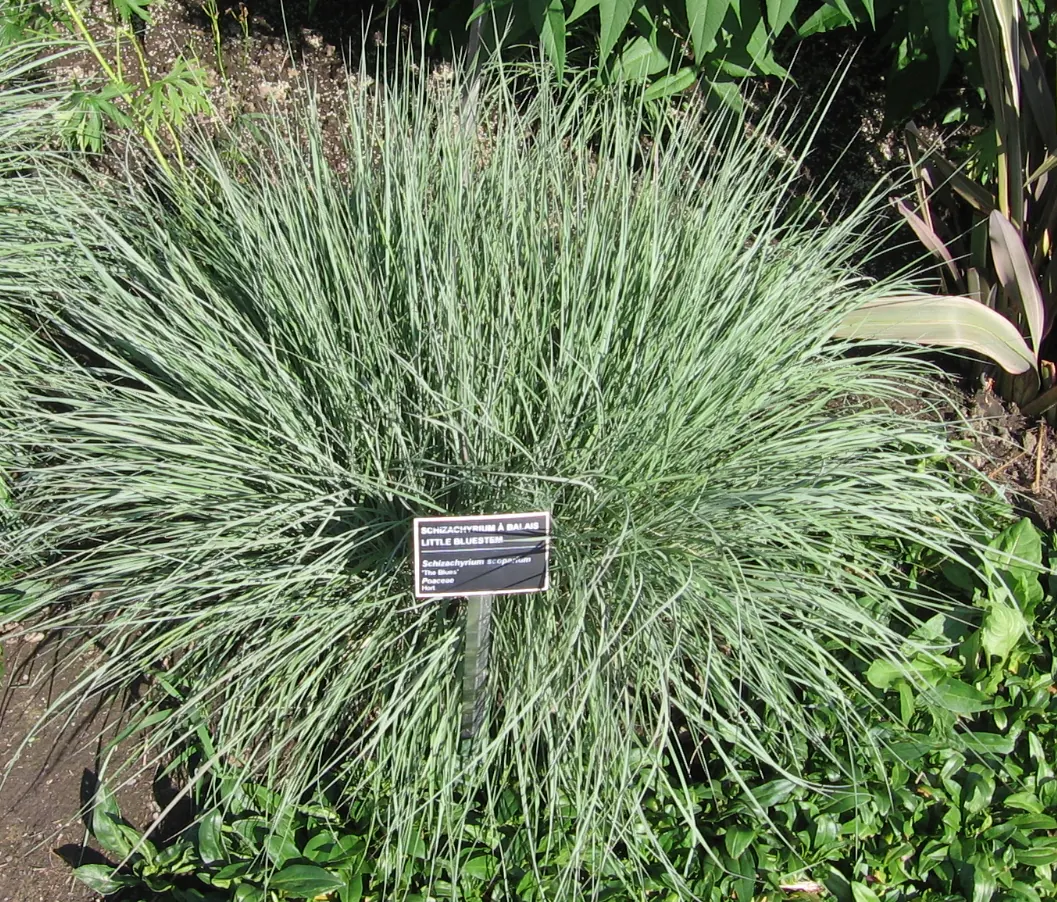
Narrow, fine-textured leaf blades 2–4 mm wide and up to 30 cm long, ascending stiffly from the base. Color is the species' signature: a cool blue-green to glaucous through May and June, deepening to silvery-blue by midsummer, then transitioning in September into the famous copper, mahogany, orange and red autumn color — arguably the most brilliant fall color of any North American native grass. Sandy soils tend to push the fall tone redder; clays favor coppery-bronze.

Flowers & Seed

Inflorescences appear late August through October as small, slender, fluffy white-tufted spikelets arrayed singly along the upper third of the flowering culm. Each spikelet pair is one fertile (sessile) and one sterile (pedicellate) — a defining trait of the Andropogoneae tribe. The fluffy white awns catch backlight beautifully in low autumn sun. Seed disperses October–December.

Winter Form

Among the most beautiful winter grasses in cultivation. The coppery-orange fall foliage fades to a warm orangish-bronze and holds its upright vase form right through the winter, catching frost, snow and low morning light. Color tans only in late February before being cut back. This persistent winter structure is a primary reason it has become a centerpiece of the New Perennial / matrix-planting movement.

Habitat & Range in NE Oklahoma

Little Bluestem is the most widely distributed of the "Big Four" tallgrass prairie grasses (with big bluestem, indiangrass and switchgrass) and one of the most abundant native plants in Texas and Oklahoma grasslands. It spans nearly the entire contiguous US except California, Nevada and Oregon, plus a strip of southern Canada and northern Mexico. Across Oklahoma it is a dominant or co-dominant grass in true tallgrass prairie, mixed-grass prairie, and shortgrass prairie alike — a remarkable ecological breadth.

In NE Oklahoma it is abundant statewide: in remnant prairies (Tallgrass Prairie Preserve in Osage County, the Cross Timbers savannas), sandstone glades, road cuts, abandoned pastures, dry uplands and the brushy edges of every county road. It tolerates the full regional soil range — chert and sandstone scree, deep prairie loam, alluvial sand, even sterile suburban subsoil — but performs best on lean, well-drained soils. Fertile or wet sites cause clumps to split and flop. It is markedly more drought-tolerant than big bluestem and persists where the latter dies out.

It is the official state grass of Nebraska (adopted 1969) and the official state grass of Kansas (adopted 2010) — honors that reflect its ecological dominance across the Great Plains.

Ecology & Wildlife Value

[ keystone forage · skipper hosts · grassland birds · soil ]

Lepidoptera Hosts

Little Bluestem is the documented larval host plant for an exceptional suite of grassland butterflies — particularly the skippers, a group whose conservation status is increasingly fragile. Confirmed hosts include the cobweb skipper (Hesperia metea), crossline skipper, Dakota skipper (federally threatened), dusted skipper, Indian skipper, Leonard's skipper, Ottoe skipper and swarthy skipper, plus the common wood nymph (Cercyonis pegala).

Birds & Mammals

Seeds and the dense bunch structure feed and shelter grassland songbirds (field sparrow, grasshopper sparrow, Henslow's sparrow, eastern meadowlark, dickcissel) and gamebirds (Northern bobwhite, wild turkey). The persistent winter clumps provide critical overwintering cover for ground-dwelling insects, small mammals and ground-nesting native bees. Bison, deer, elk, and cattle all browse it — it is a premier component of native rangeland forage.

Soil & Hydrology

Like all big prairie grasses, Little Bluestem builds prairie soil from below via a deep, dense, fibrous root system reaching 5–8 feet down. These roots stabilize slopes, infiltrate rainfall, lock carbon into long-term soil organic matter, and are responsible for the deep, fertile black soils of the Great Plains. The species is exceptionally drought-tolerant precisely because its roots reach water unavailable to most cool-season turf and forbs.

Fire & Disturbance

A classic fire-adapted prairie species — growing points are at or below ground level. Late-winter or early-spring burns (or simple mowing) remove accumulated thatch, recycle nutrients, suppress encroaching woody species and stimulate vigorous spring re-growth. Without periodic fire or mowing, individual clumps eventually decline as woody invaders shade them out.

Skipper-host keystone: at least eight named skipper butterflies are documented to use Little Bluestem as a larval host plant, including the federally threatened Dakota skipper and the regionally rare Ottoe and Leonard's skippers. If you plant a single grass for declining grassland butterflies in NE Oklahoma, plant this one. Source: Xerces Society, Gardening for Butterflies (2016).

Horticulture & Care

[ siting · soil · water · cutback · cultivars · matrix planting ]

Site selection & planting

Plant in spring after soil warms (April–May in Tulsa) for best establishment of this warm-season species — fall planting is possible but riskier. Choose full sun (6+ hours direct, more is better); anything less and the clumps stretch, weaken and flop open by August. Soil should be well-drained and on the lean side: native subsoil, sand, gravel, or unamended clay are all ideal. Avoid rich, irrigated bed soils — the most common reason a Little Bluestem flops is that a gardener treated it kindly.

Water & ongoing care

After the first season, established Little Bluestem requires essentially zero supplemental water in the Tulsa region except in the most extreme multi-month drought. Overwatering is far more harmful than underwatering — wet roots in summer cause crown decline and flopping.

Late-winter cutback

Cut clumps to 4–6" in late February or early March, before new spring growth appears. Hand pruners work for a few plants; a string trimmer or hedge shears are faster for masses. Remove or compost the cuttings — do not leave a thatch mat over the crown. Established prairie plantings can also be burned in late winter where local ordinances allow.

Propagation

Notable cultivars for NE Oklahoma

The Mt Cuba Center's landmark 2018 Little Bluestem trial evaluated dozens of selections side-by-side over multiple years and reshaped the ornamental-grass market. The cultivars below are the trial's top performers and the most reliable choices for a Tulsa garden.

Cultivar Origin Distinguishing feature Notes for Tulsa
'Standing Ovation' North Creek Nurseries (NCIN) Tight strictly-upright form; thicker, bluer blades; stiff stems that do not flop; intense red-orange fall color. PPA 2022 Plant of the Year. Top performer in the Mt Cuba 2018 trial — the most garden-friendly Little Bluestem ever released.
'Carousel' Chicagoland Grows Compact (~2 ft), exceptional multi-color fall stems — rose, copper, mahogany & orange on a single plant. Excellent for smaller residential beds; one of the Mt Cuba trial favorites.
'The Blues' Limerock Plant Co. Strikingly intense blue-glaucous summer foliage; the bluest selection in commerce. Older selection; can flop on rich soil — site lean and dry.
'Smoke Signal' Intrinsic Perennial Gardens Burgundy-red flush starting in midsummer; deep red-purple fall color. Top fall-color performer in Mt Cuba 2018; upright habit.
'Twilight Zone' Intrinsic Perennial Gardens Silvery-purple summer foliage; deep purple-mauve flowering stems. Strong vertical form; striking in mass.
'Blaze' USDA-NRCS Manhattan, KS Older release; brilliant red fall color; rangeland origin. Reliable, widely available; better for restoration than ornamental beds.
'Prairie Blues' Bluebird Nursery Blue summer foliage; orange-red fall color. Older selection now largely superseded by 'Standing Ovation' and 'The Blues'.
Local ecotype seed Oklahoma / Kansas wild collections Genetically diverse; locally adapted; variable in form. The right choice for prairie restoration, large meadow plantings, and pollinator-conservation projects.
'Standing Ovation' — Plant of the Year: Selected by North Creek Nurseries, this cultivar was the runaway top performer in the Mt Cuba Center 2018 Little Bluestem trial and was named the Perennial Plant Association's Plant of the Year for 2022. Its stiff, strictly-upright form solves the historical "flopping" problem that kept Little Bluestem out of formal gardens, while keeping the brilliant fall color and full ecological value of the species. Lean, dry, full-sun siting is still required — even 'Standing Ovation' will lean if grown rich and wet.

Companion planting — the classic Tulsa prairie quartet

Little Bluestem is the matrix — the structural grass — in countless successful NE Oklahoma garden designs. The most reliable, ecologically valuable, and visually iconic combination for our region is:

Plant Little Bluestem at 18" centers as the matrix grass with the three forbs woven through at one-quarter to one-third the density. The result is a 12-month self-sustaining, low-input planting that flowers from June to hard frost and carries copper-red structure all winter.
Uses & Cultural Significance

For Tulsa designers: ubiquitous as a native of NE Oklahoma uplands, yet still under-used in regional landscaping. The release of 'Standing Ovation' and its 2022 PPA Plant of the Year award have made Little Bluestem available, reliable, and beautiful in residential beds for the first time. Pair with butterfly milkweed, aromatic aster and black-eyed Susan for the classic, low-input, four-season Oklahoma prairie planting.

Photo Reference

Schizachyrium scoparium — flowering habit
// Schizachyrium scoparium — flowering habit
Schizachyrium scoparium — foliage & form
// Schizachyrium scoparium — foliage & form

Sources & Further Reading

  • Mt Cuba Center (2018) — Schizachyrium scoparium for the Mid-Atlantic Region: A Trial Garden Report: mtcubacenter.org/research/trial-garden/schizachyrium-research (the definitive comparative cultivar evaluation).
  • Perennial Plant Association — 2022 Plant of the Year: Schizachyrium scoparium 'Standing Ovation': perennialplant.org/page/2022PPOY.
  • USDA NRCS PLANTS Database — Schizachyrium scoparium: plants.usda.gov/plant-profile/SCSC
  • USDA Forest Service Fire Effects Information System (FEIS): fs.usda.gov/database/feis — SCHSCO
  • Kansas State University Extension — native warm-season grass establishment and management bulletins (Manhattan, KS).
  • Lady Bird Johnson Wildflower Center — Native Plant Database, Schizachyrium scoparium: wildflower.org — SCSC
  • The Xerces Society (2016), Gardening for Butterflies: How You Can Attract and Protect Beautiful, Beneficial Insects, Timber Press — documents skipper host relationships.
  • Wikipedia — Schizachyrium scoparium: en.wikipedia.org/wiki/Schizachyrium_scoparium (CC BY-SA 4.0; portions of the description, ecology, cultivation and "in culture" sections summarize Wikipedia content).
  • Derner, J.D. et al. (2004), Structural Attributes of Schizachyrium scoparium in Restored Texas Blackland Prairies, Restoration Ecology 12(1): 80–84 (tiller hierarchy).

Photos courtesy of Wikimedia Commons contributors under their respective licenses (linked under each image).