home/ plants/ prairie-blazing-star

// SPECIES PROFILE · PERENNIAL · NATIVE

Prairie Blazing Star

Liatris pycnostachya

The tallest of the Oklahoma Liatris — a 2–5 ft erect spike of densely packed, button-like, pink-purple disk florets that ignites the tallgrass prairie in late summer. Prairie Blazing Star blooms top-down (a diagnostic Liatris trait), grows from a persistent corm rather than a rhizome, and times its peak nectar flow precisely with the southbound monarch fall migration moving through Oklahoma in September. Spectacular at the Joseph H. Williams Tallgrass Prairie Preserve north of Tulsa, and one of the highest-value native perennials a NE Oklahoma pollinator garden can host.

// QUICK FACTS
Family
Asteraceae (composite)
Native range
Tallgrass prairie of central US: MN & SD south to TX & LA
Status in OK
Native; common on remnant prairie & roadsides in the eastern half
USDA hardiness
Zones 3–9 (Tulsa = 7a/7b)
Mature size
2–5 ft tall (rarely 6 ft) · 1–2 ft spread
Habit
Erect single or multi-stem spike; clump-forming
Rootstock
Corm (not rhizome) producing offsets
Bloom
Late July – early September (NE OK), top-down
Flower color
Rose-purple to pink-violet (rare white form 'Alba')
Sun
Full sun (6+ hrs); tolerates very light afternoon shade
Soil
Mesic to dry loam; tolerates clay if drained; pH 6.0–7.5
Water
Medium; drought-tolerant once established
Wildlife
Monarch nectar · bumblebees · hummingbirds · Schinia moth host · goldfinch seed
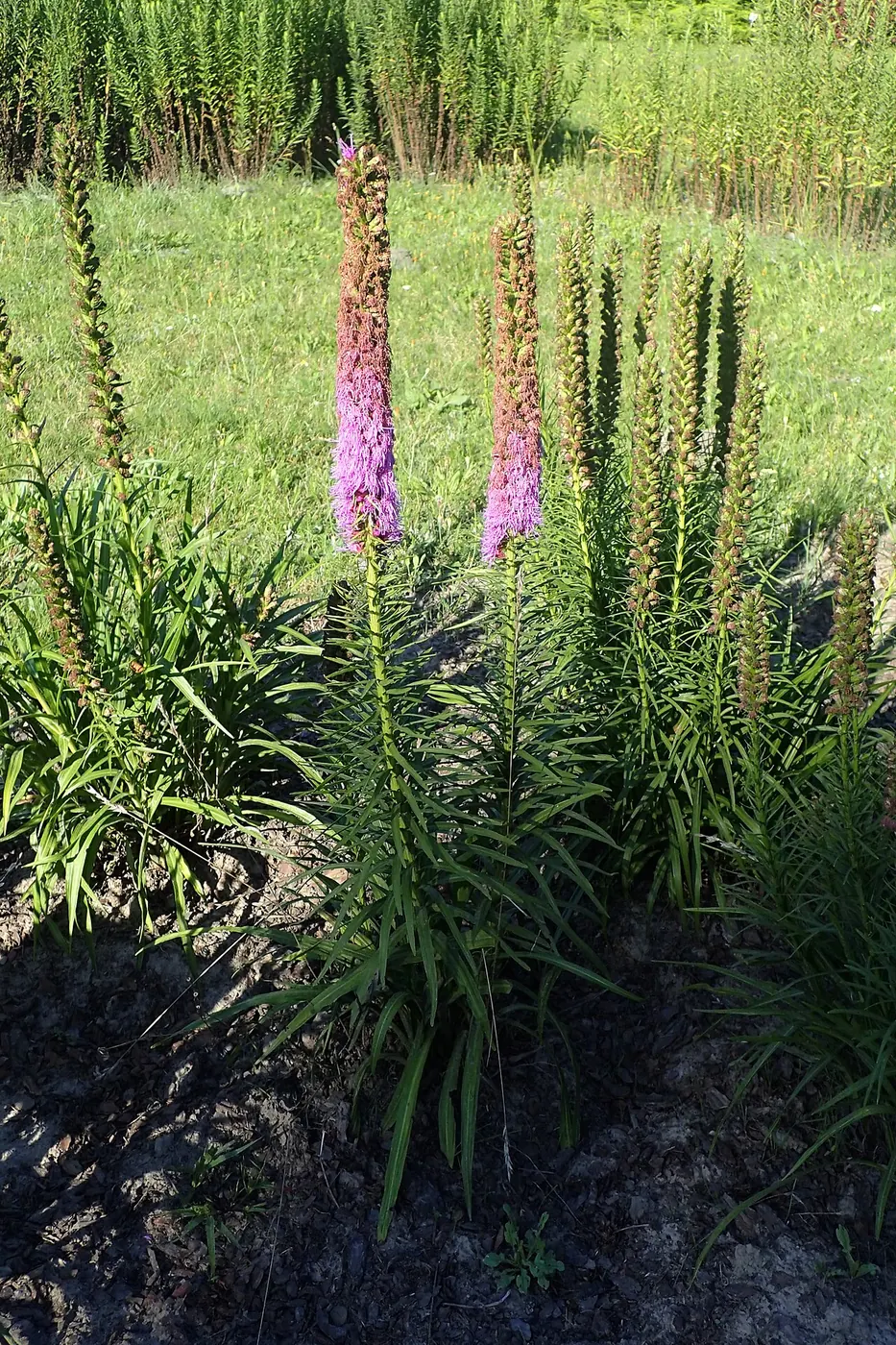
Prairie Blazing Star (Liatris pycnostachya) in full bloom showing dense vertical pink-purple flower spike
Liatris pycnostachya in late-summer bloom — the densely packed cylindrical spike that gives the species its name (Greek pyknos + stachys = "dense ear of grain"). Photo: Krzysztof Ziarnek / Kenraiz (Wikimedia Commons, CC BY-SA 4.0).

Identification

[ field key — habit · leaves · inflorescence · floret · seed ]

Habit & Stem

Erect herbaceous perennial, typically 2–5 ft tall (occasionally to 6 ft on rich, moist sites), arising from a persistent underground corm. Stems are stout, unbranched, leafy throughout, and may be smooth or finely hairy depending on the population. Plants form gradually expanding clumps as the parent corm produces offsets; older clumps may carry 5–15 spikes.

Leaves

Numerous, alternate, narrow and grass-like (linear), 11–22 cm long and only 4–10 mm wide, with a single prominent midvein and an entire margin. The largest leaves form a dense basal tuft; cauline (stem) leaves become progressively smaller up the stem, giving the plant a tapered, almost cattail-like silhouette — the source of the alternate common name cattail gayfeather.

Inflorescence & Florets

A dense terminal spike 6–18+ in long, densely packed with small flower heads ¼–½ in across, sessile or nearly so against the stem. Each head holds only 5–8 disk florets — there are no ray florets at all, which is why a Liatris head looks like a fuzzy purple button rather than a daisy. Phyllaries (involucre bracts) are pinkish with pointed, recurved tips, the key feature separating L. pycnostachya from the otherwise similar L. spicata, whose bracts are flat with rounded tips.

Seeds & Winter Form

Each floret produces a single dry, ribbed achene ~5 mm long topped with a feathery, brownish pappus for wind dispersal. Seedheads persist as buff-tan vertical wands well into winter, providing architectural interest, goldfinch forage, and overwintering habitat for cavity-nesting native bees in the hollow stems. The corm sits ~1–2 in below the soil surface and is the part to handle when dividing or transplanting — pulling on the stem alone often snaps it free of the corm.

Diagnostic Liatris trait: Liatris spikes bloom top-down — the uppermost flower heads open first and the wave of bloom progresses downward. This is unusual among spike inflorescences (most bloom bottom-up) and gives Liatris an unusually long and visually clean display: the upper portion is already setting seed while the lower buds are still fresh, extending the effective bloom window for pollinators by 2–3 weeks.

Habitat & Range in NE Oklahoma

Prairie Blazing Star is a classic plant of the tallgrass prairie — mesic to slightly dry, deep-soiled grasslands dominated by big bluestem, Indian grass, switchgrass and little bluestem. Its native range stretches from Minnesota and the Dakotas south through Iowa, Missouri, Kansas and eastern Oklahoma into northeast Texas and Louisiana, with scattered populations east into Indiana and Kentucky. It is most abundant where tallgrass prairie still exists at scale.

In NE Oklahoma, the most spectacular natural stands are at the Joseph H. Williams Tallgrass Prairie Preserve in Osage County (the largest protected tallgrass prairie remnant on the continent), where late-July through early-September visitors can see thousands of pink-purple spikes shooting up above the bluestem. Smaller populations persist on prairie remnants, Section-line roadsides, abandoned railroad rights-of-way, and unmowed pasture corners across Osage, Washington, Tulsa, Rogers, Mayes and Craig counties. Prefers loamy soils with reasonable moisture — less drought-adapted than its short cousin L. punctata, which dominates the drier mixed-grass prairies further west.

Ecology & Wildlife Value

[ pollinators · larval hosts · seed predators · trophic role ]

Pollinators & Monarchs

A top-tier late-summer nectar source. Heavily worked by bumblebees (Bombus spp.), large carpenter bees, leafcutter bees, long-horned bees, and a who's-who of butterflies: monarch (Danaus plexippus), great spangled fritillary (Speyeria cybele), silver-spotted skipper (Epargyreus clarus), eastern tiger and black swallowtails, painted lady, and several Hesperiidae skippers. Ruby-throated hummingbirds work the spikes as well.

Specialist Lepidoptera Hosts

Liatris pycnostachya is a documented larval host for the bleeding flower moth (Schinia sanguinea) — a striking pink-and-cream noctuid whose caterpillars feed inside the developing flower heads — along with the closely related Schinia gloriosa (glorious flower moth) and Schinia tertia. All three are Liatris specialists: their caterpillars eat almost nothing else. Losing Liatris from a landscape means losing an entire small radiation of moths along with it.

Birds & Mammals

American goldfinches (Spinus tristis) are the primary seed predator and disperser, working the dried spikes from late September into winter; sparrows and juncos pick fallen seed from the soil. Deer browse Liatris foliage occasionally but generally pass it over in favor of more palatable forbs — it is moderately deer-resistant. Voles and pocket gophers will eat dormant corms on disturbed sites; this is rarely a problem in established gardens.

Prairie Function

A conservative tallgrass-prairie species — that is, one that does not establish in disturbed ground and is generally a marker of intact remnant prairie. The corm stores carbohydrate that allows rapid regrowth after the late-winter prescribed burns characteristic of healthy tallgrass management. Plants flower more heavily the season after a cool-season burn — an evolutionary signature of fire-dependent prairie biology.

Monarch fall-migration timing: Peak Liatris pycnostachya bloom in NE Oklahoma (mid-August through early September) coincides almost exactly with the peak southbound monarch migration funneling through the state on its way to the Mexican overwintering colonies. Migrating monarchs require high-quality nectar to build the fat reserves they will live on through winter, and Liatris is among the most calorie-dense native sources available in the central flyway. Pair Prairie Blazing Star with butterfly milkweed (Asclepias tuberosa, summer breeding host) and showy/stiff goldenrod (Solidago speciosa / S. rigida, late-season nectar) to provide the full monarch life-cycle in one planting.

Horticulture & Care

[ planting · soil · water · propagation · pruning · pests ]

Site selection & planting

Plant Prairie Blazing Star in full sun (6+ hours direct) on well-drained loam. It will establish in Tulsa-region clay if drainage is reasonable and the spot does not pond water in winter — wet feet during dormancy is the single most common cause of corm rot and stand failure. Avoid heavily amended, over-rich beds: lush, nitrogen-fed plants on irrigated garden soil grow tall and floppy and require staking, while plants on lean prairie soil stand up unsupported. Spacing: 12–18 in apart for a naturalistic drift.

Water & long-term care

Once established (after the first full growing season), Prairie Blazing Star is notably drought-tolerant in the Tulsa region but performs best with one or two deep soaks during the late-July/August dry stretch — this is also when the inflorescence is forming and good moisture translates directly into a longer, denser spike. Cut back spent stems either in late fall (for a tidy look) or, better, in late winter (mid-February in Tulsa) so that the seedheads feed goldfinches and the hollow stems shelter overwintering native bees.

Division & propagation

Pests & diseases

Liatris species comparison for Tulsa & NE Oklahoma

Species Common name Height & spike form Habitat / drought Notes for NE OK
L. pycnostachya Prairie Blazing Star · tall gayfeather 2–5 ft · long, dense cylindrical spike · top-down bloom Mesic tallgrass prairie · medium drought Tallest OK native; classic Tallgrass Prairie Preserve species; needs decent moisture.
L. spicata Dense (marsh) Blazing Star 2–4 ft · dense spike · top-down · bracts flat, round-tipped Mesic to wet meadows · low drought Most common nursery Liatris; eastern in origin; tolerates wetter soils than other species.
L. punctata Dotted Blazing Star 1–2 ft · short, dense spike · stiff & compact Dry uplands · highest drought tolerance OK native; dominant on dry roadsides & mixed-grass prairie further west; deep taproot — do not move.
L. aspera Rough Blazing Star · button snakeroot 2–4 ft · loose, spaced flower heads · larger individual heads Dry sandy or rocky uplands · high drought OK native; latest-blooming (Sept–Oct); great companion to push the bloom window into mid-fall.
L. squarrosa Scaly Blazing Star 1–2 ft · loose · sharply recurved (squarrose) bracts Dry rocky glades · high drought Eastern OK glades & barrens; small and tough; good for hellstrips.
L. mucronata Cusp / narrowleaf Blazing Star 1–3 ft · slender spike · very fine grasslike leaves Dry calcareous soils · high drought Native in southern OK; uncommon in NE OK trade but worth seeking out for limestone gardens.
Notable named cultivars of L. pycnostachya: 'Eureka' (improved spike density & uniformity, German selection) and the white-flowered 'Alba'. Most cultivars sold as "Liatris" in big-box stores are L. spicata ('Kobold', 'Floristan White', 'Floristan Violet') — check the label.

Companion planting in a NE OK pollinator garden

Pairs naturally with: butterfly milkweed (Asclepias tuberosa) and swamp milkweed (A. incarnata) for the monarch breeding host, showy goldenrod (Solidago speciosa) and stiff goldenrod (S. rigida) for the late-season nectar handoff, purple coneflower (Echinacea purpurea), wild bergamot (Monarda fistulosa), rattlesnake master (Eryngium yuccifolium), and a matrix of warm-season bunchgrasses — little bluestem (Schizachyrium scoparium), prairie dropseed (Sporobolus heterolepis), or sideoats grama (Bouteloua curtipendula) — whose foliage both supports the Liatris spikes and disguises the bare lower stems.
Cultural & Ethnobotanical Uses

Foraging caution: Identification of Liatris to species requires care — several species share habitat and look similar in vegetative state. Do not dig wild corms; many populations are remnant prairie that cannot be replaced. Source plants and corms from reputable native-plant nurseries instead.

Photo Reference

Close-up of Liatris pycnostachya inflorescence showing densely packed pink-purple disk florets
// Inflorescence · all-disk florets · top-down bloom
Wikimedia Commons
Linear grass-like leaves of Liatris pycnostachya along the stem
// Leaves · linear · grass-like · sized down the stem
Wikimedia Commons
Bumblebee foraging on a Prairie Blazing Star spike
// Bombus sp. on Prairie Blazing Star — classic late-summer pollinator visit
Wikimedia Commons
Achene seeds of Liatris pycnostachya with feathery pappus
// Achenes & pappus · wind-dispersed · goldfinch food
Wikimedia Commons

Sources & Further Reading

  • USDA NRCS PLANTS Database — Liatris pycnostachya: plants.usda.gov/plant-profile/LIPY
  • Lady Bird Johnson Wildflower Center — Native Plant Database: wildflower.org — LIPY
  • Missouri Botanical Garden Plant Finder — Liatris pycnostachya (Kemper Code d770): missouribotanicalgarden.org
  • Flora of North America — Liatris pycnostachya (Nesom 2006, FNA Vol. 21): efloras.org
  • Illinois Wildflowers — Prairie Blazingstar (J. Hilty): illinoiswildflowers.info
  • Minnesota Wildflowers — Liatris pycnostachya (Chayka & Dziuk): minnesotawildflowers.info
  • The Xerces Society (2016), Gardening for Butterflies: How You Can Attract and Protect Beautiful, Beneficial Insects, Timber Press — documents Schinia sanguinea as a Liatris specialist.
  • The Nature Conservancy — Joseph H. Williams Tallgrass Prairie Preserve, Pawhuska, OK (in-situ reference site for native populations).
  • Wikipedia — Liatris pycnostachya: en.wikipedia.org/wiki/Liatris_pycnostachya (CC BY-SA 4.0; portions of the description, ecology and etymology sections summarize Wikipedia content).

Photos courtesy of Wikimedia Commons contributors under their respective licenses (linked under each image). Hero photo © Krzysztof Ziarnek (Kenraiz), CC BY-SA 4.0.