home/ plants/ butterfly-milkweed

// SPECIES PROFILE · PERENNIAL · NATIVE

Butterfly Milkweed

Asclepias tuberosa

The most brilliantly colored native perennial of the Oklahoma prairie — flat-topped umbels of saturated orange that blaze across roadsides, glades and tallgrass remnants from June into August. Unlike its milkweed cousins, Asclepias tuberosa has alternate, narrow lance-shaped leaves and clear (not milky) sap — two diagnostic field marks. Named the Perennial Plant Association Plant of the Year for 2017, it is a backbone monarch host, a hub for fritillaries, hairstreaks, swallowtails, hummingbirds and native bees, and one of the most drought-proof additions you can make to a Tulsa-region pollinator garden — provided you get the soil drainage right.

// QUICK FACTS
Family
Apocynaceae (formerly Asclepiadaceae)
Native range
E. & Central US: Maine → Florida, west to AZ & Sonora; native throughout OK
Subspecies in OK
ssp. interior (most common); ssp. tuberosa in far east; ssp. rolfsii south
USDA hardiness
Zones 3–9 (Tulsa = 7a/7b)
Mature size
1–2.5 ft tall · 1–1.5 ft spread (clump-forming)
Growth rate
Slow from seed; 2–3 yrs to first bloom
Lifespan
Long-lived — 20+ yrs once established
Bloom
June – August (sometimes rebloom in September)
Flower color
Brilliant orange (yellow & red-orange forms exist)
Sun
Full sun (6+ hrs); will not bloom well in shade
Soil
Dry to medium · sandy, rocky, gravelly · requires good drainage
Water
Low; drought-proof once established
Wildlife
Monarch host · fritillary & hairstreak nectar · hummingbirds · native bees
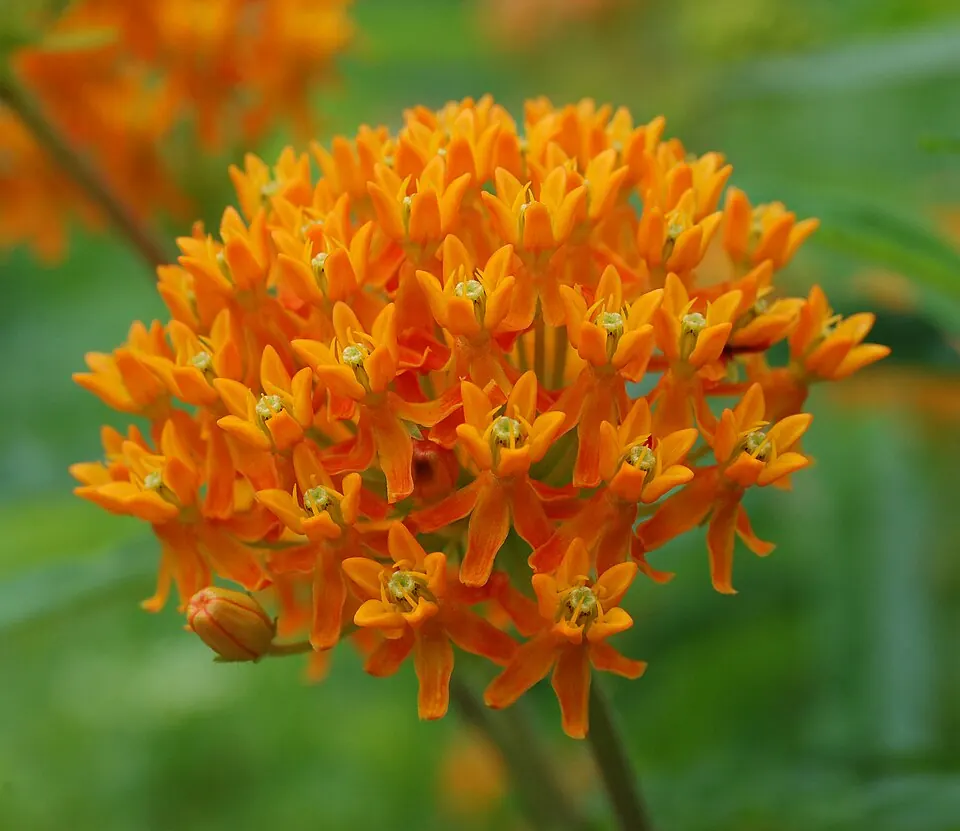
Butterfly Milkweed (Asclepias tuberosa) flat-topped umbel of brilliant orange flowers
Asclepias tuberosa in midsummer bloom — the saturated orange that pulls in monarchs, fritillaries and native bees from across the prairie. Photo: Rooted Revival.

Identification

[ field key — sap · leaves · flower · pod · root ]

Habit, Stem & Sap

Erect to ascending herbaceous perennial, 1–2.5 ft tall, forming a tight clump of multiple unbranched stems from a single woody crown. Stems are stout, hairy, green to reddish, and contain a clear, watery sap rather than the white latex of nearly every other Asclepias — one of the fastest field IDs in the genus. Snap a leaf to confirm: clear → butterfly milkweed; milky → one of the others.

Leaves

Alternate, narrow lance-shaped to oblong, 5–12 cm long, pointed at the tip, dark green above and paler beneath, with a hairy underside and short petiole. The alternate arrangement is the second diagnostic feature — nearly all other regional milkweeds (A. syriaca, A. incarnata, A. viridis, A. verticillata, A. speciosa) carry their leaves opposite or whorled.

Flowers

Dense, flat-topped to slightly rounded umbels 5–10 cm across, terminal and from upper leaf axils, blooming June through August. Individual flowers are small (~1 cm), 5-petaled, with the petals strongly reflexed downward beneath an erect crown of five orange hoods and incurved horns — the classic milkweed architecture. Color saturates from yellow-orange through brilliant orange to red-orange depending on the population; 'Hello Yellow' is a stable yellow form.

Fruit, Seeds & Root

Fruits are slender, erect, fusiform follicles (pods) 8–15 cm long, splitting along one side in fall to release stacked seeds, each tipped with a tuft of silky white floss (coma) that wind-disperses long distances. Below ground, the plant grows a thick, deep, tuberous taproot — the source of its specific epithet tuberosa and the reason it is famously drought-proof but resentful of transplanting once established.

Habitat & Range in NE Oklahoma

Butterfly Milkweed is a true prairie native, occurring on dry, rocky, open sites across the central and eastern United States and throughout all of Oklahoma. In NE Oklahoma it is reliably encountered in tallgrass prairie remnants (the Tallgrass Prairie Preserve, Joseph H. Williams Preserve, Oxley Nature Center grasslands), on cherty Ozark glades, in unmown highway road cuts and railroad rights-of-way, and on the well-drained sandy or rocky margins of Cross Timbers oak savanna. It avoids the heavy clay flats and bottomlands that its swamp milkweed cousin (A. incarnata) prefers.

The form most often seen in NE Oklahoma is subspecies interior, which extends west into the Great Plains and north into the prairie states. The Perennial Plant Association named Asclepias tuberosa the 2017 Perennial Plant of the Year, citing its toughness, ecological value, and ornamental brilliance — an unusual choice for a true prairie native and a strong endorsement for using it as the structural backbone of any Oklahoma pollinator planting.

Ecology & Wildlife Value

[ pollinators · monarch host · associated insects · trophic role ]

Monarch Host

One of the four major monarch (Danaus plexippus) larval host plants in our region, alongside common milkweed (A. syriaca), swamp milkweed (A. incarnata), and green antelopehorn (A. viridis). Monarch caterpillars feed on the leaves and sequester its cardenolides for chemical defense as adults. The Monarch Joint Venture and Xerces Society both recommend planting A. tuberosa as part of any south-central US monarch waystation, ideally in a mix with at least one other native Asclepias species to extend the host window across the season.

Non-Monarch Pollinators

Unusual among milkweeds for serving as a major nectar hub well beyond monarchs: regular visitors include the great spangled fritillary (Speyeria cybele), gray hairstreak (Strymon melinus), eastern tailed-blue (Cupido comyntas), tiger and pipevine swallowtails, ruby-throated hummingbirds, bumblebees (Bombus spp.), and dozens of native solitary bees. Heavy nectar production combined with a flat landing platform makes it one of the highest-value summer nectar plants in our flora.

Associated Insects

A small specialist insect community lives almost entirely on Asclepias: the bright yellow oleander aphid (Aphis nerii) often clusters on stem tips — visually alarming but not damaging, and a useful indicator that you've planted the right thing. The milkweed leaf beetle (Labidomera clivicollis), red milkweed beetle (Tetraopes tetrophthalmus), and large & small milkweed bugs (Oncopeltus fasciatus, Lygaeus kalmii) are normal residents. All advertise their cardenolide content with aposematic orange-and-black coloring.

Mammals & Trophic Role

Strongly deer- and rabbit-resistant due to cardenolide content; rarely browsed even in pressured suburban plantings. Goldfinches and other seed-eating birds will pick at the silken-tufted seeds in fall and winter — a good reason to leave the dried stalks standing through cold weather. Functionally, butterfly milkweed is a slow-and-steady, deeply-rooted prairie perennial that anchors a clump of soil, draws moisture from far below the grass-root zone, and persists for decades on the same spot.

Tulsa pollinator-garden role: structural backbone of a sunny native planting. Pair with prairie blazing star (Liatris pycnostachya), black-eyed Susan (Rudbeckia hirta), purple coneflower (Echinacea purpurea), and little bluestem (Schizachyrium scoparium) for a low-maintenance Oklahoma prairie-style border that feeds monarchs, fritillaries and native bees from June through October. Add at least one additional Asclepias species (swamp or common milkweed) to extend host availability for monarch larvae.

Horticulture & Care

[ planting · soil · water · propagation · pruning · pests ]

Site selection & planting

Plant in full sun on a well-drained or rocky site — the single most important horticultural decision is drainage. Butterfly milkweed evolved on cherty glades and sandy prairies and rots quickly in wet clay or irrigated turf soils. Raised beds, slopes, gravel berms, and sandy or amended-rocky soils all work; heavy bottomland clay and sites that sit wet in winter do not. Install young 4″ or quart-pot plants in spring and do not move them once established — the deep tuberous taproot does not recover well from disturbance.

Water & soil after establishment

One of the most drought-proof perennials available to NE Oklahoma growers. Established plants pull from deep soil moisture and need no supplemental water in any normal Tulsa summer. Overwatering — not drought — is the #1 way to kill butterfly milkweed in cultivation. Do not fertilize.

Pruning & winter care

Leave the dried stalks standing through winter. They feed goldfinches with leftover seeds, shelter overwintering native bees in hollow stems, and provide visible reminders of where your slow-emerging plants are come spring. Cut back to ~3″ in late winter (February) only. Butterfly milkweed is one of the last perennials to break dormancy in spring — do not assume a plant is dead until well into May.

Propagation

Pests & diseases

Notable cultivars & related species

Cultivar / Species Type Distinguishing feature Notes for Tulsa
'Hello Yellow' cultivar Stable clear-yellow flowers; otherwise identical Pairs strikingly with the orange wild form & with purple coneflower.
'Gay Butterflies' seed strain Mix of yellow, orange, and red-orange forms Inexpensive seed strain; good for prairie meadow seeding.
A. syriaca (Common Milkweed) related sp. Tall, opposite leaves, milky sap, pink ball-umbels, rhizomatous Spreads aggressively by runners; best at field edges, not borders.
A. incarnata (Swamp Milkweed) related sp. Opposite leaves, milky sap, pink umbels, wet-tolerant Use where A. tuberosa would rot — rain gardens, low spots, clay.
A. viridis (Green Antelopehorn) related sp. Sprawling, opposite leaves, green-and-purple flowers Native OK roadside milkweed; also a key monarch host in our region.
A. curassavica (Tropical Milkweed) non-native Red-and-yellow flowers, evergreen in mild winters Avoid: disrupts monarch migration timing & harbors OE protozoan parasite. Plant the natives instead.

Companion planting in a pollinator border

Pairs naturally with: prairie blazing star (Liatris pycnostachya) for vertical contrast and late-summer bloom, black-eyed Susan (Rudbeckia hirta) for color echo, purple coneflower (Echinacea purpurea) for complementary color and pollinator stacking, little bluestem (Schizachyrium scoparium) for the warm-season grass matrix that real Oklahoma prairie wears, and aromatic aster (Symphyotrichum oblongifolium) for late-season fall nectar after the milkweed is done. This five-species combination — orange + purple + yellow + bluestem + lavender — is the closest a small garden gets to a working remnant of tallgrass prairie.
Cultural & Medicinal Uses

The common name "pleurisy root" reflects the historical medicinal use of Asclepias tuberosa by Indigenous peoples of eastern North America — including Cherokee, Iroquois, Lakota, Menominee and others — and later by European-American settlers and 19th-century Eclectic physicians. The thick taproot was prepared as a decoction or tincture and used as a diaphoretic and expectorant for respiratory ailments such as pleurisy, bronchitis and pneumonia. It was an official drug in the United States Pharmacopoeia from 1820 to 1905.

Toxicity caution: All parts of Asclepias tuberosa contain cardenolides (cardiac glycosides) and are toxic if eaten in quantity. Livestock generally avoid milkweeds, but honey produced from large stands has occasionally been implicated in livestock poisonings, and direct ingestion of leaves or roots can cause vomiting, diarrhea and cardiac symptoms in humans and animals. Do not use internally without expert guidance from a qualified medical herbalist. Modern medicinal use of pleurisy root is essentially obsolete; the plant’s real value today is ecological and ornamental.

Photo Reference

Asclepias tuberosa — flowering habit
// Asclepias tuberosa — flowering habit

Sources & Further Reading

Strip photos courtesy of Wikimedia Commons contributors under their respective licenses (linked under each image). Hero photo © Rooted Revival.