home/ plants/ switchgrass

// SPECIES PROFILE · GRASS · NATIVE · BIG FOUR

Switchgrass

Panicum virgatum

Switchgrass is one of the Big Four tallgrass prairie grasses — along with big bluestem, little bluestem and indiangrass — that once covered the eastern half of Oklahoma in a sea of waist-to-shoulder-high summer grass. A warm-season (C4) perennial that wakes up in late spring, throws sturdy 3–7 ft stems through summer, and finishes the year in a brilliant open, airy pyramidal panicle that catches afternoon light like nothing else in the garden. Panicum virgatum is uniquely adaptable to both wet and dry sites, making it the easiest of the Big Four for most NE Oklahoma landscapes — and the species the U.S. Department of Energy and Oak Ridge National Laboratory selected as the model herbaceous biofuel crop.

// QUICK FACTS
Family
Poaceae (grass)
Native range
Most of North America east of the Rockies, S. Canada → N. Mexico
Photosynthesis
C4 (warm-season; growth concentrated May–September)
USDA hardiness
Zones 3–9 (Tulsa = 7a/7b)
Mature size
3–7 ft tall in flower (some lowland cultivars to 8 ft) · 2–3 ft wide clump
Habit
Tightly clumping bunchgrass with short rhizomes (lowland types)
Root depth
Commonly 6–10+ ft; among the deepest of any prairie grass
Bloom / panicle
July–September; open pink-flushed pyramidal panicle
Fall color
Gold-yellow → russet-red; persistent through winter
Sun
Full sun (6+ hrs); tolerates light shade with floppier habit
Soil
Almost any: sand, loam, clay; pH 4.9–7.6
Water
Wet to dry — tolerates seasonal flooding AND drought once established
Wildlife
Skipper host · sparrow & junco seed · grassland bird cover
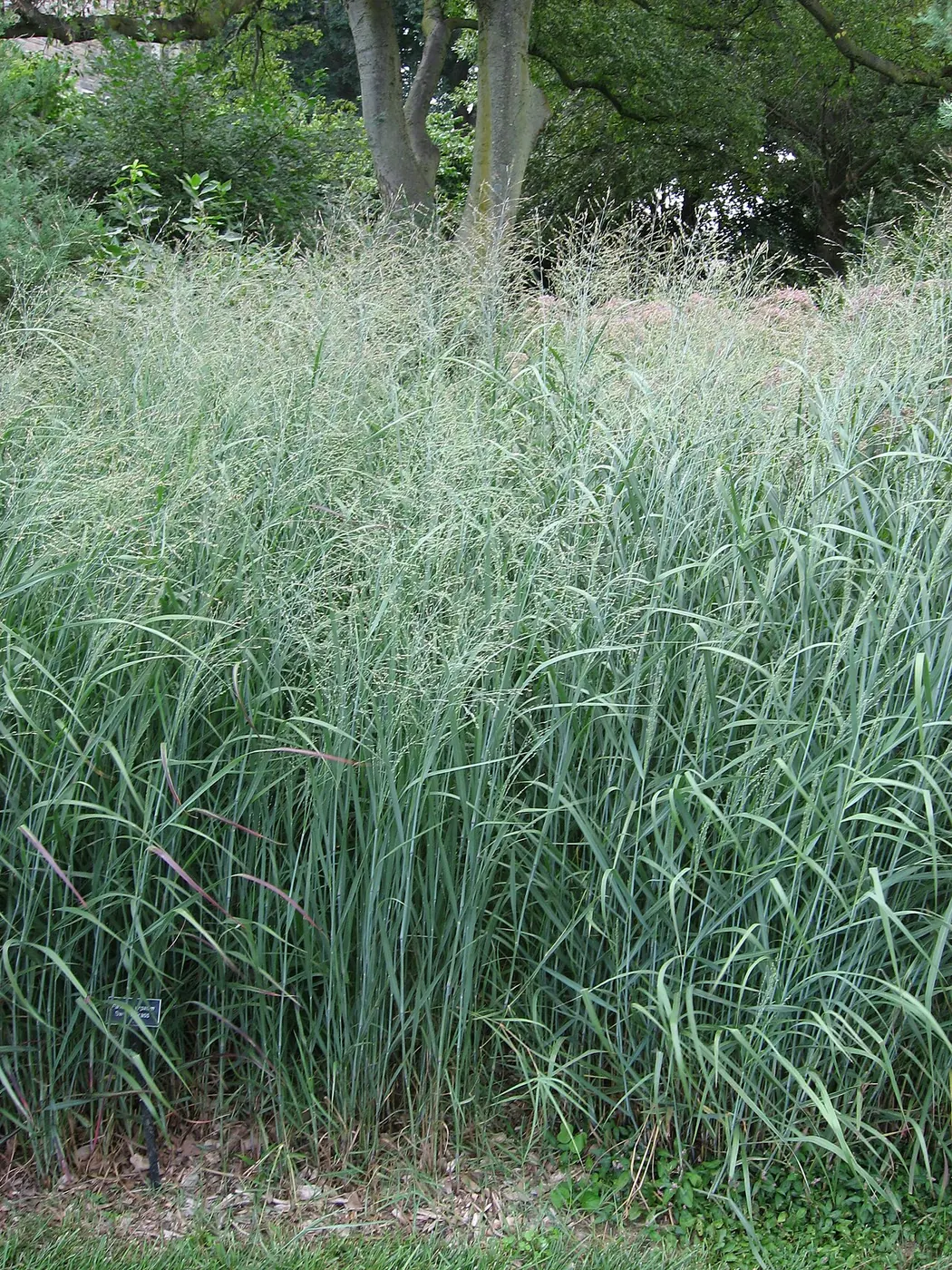
Switchgrass (Panicum virgatum) clump in late summer showing open pyramidal panicles
Panicum virgatum in late-summer flower — the diagnostic open, airy pyramidal panicle distinguishes it from the dense, spike-like panicle of indiangrass. Photo: Wikimedia Commons.

Identification

[ field key — habit · foliage · panicle · seed ]

Habit & Stems

Erect, tightly clumping warm-season bunchgrass 3–7 ft tall in flower (lowland cultivars occasionally to 8 ft+). Lowland cytotypes are clearly bunchgrass-like; upland cytotypes have more vigorous short rhizomes and form looser sod — but neither runs aggressively the way cordgrass (Spartina) does. Stems are sturdy, round, smooth and upright, holding the inflorescence well above the foliage even after thunderstorms. The whole plant collapses to dormancy after hard frost and persists as a tan winter sculpture until cut back.

Leaves

Long, narrow blades 30–90 cm (12–35 in) long with a prominent white midrib, arching from the base of the clump. Foliage color varies enormously by cultivar: wild populations are mid-green, but selections range from strongly glaucous steel-blue ('Heavy Metal', 'Dallas Blues') to deep burgundy-tipped ('Shenandoah', 'Rotstrahlbusch'). A diagnostic field mark is a small triangular patch of dense white hairs at the leaf collar where the blade meets the sheath — visible with a hand lens.

Inflorescence (Panicle)

The diagnostic feature: a large, open, airy, pyramidal panicle 20–55 cm long, with widely spreading branches and tiny spikelets held at the tips. The whole inflorescence shows a pink to dull-purple flush when fresh, fading to golden brown by autumn. This is the single best way to separate switchgrass from indiangrass (Sorghastrum nutans), whose panicle is narrow, dense and spike-like with conspicuous awns. If you can see daylight through the seed head, it is switchgrass.

Fruit (Caryopses)

Tiny one-seeded grains (caryopses) ~2 mm long, chestnut-brown, enclosed in shiny, pointed glumes. Mature in early autumn and persist on the panicle through fall and into winter, providing a long-season food source for sparrows, juncos and mourning doves. Seed has strong dormancy — cold-moist stratification (or simply a winter on the soil surface) is required for good germination.

Habitat & Range in NE Oklahoma

Switchgrass is one of the dominant species of the central North American tallgrass prairie — the ecosystem that historically blanketed eastern Oklahoma. In NE Oklahoma it is abundant statewide in moist meadows, riparian buffers along the Arkansas, Verdigris and Caney rivers, the wet swales of remnant Cross Timbers prairies, roadside ditches, old pastures and reclaimed mine lands. Tallgrass Prairie Preserve north of Pawhuska holds it in association with big bluestem, little bluestem, indiangrass, sideoats grama, eastern gamagrass and a dense forb layer of compass plant, gayfeather and prairie clover.

Among the Big Four, switchgrass is the most uniquely adaptable to both wet and dry sites. It will tolerate seasonal flooding (occupying pond margins and floodplains other prairie grasses avoid) and, once established, also tolerate the heavy drought conditions of NE Oklahoma summers. This wet-AND-dry range is why USDA-NRCS, KDOT and other agencies use it for erosion control on highway right-of-ways, strip-mine reclamation, pond dams and dike stabilization, and why landscape designers reach for it when a single grass has to cover a sloped lot that is wet at the bottom and dry at the top.

Ecology & Wildlife Value

[ pollinators · larval hosts · seed predators · soil function ]

Lepidoptera Hosts

Switchgrass is a documented larval host plant for the Delaware skipper (Anatrytone logan), Hobomok skipper (Lon hobomok), and is the preferred host of the pink streak moth (Dargida rubripennis). It is one of the warm-season grasses that supports the broader skipper guild that historically depended on tallgrass prairie — including Dakota and several other Hesperia skippers in the region. Removing switchgrass from a regional plant palette removes the breeding habitat for these insects.

Birds & Small Mammals

The small persistent caryopses are eaten through fall and winter by field, song and tree sparrows, dark-eyed juncos, mourning doves, bobwhite, pheasant and wild turkey. Standing winter clumps provide critical cover for grassland-nesting birds the following spring, and for cottontails, voles and shrews year-round. Switchgrass plantings are the standard recommendation in USDA-NRCS conservation seed mixes aimed at upland game-bird habitat.

Soil & Water Quality

The single biggest ecological argument for switchgrass is its root system: a dense, fibrous mass commonly reaching 6–10+ ft deep, nearly as deep as the plant is tall. This makes it an outstanding plant for riparian buffers, grass waterways, terrace risers and contour strips on erodible NE Oklahoma cropland. Roots simultaneously anchor soil against flood scour, intercept nutrient and sediment runoff before it enters streams, and deposit large quantities of carbon several feet below the surface — a recognised carbon-sequestration pathway being actively studied by USDA and the DOE.

Trophic Role

A keystone forage grass of the historic tallgrass prairie. Switchgrass-dominated stands fed the bison herds that once roamed the Osage; today managed switchgrass pasture is excellent for cattle if grazed correctly (50 cm in, 25 cm out, 30–45 day rest). Note: switchgrass contains steroidal saponins that are toxic to horses, sheep and goats, causing photosensitivity and liver damage — do not feed it to those species.

The Big Four: For an authentic NE Oklahoma tallgrass planting, pair switchgrass with the other three keystone prairie grasses — big bluestem (Andropogon gerardii), little bluestem (Schizachyrium scoparium), and indiangrass (Sorghastrum nutans). The Noble Research Institute in Ardmore, OK and Oak Ridge National Laboratory have made switchgrass the model species for U.S. herbaceous biofuel research, so most commercially available improved seed traces back to one of those programs.

Horticulture & Care

[ planting · soil · water · cutback · burning · cultivars ]

Site selection & planting

Plant in spring, after the soil has warmed — switchgrass is a warm-season C4 grass and will not establish well in cold soil. Container stock can be set out from April through early summer; for direct seeding, wait for soil temperatures of 60 °F+. Choose a site with full sun (6+ hours); in light shade plants persist but flop and bloom poorly. Switchgrass tolerates the full range of NE Oklahoma soils — sand to heavy clay, pH 4.9–7.6 — and the full range of soil moisture from seasonally flooded bottoms to dry upland slopes.

Water, fertility & weed competition

Once established (typically by the end of year 2), mature switchgrass is essentially drought-proof in the Tulsa region thanks to its 6–10 ft root system. It is also a famously light feeder — avoid lawn fertilizer drift, which causes lodging (the clump falls over). For seeded prairie restorations, first-year stands often look weedy; this is normal and switchgrass typically out-competes annual weeds in years 2–3 with no chemical intervention.

Cutback & controlled burning

Cut clumps to 4–6" above the crown in late winter (February in Tulsa), before new growth pushes from the base. The standing winter form is one of the best ornamental features of the species, so resist the temptation to cut back in fall. On larger plantings, a controlled burn every 2–3 years in late winter both cleans out thatch and stimulates more vigorous flowering — this is the historic prairie fire regime switchgrass is adapted to.

Propagation

Pests & diseases

Notable cultivars for NE Oklahoma

Cultivar Type Distinguishing feature Notes for Tulsa
'Heavy Metal' Landscape Steel-blue glaucous foliage, strictly upright 3–5 ft The standard blue-leaf switchgrass; RHS Award of Garden Merit. Excellent in modern, formal plantings.
'Northwind' Landscape Very upright, narrow, 4–6 ft; olive-green foliage Most upright cultivar — the "exclamation point" grass. Stays vertical even after Oklahoma thunderstorms.
'Shenandoah' Landscape Red-tipped foliage by July, deep burgundy fall color, 3–4 ft Best red-leaf switchgrass for NE OK; pairs beautifully with russet sedges and asters.
'Cloud Nine' Landscape Giant 6–8 ft; blue-green foliage; massive panicles Use as a privacy screen or vertical anchor; needs full sun and elbow room.
'Dallas Blues' Landscape Wide steel-blue blades, large pink panicles, 4–5 ft The heaviest-blue switchgrass; RHS Award of Garden Merit.
'Cape Breeze' Landscape Compact 2–3 ft; salt & humidity tolerant For tighter beds, parking strips, or where 'Heavy Metal' is too tall.
'Alamo' Lowland forage / biofuel Tall, coarse, very high biomass; southern lowland ecotype The standard lowland cultivar for southern-tier biofuel and forage trials — widely studied in OK/TX.
'Kanlow' Lowland forage / biofuel Tall (6–8 ft), wet-tolerant, flood-tolerant lowland ecotype Workhorse for riparian-buffer plantings on bottomland and pond margins.
'Cave-in-Rock' Upland forage / conservation Mid-tall upland ecotype; hardy and reliable USDA-NRCS workhorse for CRP and grass-waterway plantings across the central U.S.
'Trailblazer' Upland forage Improved digestibility selection from 'Pathfinder' Cattle-pasture cultivar; bred at the USDA grassland research program.
Landscape design note: For NE Oklahoma residential and commercial sites, choose 'Northwind' for strictly vertical structure, 'Heavy Metal' for blue glaucous foliage, 'Shenandoah' for red autumn color, and 'Cloud Nine' for screen-height plantings. Reserve 'Alamo', 'Kanlow', 'Cave-in-Rock' and 'Trailblazer' for forage, riparian-buffer or biofuel plantings — they are taller, coarser, and less ornamentally refined than the named landscape cultivars.

Companion planting in a prairie meadow

Pairs naturally with the rest of the Big Four (big bluestem, little bluestem, indiangrass) plus a forb layer of compass plant (Silphium laciniatum), gayfeather (Liatris spicata / L. punctata), purple coneflower, black-eyed Susan, wild bergamot, aromatic aster and any of the native Solidago goldenrods. For riparian-buffer plantings, combine with eastern gamagrass and sedges (Carex spp.) on the wettest band, switchgrass on the moist middle band, and little bluestem on the dry upland band.
Forage, Biofuel & Cultural Uses

Switchgrass is one of the most extensively studied native plants in North America — not because it is rare, but because it sits at the intersection of forage agriculture, soil and water conservation, and renewable energy.

Tulsa take: Switchgrass tolerates BOTH wet and dry sites, making it the most adaptable of the Big Four for our region. For a finished landscape look choose 'Heavy Metal' · 'Northwind' · 'Shenandoah' · 'Cloud Nine'. For prairie restoration, riparian buffers or biofuel/forage plantings choose lowland 'Alamo' / 'Kanlow' or upland 'Cave-in-Rock' / 'Trailblazer'. All of them root 6–10 ft deep and quietly rebuild Oklahoma soil while they look good.

Photo Reference

Panicum virgatum 'Heavy Metal' showing strongly glaucous steel-blue upright foliage
// 'Heavy Metal' · steel-blue glaucous foliage · strictly upright
Wikimedia Commons
Panicum virgatum 'Northwind' showing very upright narrow habit
// 'Northwind' · the most upright switchgrass cultivar
Wikimedia Commons
Panicum virgatum 'Shenandoah' showing burgundy-tipped foliage
// 'Shenandoah' · red-tipped foliage and burgundy fall color
Wikimedia Commons
Switchgrass root system excavated at the Land Institute, showing roots much deeper than the plant is tall
// Root system — commonly 6–10+ ft deep
Wikimedia Commons · The Land Institute
Switchgrass seed (caryopses) on the panicle in autumn
// Seeds (caryopses) · persistent winter food for sparrows & juncos
Wikimedia Commons
Switchgrass in autumn color, gold to russet
// Autumn color · gold-yellow → russet-red
Wikimedia Commons

Sources & Further Reading

  • USDA NRCS PLANTS Database — Panicum virgatum: plants.usda.gov/plant-profile/PAVI2
  • USDA NRCS Plant Fact Sheet — Switchgrass (Panicum virgatum) (PDF): plants.usda.gov/factsheet/pdf/fs_pavi2.pdf
  • USDA Forest Service Fire Effects Information System (FEIS) — Panicum virgatum: fs.usda.gov/database/feis/plants/graminoid/panvir
  • Noble Research Institute (Ardmore, OK) — switchgrass forage and bioenergy research program: noble.org
  • Bransby, D. (2005), Switchgrass Profile, Bioenergy Feedstock Information Network (BFIN), Oak Ridge National Laboratory — the foundational ORNL/DOE selection of switchgrass as the model herbaceous biofuel crop.
  • McLaughlin, S.B. & Kszos, L.A. (2005), Development of switchgrass (Panicum virgatum) as a bioenergy feedstock in the United States, Biomass and Bioenergy 28(6):515–535 — the canonical Oak Ridge biofuel synthesis paper.
  • Schmer, M.R., Vogel, K.P., Mitchell, R.B., Perrin, R.K. (2008), Net energy of cellulosic ethanol from switchgrass, PNAS 105(2):464–469 — documents the ~5.4× net energy ratio.
  • Lovell, J.T. et al. (2021), Genomic mechanisms of climate adaptation in polyploid bioenergy switchgrass, Nature 590:438–444 — upland vs lowland ecotype genomics.
  • Lady Bird Johnson Wildflower Center — Native Plant Database, Panicum virgatum: wildflower.org — PAVI2
  • Missouri Botanical Garden Plant Finder — Panicum virgatum cultivar profiles ('Heavy Metal', 'Northwind', 'Shenandoah', 'Cloud Nine', 'Dallas Blues').
  • Oklahoma State University Extension — Native warm-season grass establishment and management for the Southern Great Plains.
  • Wikipedia — Panicum virgatum: en.wikipedia.org/wiki/Panicum_virgatum (CC BY-SA 4.0; portions of the description, ecology, bioenergy and uses sections summarize Wikipedia content).

Photos courtesy of Wikimedia Commons contributors under their respective licenses (linked under each image). Switchgrass root photo: The Land Institute, via Wikimedia Commons.