home/ plants/ big-bluestem

// SPECIES PROFILE · GRASS · NATIVE · KEYSTONE

Big Bluestem

Andropogon gerardii

The defining grass of the North American tallgrass prairie — once the dominant species across ~170 million acres of the Great Plains, and still the keystone of the Joseph H. Williams Tallgrass Prairie Preserve in Osage County, the largest protected tallgrass prairie remaining on Earth (~40,000 acres just up the road from Tulsa). A warm-season (C4) bunchgrass that throws flowering culms 4–8 ft tall topped with a distinctive cluster of three (sometimes 2–5) finger-like racemes that resembles a turkey's foot — the diagnostic field mark and the source of its other common name. Foliage is blue-green in summer and turns rich copper-bronze and burgundy in fall. Roots descend 6–10 ft into the profile, building deep prairie soil and sequestering carbon.

// QUICK FACTS
Family
Poaceae (grass)
Photosynthesis
C4 (warm-season)
Native range
Great Plains + most of central & eastern N. America; S. Canada → N. Mexico
USDA hardiness
Zones 3–9 (Tulsa = 7a/7b)
Mature size
4–8 ft (rarely 10) in flower; basal foliage to ~3 ft
Root depth
6–10+ ft fibrous, with short rhizomes
Habit
Bunchgrass; slowly forms colonies via rhizomes
Bloom
Late July – September (NE OK)
Inflorescence
2–6 (usually 3) digitate racemes — "turkey's foot"
Fall color
Copper-bronze, burgundy, deep red
Sun
Full sun (6+ hrs); shade-intolerant
Soil
Sand → clay loam; pH 5.5–7.5; tolerates poor soils
Water
Low; deeply drought-tolerant once established
Wildlife
Host: Delaware/Arogos/Dusted skippers · cover: prairie chicken, Henslow's sparrow, dickcissel, bobwhite
State symbols
State prairie grass of Illinois & Missouri; official prairie grass of Manitoba
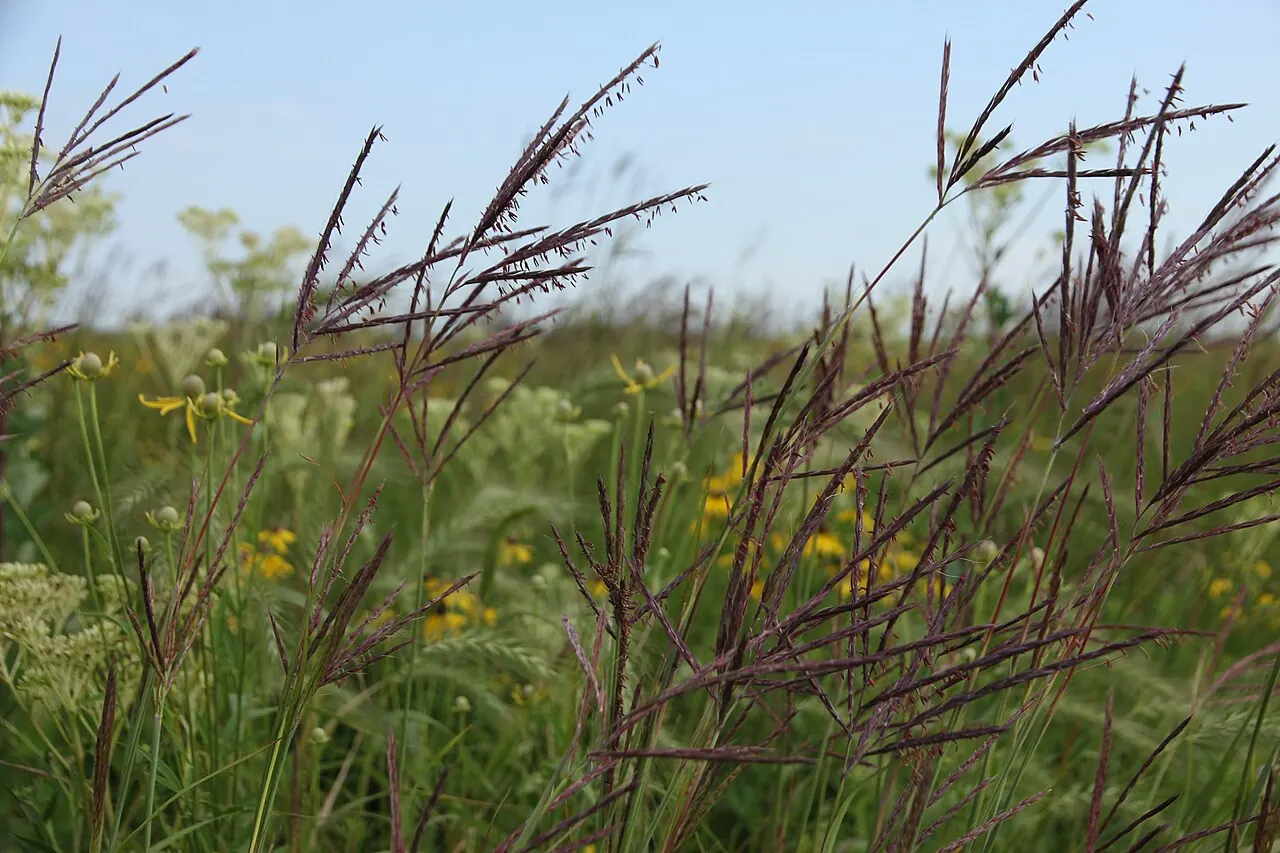
Big Bluestem (Andropogon gerardii) standing tall in restored tallgrass prairie
Andropogon gerardii rising above a tallgrass prairie remnant — the plant that built the soils of the Great Plains. Photo: Wikimedia Commons.

Identification

[ field key — habit · culm · leaf · inflorescence ]

Habit & Roots

A robust, perennial, warm-season (C4) bunchgrass that slowly forms colonies through short, tough rhizomes. Basal foliage forms a dense tussock 2–3 ft tall; in summer, slender flowering culms shoot up to 4–8 ft (occasionally 10 ft on the richest sites). The fibrous root system descends 6–10 ft into the soil profile — the engine behind the deep, dark mollisols of the historic Great Plains and the species' legendary drought tolerance.

Culms & Leaves

Culms (stems) are round, smooth, and develop the characteristic blue-purple cast at the base and nodes as they mature — the source of the name "bluestem." Leaf blades are flat, 6–24 in long and 6–10 mm wide, blue-green in summer, often hairy near the base. Foliage turns rich copper-bronze, mahogany, and burgundy after first frost and holds that color into winter, a major ornamental asset.

Inflorescence (Diagnostic)

The turkey-foot raceme is unmistakable: a terminal cluster of 2–6 finger-like (digitate) racemes, most commonly three, splayed off the tip of the culm like the toes of a wild turkey. Each raceme bears paired spikelets — one stalkless, fertile, and awned; the other stalked, awnless, and either sterile or staminate. Flowers are reddish-purple at anthesis. Bloom runs late July through September across NE Oklahoma.

Lookalikes

Easily confused with Schizachyrium scoparium (little bluestem) when not in flower — little bluestem is shorter (2–4 ft), tufted with no rhizomes, and has solitary racemes per branch. Sorghastrum nutans (indiangrass) is similar in stature but has a single, plume-like, golden-bronze panicle, not a turkey-foot. Panicum virgatum (switchgrass) has an open, airy, diffuse panicle — nothing like the digitate raceme of Andropogon.

Habitat & Range in NE Oklahoma

Big bluestem is the keystone species of the tallgrass prairie, a biome that once stretched from Manitoba to Texas across roughly 170 million acres — the most thoroughly destroyed major ecosystem in North America. Today less than 4% of the original tallgrass prairie remains, and Oklahoma holds the single largest remaining contiguous tract on the continent: The Nature Conservancy's Joseph H. Williams Tallgrass Prairie Preserve in Osage County (~40,000 acres), about an hour northwest of Tulsa. Big bluestem dominates this preserve and is grazed by its restored bison herd of ~2,500 animals.

Other NE Oklahoma strongholds include Black Kettle National Grassland, the prairie openings of the Wichita Mountains, the Cookson Hills, and the prairie remnants of the Cross Timbers ecotone. Big bluestem grows in deep loams, clay uplands, sandstone hills, and along rocky slopes — anywhere with full sun and no permanent shade. It is the dominant plant in the Konza Prairie Biological Station (LTER site) just over the Kansas line, where decades of fire and grazing experiments have made it one of the most-studied grasses on Earth.

Ecology & Wildlife Value

[ keystone role · larval hosts · grassland birds · soil function ]

Keystone Forage

Historically the primary forage of the American bison, and still the foundation of the bison herd at the Tallgrass Prairie Preserve. Also eaten heavily by elk, pronghorn, white-tailed deer, and domestic cattle — ranchers across the central plains call it the "ice cream" of native pasture grasses for its high palatability and protein content. Provides essential winter cover for grassland wildlife long after summer growth has cured into standing biomass.

Lepidoptera Hosts

Larval host plant for a remarkable suite of prairie skippers, several of which are conservation priorities: Delaware skipper (Anatrytone logan), Arogos skipper (Atrytone arogos), dusted skipper (Atrytonopsis hianna), byssus skipper (Problema byssus), cobweb skipper (Hesperia metea), and the common wood nymph (Cercyonis pegala). Many of these butterflies are obligate tallgrass species — lose the bluestem and you lose them.

Grassland Birds

Critical nesting habitat and seed source for the steeply declining grassland bird guild: greater prairie-chicken, Henslow's sparrow, grasshopper sparrow, dickcissel, bobolink, eastern meadowlark, and Northern bobwhite. Henslow's sparrows in particular require the dense litter layer big bluestem produces; loss of tallgrass habitat is the leading driver of their range-wide decline.

Soil & Carbon

Big bluestem's deep fibrous roots and prodigious annual biomass turnover are what built the legendary mollisols of the central United States — some of the deepest, most fertile soils on the planet. The species sequesters substantial carbon belowground, fuels rich soil microbial communities (including arbuscular mycorrhizae), and is fire-adapted: bud crowns sit at or just below the soil surface and resprout vigorously after fire. Hosts the rust fungus Puccinia andropogonis and provides nest structure for several Formica ant species.

Keystone of the tallgrass prairie: Big bluestem is one of the "Big Four" prairie grasses — pair it with little bluestem (Schizachyrium scoparium), indiangrass (Sorghastrum nutans), and switchgrass (Panicum virgatum) to reconstruct the structural matrix of the historic Osage County prairie. These four grasses together provide the cover, host-plant base, and seasonal structure that the rest of the prairie food web depends on. Any serious native plant restoration in NE Oklahoma starts here.

Horticulture & Care

[ siting · establishment · fire/cutback · propagation · cultivars ]

Site selection & planting

Plant in full sun (6+ hours, more is better) on essentially any well-drained soil — sand, loam, clay, rocky upland, the works. Big bluestem tolerates a wider soil range than almost any other ornamental grass, but it is shade intolerant and will flop or die out in even half-shade. Plant from container stock in spring after soil warms, or seed in late fall (cold-moist stratification happens in the ground over winter). Space landscape plantings 18–36" apart; restoration seedings target ~30–60 PLS lb/acre depending on mix.

Annual management: fire & cutback

Big bluestem is profoundly fire-adapted. The historic management of the tallgrass prairie was Indigenous-set fire on a roughly 1–3 year cycle, and today the Tallgrass Prairie Preserve uses prescribed burning as its primary tool. Spring burning before green-up removes thatch, suppresses cool-season competitors, and stimulates vigorous warm-season regrowth.

In a residential landscape setting where fire isn't practical, cut clumps to within 4–6 inches of the ground in late winter (February in Tulsa), before new growth emerges. Skipping this step every couple of years is fine; doing it annually keeps clumps tight and bloom strong. Resist the urge to cut in fall — the standing copper foliage is a major winter ornamental and provides cover for overwintering insects and birds.

Propagation

Pests & diseases

Notable cultivars for NE Oklahoma

Cultivar Origin Distinguishing feature Notes for Tulsa
'Red October' Brent Horvath / Intrinsic Perennial Gardens Brilliant red-burgundy fall color, upright 6 ft form Perennial Plant Association Plant of the Year 2014. Best fall color of any cultivar — lights up October landscapes.
'Indian Warrior' Selection Deep wine-red foliage by midsummer, intensifying in fall Strong red color earlier in season than 'Red October'; 5–6 ft.
'Bonanza' USDA NRCS release Heavy seed producer, vigorous Forage / restoration cultivar; less ornamental but tough.
'Lord Snowden' Bluemount Nurseries Tall (8 ft), strongly upright, heavy bloom Vertical accent or screen planting; needs full sun.
'Niagara' NY ecotype (USDA) Northern ecotype, blue-green foliage, purple fall Available but flowers a bit late for OK; prefer southern ecotypes.
Local OK ecotype seed Tallgrass Prairie Preserve area / regional seed houses True wild type, full genetic diversity Best choice for restoration — matches local climate, photoperiod, and pollinator timing. Sourced from suppliers like Roundstone Native Seed, Johnston Seed, and Bamert Seed.

Companion planting — the "Big Four" prairie matrix

Plant big bluestem with the rest of the historic tallgrass guild for a self-sustaining prairie planting: little bluestem (Schizachyrium scoparium) for shorter structure and orange fall color, indiangrass (Sorghastrum nutans) for golden plumes, switchgrass (Panicum virgatum) for airy seed heads. Interplant with prairie forbs: Echinacea pallida and E. angustifolia, Ratibida pinnata (gray-headed coneflower), Liatris pycnostachya (prairie blazing star), Asclepias tuberosa (butterfly milkweed), Baptisia australis, Silphium laciniatum (compass plant), and Solidago rigida. Avoid planting in any spot that gets afternoon shade from mature trees.

Management reality check: Prescribed fire is the historical and ecologically optimal management tool for big bluestem and tallgrass prairie. In residential and most commercial landscapes, fire isn't practical — substitute a late-winter cut to 4–6 inches, ideally with the clippings removed or chopped fine. A spring mow on the highest setting works for larger naturalized plantings. Do this in February or early March in NE OK, before new growth emerges.
Forage & Cultural Uses

Big bluestem has been the most ecologically and economically important native forage grass of the central United States for as long as ranching has existed on this continent. It is the grass that fed the bison herds that fed the plains nations, and then fed the cattle herds that displaced them. Its uses today span agriculture, ecology, and ornamental horticulture:

Photo Reference

Andropogon gerardii — flowering habit
// Andropogon gerardii — flowering habit

Sources & Further Reading

  • USDA NRCS PLANTS Database — Andropogon gerardii: plants.usda.gov/plant-profile/ANGE
  • USDA Forest Service Fire Effects Information System (FEIS) — Andropogon gerardii: fs.usda.gov/database/feis/plants/graminoid/andger
  • The Nature Conservancy — Joseph H. Williams Tallgrass Prairie Preserve, Osage County, OK: nature.org — Tallgrass Prairie Preserve
  • Konza Prairie Biological Station (NSF LTER) — long-term tallgrass prairie research: kpbs.konza.k-state.edu
  • Kansas State University — Big Bluestem as a Bioenergy Crop (Zhang et al., 2015), Renewable and Sustainable Energy Reviews 52: 740–756.
  • Lady Bird Johnson Wildflower Center — Andropogon gerardii: wildflower.org — ANGE
  • Missouri Botanical Garden Plant Finder — Andropogon gerardii cultivar profiles ('Red October', 'Indian Warrior').
  • Perennial Plant Association — 2014 Plant of the Year: Andropogon gerardii 'Red October'.
  • Xerces Society (2016), Gardening for Butterflies, Timber Press — documents skipper hosts on big bluestem.
  • Weaver, J.E. (1919, 1954), The Ecological Relations of Roots & North American Prairie — foundational root architecture and prairie ecology.
  • Wikipedia — Andropogon gerardi: en.wikipedia.org/wiki/Andropogon_gerardi (CC BY-SA 4.0; portions of the description and ecology sections summarize Wikipedia content).

Photos courtesy of Wikimedia Commons contributors under their respective licenses (linked under each image). Hero photo: Wikimedia Commons, tallgrass prairie flora.