home/ plants/ american-beautyberry

// SPECIES PROFILE · SHRUB · NATIVE

American Beautyberry

Callicarpa americana

Few native shrubs put on a fall fruit display quite like beautyberry. From September into November, dense clusters of brilliant magenta-purple drupes wrap tightly around every leaf node along arching stems — one of the most distinctive native fruit displays anywhere in North America. Once placed in the verbena family, modern molecular work has moved the genus Callicarpa into Lamiaceae, the mints. In NE Oklahoma you'll find it at the western edge of its native range, scattered through oak-hickory understory and Arkansas River bottomlands — and thriving in any Tulsa-area garden with part shade and decent drainage.

// QUICK FACTS
Family
Lamiaceae (formerly Verbenaceae)
Native range
SE US: Maryland → Florida, west to E Texas, Arkansas, E/SE Oklahoma; also Mexico, Bermuda, Bahamas, Cuba
USDA hardiness
Zones 6–10 (Tulsa = 7a/7b)
Mature size
4–8 ft tall · 4–6 ft spread
Habit
Open, loose, arching deciduous shrub
Bloom
Mid June – August (NE OK)
Flower color
Pale pink to lavender (small, in axillary cymes)
Fruit
Magenta-purple drupes; Sept–Nov; persistent into early winter
Sun
Part shade → full sun (more sun = more fruit)
Soil
Average, well-drained; loam, sand, sandy clay; pH 5.5–7.5
Water
Medium; drought-tolerant once established
Wildlife
40+ bird species · native bees · butterflies · deer browse · spring azure host
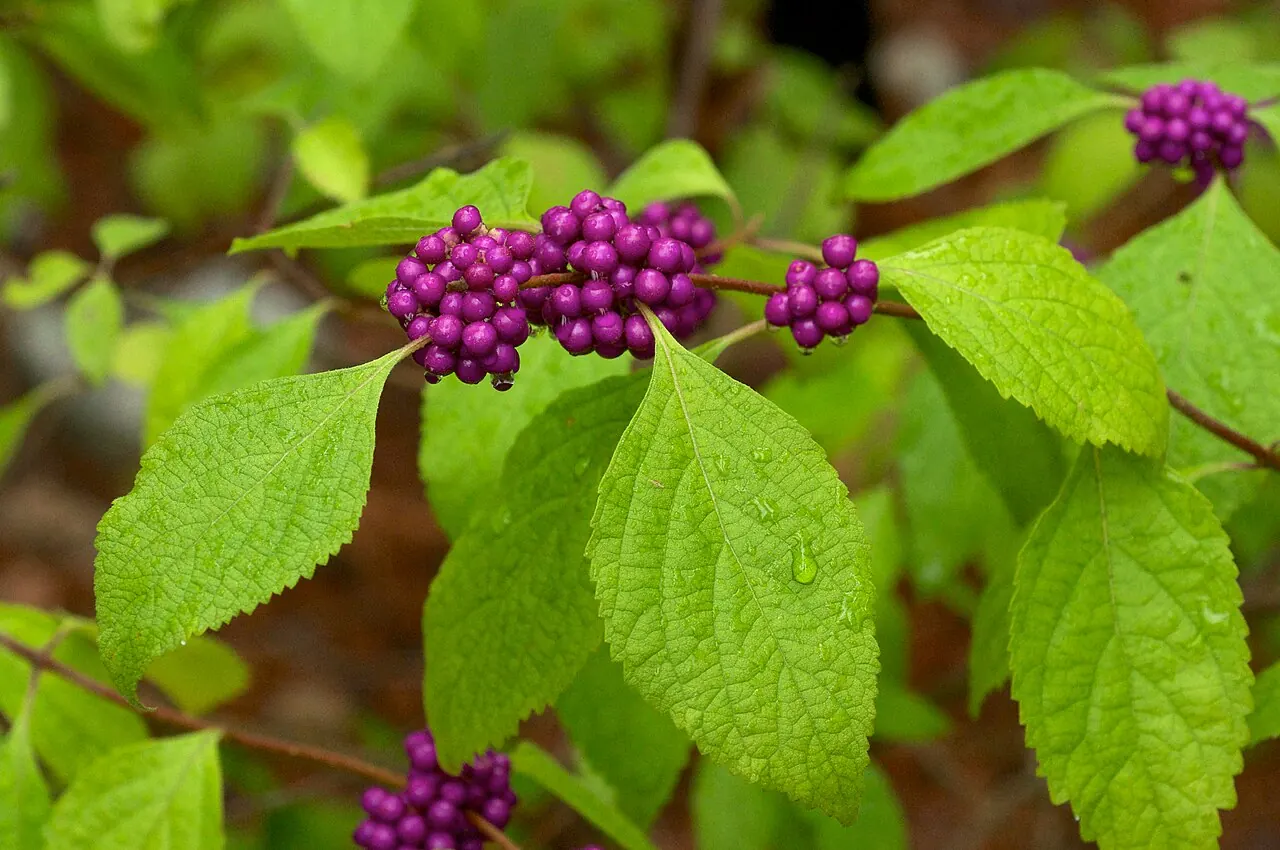
American Beautyberry (Callicarpa americana) with dense magenta-purple fruit clusters wrapped around arching stems
Callicarpa americana in fall fruit — the trademark magenta drupes encircling the stems at every leaf node. (Wikimedia Commons).

Identification

[ field key — habit · leaf · flower · fruit ]

Habit & Stem

Open, loose, deciduous shrub, typically 4–8 ft tall and nearly as wide, with long, gracefully arching stems radiating from the base. Young stems are densely covered in fine, pale, stellate (star-shaped) scurfy hairs — a useful close-range ID feature — and shed those hairs as the wood matures. There's no central leader; untouched plants tend to sprawl rather than form a tidy mound.

Leaves

Leaves are opposite (occasionally in whorls of three), ovate to elliptic, 8–23 cm long with a tapered tip and coarsely toothed margin. Upper surface medium green and nearly hairless at maturity; the underside is distinctly pale gray-green and felted with stellate hairs — flip a leaf in the field and the contrast is unmistakable. Crushed foliage is faintly aromatic. Yellow fall color before drop.

Flowers

Small and easy to miss: tubular, 4-lobed corollas only 2–3 mm across, ranging from pale pink to lavender (rarely white), held in tight axillary cymes — compact clusters sitting in the leaf axils, shorter than the petioles. Blooms over a long window from mid June into August in Tulsa. Long exserted stamens give the cymes a faintly fuzzy halo and provide an easy landing for small native bees and butterflies.

Fruit

The signature: dense, rounded clusters of small (3–6 mm) drupes wrapped tightly around the stem at every leaf node, ripening from green through pink to a saturated, almost iridescent magenta-purple in September. Only the skin is colored; the flesh inside is white. A naturally occurring white-fruited form is sold as var. lactea (cultivars 'Lactea', 'Russell Montgomery'). Fruits persist into early winter and are one of the most reliable ID features long after the leaves drop.

Habitat & Range in NE Oklahoma

American Beautyberry is widespread through the Southeastern United States, from Maryland and Virginia south to Florida and west across the Gulf Coastal Plain to East Texas, Arkansas and the southeastern half of Oklahoma. Tulsa and the broader NE Oklahoma corridor sit at the western edge of its native range, where it occurs sporadically through the Cross Timbers transition and along the Arkansas River bottomlands in oak-hickory understory, sandy floodplain woods, woodland edges, and shaded fence rows.

In the wild it favors filtered light beneath open canopies of post oak, blackjack oak, hickory and pecan, with moist but well-drained sandy or loamy soils. Established plants are noticeably drought-tolerant — one of the reasons it succeeds at the dry western edge of its range — but it performs best with at least some summer moisture. Salt-tolerant enough to grow inland from Gulf Coast dunes; equally at home in deep East Texas pine flatwoods.

Ecology & Wildlife Value

[ pollinators · larval hosts · birds & mammals · chemistry ]

Pollinators

The small lavender flowers attract a steady stream of native bees (sweat bees, small carpenter bees, bumblebees), several butterflies and skippers, and occasional hummingbirds. The long bloom window — mid summer into August — makes beautyberry a useful bridge nectar source between the spring and fall flushes when many other natives are dormant.

Lepidoptera Hosts

Larval host for the spring azure (Celastrina ladon) and several geometrid moths that feed on the foliage. Beautyberry is also a documented host for the snowberry clearwing and a handful of small noctuids. Foliage damage from caterpillars is cosmetic and shrubs recover quickly — do not spray.

Birds & Mammals

The fruits are eaten by at least 40 bird species, including northern mockingbird, brown thrasher, northern cardinal, eastern bluebird, American robin, gray catbird, Northern bobwhite, wild turkey, downy and red-bellied woodpeckers, and many migrating thrushes that pass through NE Oklahoma each fall. White-tailed deer browse the foliage readily, and raccoons, opossums, gray foxes and several rodents take the fruit. Few natives feed more wildlife per square foot of garden.

Chemistry & Defense

Beautyberry leaves contain the terpenoid compounds callicarpenal and intermedeol, which USDA Agricultural Research Service chemists (Cantrell, Klun et al., 2006) isolated from the foliage and confirmed as effective repellents against yellow-fever mosquitoes (Aedes aegypti), malaria mosquitoes (Anopheles stephensi) and black-legged ticks. The work validated a long-standing southern folk practice and is the basis for ongoing botanical-repellent research at USDA-ARS and the University of Mississippi.

Ethnobotany meets modern chemistry: The Choctaw and several other Southeastern tribes traditionally crushed beautyberry leaves and rubbed them on the skin (and on horses and mules) to repel biting insects. In 2006, USDA-ARS researchers Cantrell, Klun and colleagues isolated callicarpenal and intermedeol from the leaves and demonstrated in laboratory bioassays that both compounds are effective mosquito and tick repellents — one of the cleaner cases of indigenous knowledge being confirmed by modern phytochemistry.

Horticulture & Care

[ planting · soil · water · pruning · propagation · pests ]

Site selection & planting

Plant in fall through early spring, while dormant or just before bud-break. Beautyberry is forgiving of soil type — sandy loam, sandy clay, even fairly rocky sites — provided drainage is reasonable and the pH stays in the 5.5–7.5 range. Choose a spot with at least 4–6 hours of sun; in deeper shade plants stay vigorous but produce noticeably fewer fruit. Afternoon shade in west-facing Tulsa exposures helps prevent mid-summer leaf scorch.

Water & soil after establishment

Established beautyberries are notably drought-tolerant in NE Oklahoma but reward one or two deep soaks during prolonged August–September dry spells with substantially heavier fruit set. Avoid waterlogged sites; root rot is the most common cause of decline.

Pruning — the single most important practice

Beautyberry flowers and fruits exclusively on new wood produced in the current season. The standard practice is to coppice the entire shrub down to 6–12 inches in late winter (February in Tulsa, before bud-break), every year or every other year. Hard cut-back produces a denser, more compact form, much heavier flowering, and the most spectacular fruit display the following fall. Plants left unpruned for many years become leggy and sparse, with fruit clusters scattered out at the tips of long arching canes.

Propagation

Pests & diseases

Notable cultivars for NE Oklahoma

Cultivar Origin Distinguishing feature Notes for Tulsa
Straight species (wild type) SE US native Magenta-purple fruit, lavender flowers, 4–8 ft The default choice; most genetic diversity, best wildlife value.
'Welch's Pink' Texas selection Soft pink fruit instead of magenta Striking foil for the species form; same vigor and hardiness.
'Lactea' (var. lactea) Naturally occurring white-fruited form Pure white fruit clusters; pale yellow-green leaves Glows in shaded woodland edges; pairs perfectly with the magenta type.
'Russell Montgomery' Mississippi nursery selection Vigorous white-fruited cultivar More uniform fruit set than seed-grown 'Lactea'.
'Berries & Cream' / variegated forms Various nurseries Cream-margined or splashed foliage Less vigorous; best in part shade with afternoon protection.
For maximum fall impact: coppice the entire shrub to 6–12 inches every late winter. Beautyberry flowers and fruits only on current-season wood, so hard cut-back is the single biggest lever for a dense plant and the heaviest possible display of magenta drupes — the same clusters that will feed 40+ species of birds from October into early winter.

Companion planting in a food forest

Layer 4 (shrub layer) in a 7-layer food forest. Plant in the dappled gaps beneath post oak, blackjack oak, hickory or pecan canopies, paired with eastern redbud and fragrant sumac at the shrub edge, and underplanted with aromatic aster, wild bergamot and little bluestem. The magenta fall fruit reads beautifully against the gold tones of bluestem and indiangrass in October.
Edible & Cultural Uses

Beautyberry has a long history of use that goes well beyond the ornamental:

Caution: The repellent effect from rubbing crushed leaves on skin is real but transient and inconsistent compared with formulated repellents. Patch-test for skin sensitivity, and don't rely on it as your only line of defense in heavy mosquito or tick country. Eat raw berries sparingly, if at all — jelly is the safer (and more rewarding) culinary use.

Photo Reference

Callicarpa americana — close-up of small lavender-pink axillary cyme flowers
// Flowers · pale lavender-pink · tight axillary cymes
Wikimedia Commons
Adaxial (upper) leaf surface of Callicarpa americana showing ovate shape and coarsely toothed margin
// Leaves · opposite · ovate · coarsely toothed margin
Wikimedia Commons
Dense clusters of magenta-purple beautyberry drupes wrapped around a stem
// Infructescence · drupes encircling the stem at every node
Wikimedia Commons
Callicarpa americana growing in open pine-oak understory habitat
// Habitat · open understory · woodland edge
Wikimedia Commons

Sources & Further Reading

  • USDA NRCS PLANTS Database — Callicarpa americana: plants.usda.gov/plant-profile/CAAM2
  • USDA Forest Service Fire Effects Information System (FEIS) — Callicarpa americana: fs.usda.gov/database/feis/plants/shrub/calame
  • Lady Bird Johnson Wildflower Center — Native Plant Database: wildflower.org — CAAM2
  • Missouri Botanical Garden Plant Finder — Callicarpa americana: missouribotanicalgarden.org — Callicarpa americana
  • Mississippi State University Extension — American beautyberry production and landscape use guides.
  • Cantrell, C. L., Klun, J. A., Bryson, C. T., Kobaisy, M., & Duke, S. O. (2005–2006). Isolation and identification of mosquito bite deterrent terpenoids from leaves of American (Callicarpa americana) and Japanese (Callicarpa japonica) beautyberry. J. Agric. Food Chem. 53(15):5948–5953; popularized in USDA-ARS Agricultural Research magazine, Feb. 2006 ("Learning from our elders: Folk Remedy Yields Mosquito-Thwarting Compound").
  • Moerman, D. E. Native American Ethnobotany (Timber Press, 1998) — Choctaw and other Southeastern uses of Callicarpa americana.
  • Wikipedia — Callicarpa americana: en.wikipedia.org/wiki/Callicarpa_americana (CC BY-SA 4.0; portions of the description and uses sections summarize Wikipedia content).

Photos courtesy of Wikimedia Commons contributors under their respective licenses (linked under each image).