home/ plants/ fragrant-sumac

// SPECIES PROFILE · SHRUB · NATIVE

Fragrant Sumac

Rhus aromatica

A low, spreading, supremely tough deciduous shrub for the dry, rocky, sun-baked edges of NE Oklahoma. Rhus aromatica is the native that quietly holds road cuts and pasture banks together — yellow catkin flowers before the leaves in late February feed the first emerging bees of the year, fuzzy red drupes feed thirty-plus bird species through summer, and the trifoliate leaves erupt into orange-red-burgundy fall color that rivals any imported maple. The compact selection 'Gro-Low' turned this prairie-edge shrub into one of the most-used native landscape plants in the Midwest.

// QUICK FACTS
Family
Anacardiaceae (cashew/sumac family)
Native range
S. Canada through most of the contiguous US into Mexico
USDA hardiness
Zones 3–9 (Tulsa = 7a/7b)
Mature size
2–6 ft tall · 6–10 ft wide; suckers into colony
Habit
Low spreading shrub; trailing branches root where they touch
Bloom
Late February – April (NE OK), before leaves
Flower color
Yellow catkin-like clusters
Fruit
Fuzzy red drupes, June–August (female plants only)
Sex
Polygamodioecious (mostly dioecious — male & female plants)
Sun
Full sun → deep shade (best fall color in sun)
Soil
Any well-drained: rocky, sandy, clay, alkaline; pH 6.0–8.5
Water
Very low once established; outstanding drought tolerance
Wildlife
Early bees · hairstreak butterfly host · 30+ bird species
Fragrant Sumac (Rhus aromatica) showing brilliant orange and red fall foliage
Rhus aromatica in late-September fall color — the moment that earns this shrub a place in the landscape. Photo: Wikimedia Commons (file, CC BY-SA).

Identification

[ field key — habit · leaf · flower · fruit ]

Habit & Stems

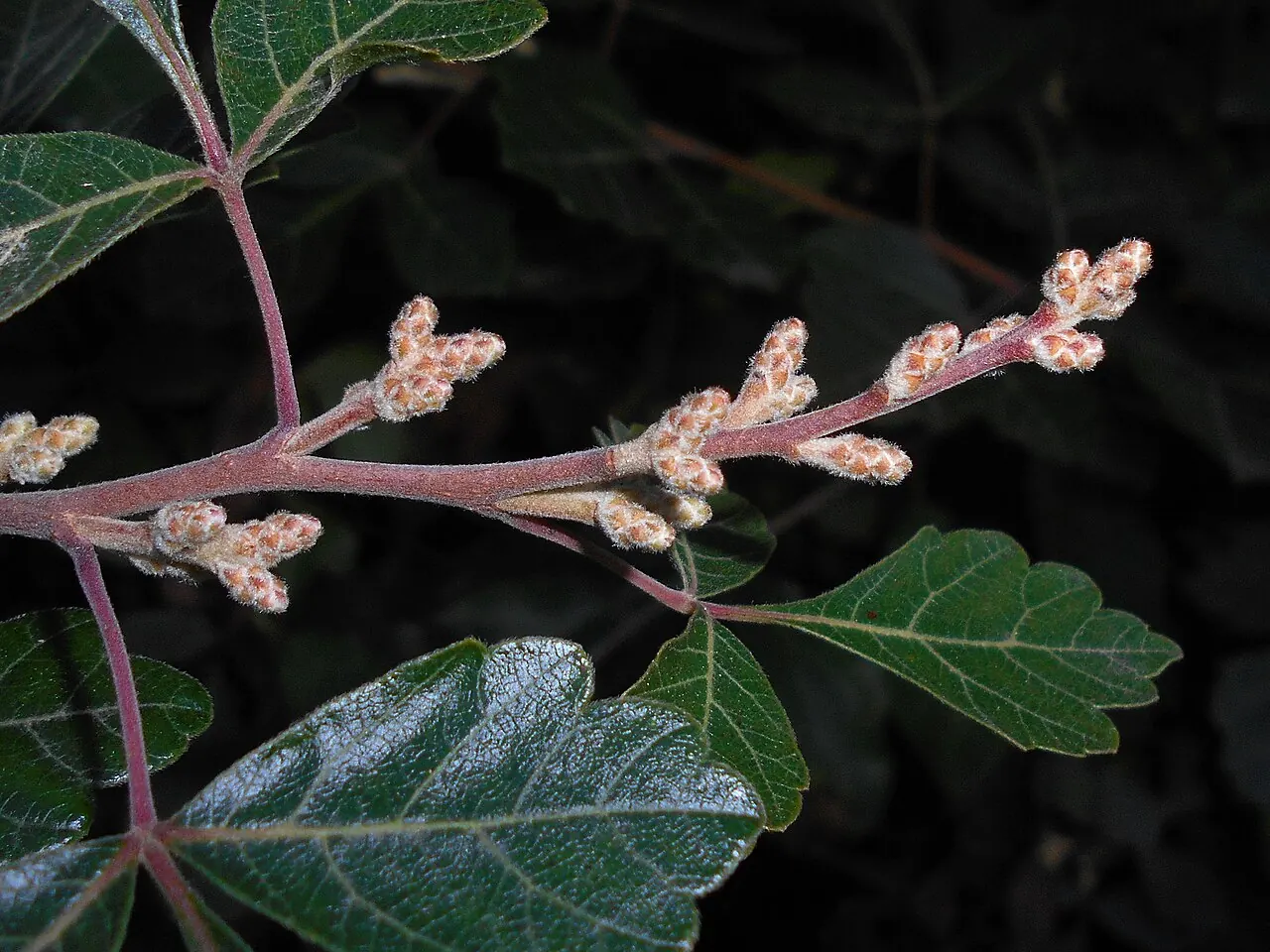
Low, mounded, often wider than tall deciduous shrub, typically 2–6 ft high by 6–10 ft across. Lower branches commonly trail along the ground and root where they touch; the plant also produces basal suckers from a shallow, fibrous root system, slowly forming a colony or thicket. Stems are thin, brownish-gray, dotted with rust-colored lenticels when young. No terminal buds — but overwintering male catkins sit at branch tips through winter, a useful cold-season ID feature.

Leaves (the diagnostic)

Alternate, compound with three leaflets (trifoliate). The terminal leaflet is largest (3–6.5 cm), ovate to rhomboid, coarsely toothed, and sessile — joined directly to the lateral leaflets with no stalk (petiolule). This is the single most important field mark separating fragrant sumac from poison ivy (see warning below). Foliage is glossy dark green in summer, aromatic when crushed with a citrus / turpentine note, and turns brilliant orange, scarlet and burgundy in autumn.

Flowers

Small, yellow, in dense clusters that open before the leaves emerge — late February through April in the Tulsa region, often the first significant woody bloom of the year. The species is polygamodioecious: male (staminate) flowers form short yellow catkins, while female (pistillate) flowers form short bright-yellow panicles at the ends of branches. Most plants are functionally one sex or the other, so only female plants set fruit.

Fruit (Drupes)

Tight clusters of small (5–7 mm), round, fuzzy red drupes ripening June through August on female plants. Each drupe contains a single nutlet. The hairs are sticky and faintly tart with malic and ascorbic acids — the same chemistry that makes staghorn sumac into "sumac-ade." Fruits often persist on the plant into winter if not stripped by birds, making them an important off-season wildlife food.

Habitat & Range in NE Oklahoma

Fragrant sumac is common along the forested eastern margins of the Great Plains — exactly the ecotone NE Oklahoma sits in. Look for it in dry rocky open woods, on glade edges and sandstone outcrops, along prairie-woodland transitions, on road cuts, and in old fence rows across the Cross Timbers, the western Ozarks, and the Osage prairies. It tolerates poor, gravelly, alkaline soils that defeat most ornamental shrubs, and once established it is essentially self-sufficient.

Because rhizomes and shallow roots survive fire, R. aromatica resprouts readily after burns and is a normal component of fire-maintained prairie and savanna systems. In NE Oklahoma it pairs naturally with little bluestem, Indiangrass, chinquapin oak, and chickasaw plum on dry rocky sites, and with eastern redbud and blackjack oak on sandy uplands.

Ecology & Wildlife Value

[ pollinators · larval hosts · birds · cover ]

Early-Spring Pollinators

Because it flowers before almost anything else woody — often in late February in Tulsa — fragrant sumac fills a critical hunger gap for emerging native bees. Solitary mining bees (Andrena spp.) and mason bees (Osmia spp.) visit the catkins heavily, as do early honeybee foragers. In landscapes dominated by lawn and non-native ornamentals, this single shrub can be the difference between a successful and failed early-bee year.

Lepidoptera Hosts

The genus Rhus is a documented host for several hairstreak butterflies, including the Red-banded Hairstreak (Calycopis cecrops) and Banded Hairstreak (Satyrium calanus), along with a long list of moths in the Saturniidae and Noctuidae. Caterpillar damage is almost always cosmetic on a healthy shrub — the foliage is the point.

Birds & Mammals

The fuzzy red drupes are eaten by an estimated 30+ bird species, including northern bobwhite, wild turkey, American robin, northern mockingbird, eastern bluebird, gray catbird, and a long list of thrushes and sparrows. Because the fruits hang on through winter, they function as an emergency-food reserve when other food fails. Deer browse foliage and twigs lightly, and small mammals shelter in the colony.

Thicket Cover & Soil Function

Mature colonies form low, dense thickets ideal for ground-nesting and shrub-nesting birds. The shallow, fibrous, suckering root system is excellent at holding loose soil on slopes and embankments — one of the species' most cited landscape uses. Leaf litter decomposes quickly into a mild humus, and the plant resprouts readily after fire.

Permaculture / regenerative role: A low shrub layer (Layer 4) that doubles as living groundcover on banks, slopes, and the outer edges of food forests. One of the very best early-spring nectar sources for native solitary bees in our region — pair with later-blooming serviceberry, plum, and redbud to build a continuous February-through-May bee buffet. Plant the compact cultivar 'Gro-Low' where you need a residential-scale groundcover that can replace turf on a difficult bank.

Horticulture & Care

[ planting · soil · water · propagation · pruning · pests ]

Site selection & planting

Fragrant sumac is one of the easiest native shrubs to establish in NE Oklahoma. Plant in fall through early spring while dormant. It will grow in essentially any well-drained soil — rocky, sandy, clay, mildly acidic to strongly alkaline (pH 6.0–8.5) — and tolerates everything from full sun to deep shade, though fall color and flowering are best in full sun. The one condition it cannot tolerate is standing water.

Managing the colony

Fragrant sumac suckers and layers — that's its whole strategy. Decide up front whether you want a spreading colony (best for slope stabilization, hedgerows, and wildlife) or a contained shrub (residential beds). For containment, mow or string-trim runners that escape the planting bed once or twice per year, or use the compact 'Gro-Low' cultivar, which suckers far less aggressively than the species. Avoid herbicide on suckers; root-translocated chemistry can damage the parent colony.

Water & soil after establishment

After one full growing season, fragrant sumac is essentially drought-proof in our region — one of the reasons it's recommended for highway right-of-way and reclamation plantings. Supplemental water is unnecessary except in extreme multi-year drought. Fertilizer is not needed and can encourage rank, weak growth.

Pruning

Minimal. Remove dead wood any time. Rejuvenate overgrown plants by cutting the entire colony to ~6" in late winter every 5–10 years; it will resprout vigorously. 'Gro-Low' is shaped naturally and rarely needs pruning at all.

Propagation

Pests & diseases

Notable cultivars for NE Oklahoma

Cultivar Origin Distinguishing feature Notes for Tulsa
'Gro-Low' Synnestvedt Nursery, IL (1971) Very compact: ~2 ft tall × 6–8 ft wide; less aggressive suckering The default residential choice. Mass-plant on banks, in parking islands, as a turf alternative on dry sun. Outstanding fall color.
'Konza' Kansas State / Konza Prairie selection Tallgrass-prairie provenance; selected for rust and insect resistance Excellent regional genetics for OK; tough, prairie-adapted, very heat-tolerant.
Straight species Wild collected Full 4–6 ft size, full suckering habit Best for restoration, hedgerows, slope stabilization, and wildlife plantings — anywhere a colony is desirable.

Companion planting in a food forest or hedgerow

Pairs well with: eastern redbud and chickasaw plum for the small-tree layer above; little bluestem, sideoats grama, and prairie dropseed for the groundcover layer between colonies; and aromatic aster, Missouri evening primrose, and purple poppy mallow for late-season bloom in the same dry-soil community. A 'Gro-Low' planting along a south-facing foundation replaces both turf and high-water shrubs at once.
Edible & Cultural Uses

Fragrant sumac is a member of the same culinary lineage as the spice sumac (za'atar's tart red ingredient).

Caution — fragrant sumac vs. poison ivy. Both have alternate leaves of three, and young fragrant sumac can be mistaken for Toxicodendron radicans. Three reliable diagnostic differences:
  1. Terminal leaflet stalk: Fragrant sumac's terminal leaflet is sessile — joined directly to the two lateral leaflets with no stalk. Poison ivy's terminal leaflet sits on a long, distinct stalk (petiolule). This is the single most reliable field mark.
  2. Habit: Fragrant sumac is a low, upright, mounded shrub that does not climb. Poison ivy is a trailing or climbing vine with hairy aerial rootlets on bark.
  3. Aroma: Crushed fragrant sumac leaves smell distinctly of citrus or turpentine. Poison ivy is essentially odorless. Do not crush leaves to test unless you are confident in the first two characters.

Photo Reference

Trifoliate leaves of Rhus aromatica showing terminal leaflet sessile to lateral leaflets
// Trifoliate leaves · terminal leaflet sessile (no stalk)
Wikimedia Commons
Yellow flowers of fragrant sumac in early spring before leaves emerge
// Yellow flower clusters · early spring · before leaves
Wikimedia Commons
Cluster of fuzzy red drupes (fruits) of Rhus aromatica in summer
// Fuzzy red drupes · summer · female plants only
Wikimedia Commons
Rhus aromatica 'Gro-Low' used as low landscape groundcover
// Cultivar 'Gro-Low' · ~2 ft × 6 ft · landscape workhorse
Wikimedia Commons

Sources & Further Reading

Photos courtesy of Wikimedia Commons contributors under their respective licenses (linked under each image).