home/ plants/ maximilian-sunflower

// SPECIES PROFILE · PERENNIAL · NATIVE

Maximilian Sunflower

Helianthus maximiliani

The tall, golden spire that lights up Oklahoma roadsides in late September and October, when nearly everything else on the prairie has already gone to seed. Helianthus maximiliani is a 5–10 ft rhizomatous perennial sunflower that carries dozens of sessile, lemon-yellow flower heads stacked along the upper third of each stem — a single clump in full bloom looks like a candelabra. Named for Prince Maximilian of Wied-Neuwied, who collected it during his 1832–1834 Plains expedition with the painter Karl Bodmer, it is one of the single most important late-season nectar sources for monarchs at fall migration peak and for bumblebees provisioning their last overwintering queens.

// QUICK FACTS
Family
Asteraceae (composite / sunflower)
Native range
Central N. America: Saskatchewan & Manitoba → Texas; native throughout OK
USDA hardiness
Zones 3–9 (Tulsa = 7a/7b)
Mature size
5–10 ft tall · 2–4 ft spread per stem · forms colonies
Habit
Erect, clump-forming, strongly rhizomatous
Lifespan
Long-lived perennial; clones can persist for decades
Bloom
Late August – first hard frost (peak Sept–Oct in NE OK)
Flower color
Bright lemon-to-golden yellow, ~3 in. heads
Sun
Full sun (6+ hrs); flops in shade
Soil
Almost any — loam, sand, heavy clay; pH 5.5–8.0
Water
Low; very drought-tolerant once established
Wildlife
Late-season nectar · sunflower-specialist bees · songbird seed · Lep. host
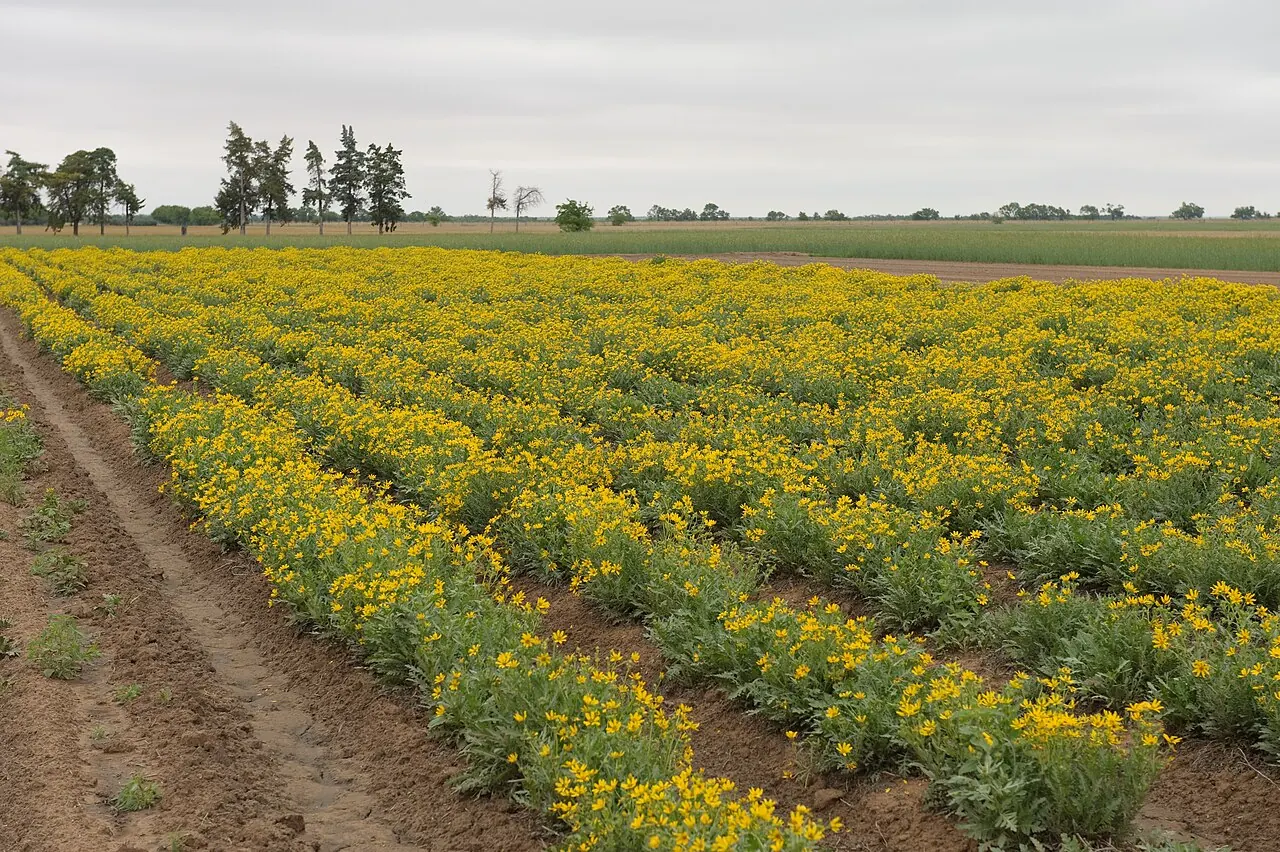
A dense stand of Maximilian sunflower (Helianthus maximiliani) in full golden bloom at an NRCS Plant Materials Center seed plot
Helianthus maximiliani in a seed-increase plot at the USDA-NRCS Plant Materials Center, Knox City, Texas — the same regional ecotype used in Oklahoma roadside & CRP plantings. Photo: USDA-NRCS (Wikimedia Commons, public domain).

Identification

[ field key — stem · leaf · flower · habit ]

Habit & Stem

Tall, erect herbaceous perennial, typically 5–10 ft in NE Oklahoma (and up to 12 ft in deep prairie soils). Stems are stout, rough-hairy, often reddish at the base, branching only in the upper portion where the inflorescence develops. The plant emerges in spring from a network of thick, scaly rhizomes — over time a single seedling becomes a dense, ever-widening clone of dozens of identical stems.

Leaves

Alternate (the lower-most pairs sometimes opposite), narrow and lance-shaped, 4–12 in. long and only 0.5–1.5 in. wide. The most useful field character is that the leaves are folded lengthwise (conduplicate) along the midrib and curve downward in a characteristic gentle arc — from a distance the foliage looks almost grass-like. Surfaces are gray-green and rough-sandpapery on both sides; margins entire to slightly toothed; tips pointed.

Flowers

Composite heads ~2.5–3.5 in. across with 15–30 bright yellow ray florets surrounding a yellow-to-yellowish-brown disk. The diagnostic feature: heads are nearly sessile (very short-stalked) and arranged singly in the leaf axils along the upper 1–3 ft of the stem, forming a long, leafy spike-like raceme rather than the branched, flat-topped clusters of most other native Helianthus. Bracts (phyllaries) are narrow, lance-tipped, and conspicuously longer than the disk — another reliable ID character.

Phenology & Fruit

Stems emerge in April, reach full height by late July, and begin flowering from the bottom of the spike upward in late August. Peak bloom in NE Oklahoma is mid-September through mid-October — this extreme late flowering is the species' single most valuable trait. Fruit is a typical sunflower achene (~4 mm), gray to brown, ripening October–November and persisting on the dried stalks well into winter, feeding goldfinches, sparrows and doves through the cold months.

Habitat & Range in NE Oklahoma

Maximilian sunflower is a true central-Plains species, native from the prairie provinces of Canada south through the Dakotas, Nebraska, Kansas and Oklahoma into north Texas. It is native to all 77 Oklahoma counties and is one of the most conspicuous late-season prairie wildflowers in the state. In NE Oklahoma it is most often seen along highway rights-of-way, county-road ditches, old fence lines, abandoned pastures, prairie remnants, and disturbed CRP fields — any sunny site that escapes mowing through September.

It tolerates a startling range of soils, from deep silty bottomland loam to the heavy red and black clays that defeat most ornamentals, to thin rocky prairie soils over Pennsylvanian sandstone. It is happiest with full sun and average-to-dry moisture; in continually wet sites it is replaced by Helianthus grosseserratus (sawtooth sunflower) and in deeper shade by woodland sunflowers. Drive any rural road in Osage, Tulsa, Rogers, Wagoner or Mayes county in early October and the tall yellow spires backing the ditches are almost always this species.

Ecology & Wildlife Value

[ pollinators · larval hosts · seed predators · trophic role ]

Pollinators & Specialist Bees

Because it blooms when little else does, Maximilian sunflower is a disproportionately important late-season nectar & pollen source for the entire native bee community. Documented visitors include the sunflower-specialist mining bee Andrena helianthi, the sunflower-specialist long-horned bees Melissodes agilis and Svastra obliqua, several bumblebees (Bombus pensylvanicus, B. griseocollis, B. impatiens), green sweat bees (Agapostemon), leafcutter bees, syrphid flies, soldier beetles, and butterflies including monarchs, painted ladies, sulphurs, and bordered & silvery checkerspots.

Lepidoptera Hosts

Native Helianthus species, including Maximilian sunflower, serve as larval host plants for the silvery checkerspot (Chlosyne nycteis), gorgone checkerspot (Chlosyne gorgone), bordered patch (Chlosyne lacinia) and painted lady (Vanessa cardui), plus sunflower moth (Homoeosoma electellum) and a long list of smaller noctuids and gelechiids. The leaves and stems also support several gall-forming midges (Asphondylia helianthiglobulus, Olpodiplosis helianthi) which are themselves food for parasitoid wasps.

Birds & Mammals

The fat-rich achenes are a major winter food source for granivorous birds: American goldfinch, house and purple finch, several sparrow species, mourning dove, northern bobwhite, and ring-necked pheasant. Stems left standing through winter shelter overwintering insects and provide perches and roosting cover for songbirds. White-tailed deer browse young foliage in spring and the late-summer regrowth after mowing; cattle, horses and sheep graze it readily (see Horticulture).

Fall-Migration Role

For Tulsa-region landscapes, the highest-value ecological function of this plant is feeding the fall monarch migration. The peak of monarch movement through Oklahoma toward central-Mexican overwintering sites is roughly the last week of September through mid-October — precisely the peak bloom of H. maximiliani. A roadside or pasture-edge stand in October is one of the few reliable nectar refuels available to migrating monarchs after most other prairie forbs have set seed.

Late-season keystone: Maximilian sunflower's bloom window directly overlaps the peak fall monarch migration and the final pollen-provisioning period for next year's overwintering bumblebee queens. In a NE Oklahoma pollinator planting, omitting it leaves a critical September–October nectar gap that is very hard to fill any other way.

Horticulture & Care

[ planting · soil · water · pruning · spread management ]

Site selection & planting

Plant container or bare-root divisions in fall or early spring, or sow seed directly on a prepared site in late fall to take advantage of natural winter stratification (seed needs ~30 days of cold-moist chilling for high germination). Choose a full-sun location — 6 hours minimum, more is better. The plant is essentially soil-indifferent: it succeeds on heavy red clay, thin rocky upland, sandy loam, and reclaimed disturbed ground alike. It does not tolerate poor drainage or chronically wet feet.

Managing the spread

This is the single most important horticultural fact about H. maximiliani: it is aggressively rhizomatous. A single planting will, within 3–5 years, expand into a dense colony 6–12 ft across, and will continue to push outward indefinitely. In appropriate sites — large pollinator meadows, naturalized pasture edges, hellstrip plantings, restored prairie — this is exactly what you want. In small formal gardens, it will swallow neighboring perennials within a few seasons. Options to contain it:

Pruning & flop control

In rich garden soil or with extra irrigation, stems can reach 9–10 ft and flop badly under their own weight, especially after October thunderstorms. The standard "Chelsea chop" applies: cut all stems back by one-third to one-half in early to mid-June. The plants respond by producing shorter (4–6 ft), stockier, more densely branched stems that bear nearly as many flowers and almost never flop. After the first hard freeze, leave stems standing through winter for wildlife, then cut to the ground in late February.

Forage, conservation & biofuel uses

Beyond ornamental and pollinator-garden use, H. maximiliani is one of a small number of native perennials with documented agricultural applications:

Cultivars & closely related native sunflowers

Selection / species Type Distinguishing feature Notes for Tulsa
H. maximiliani 'Santa Fe' Cultivar Compact, ~5–6 ft; uniform habit; heavy bloom Best choice for residential pollinator beds with a little more room.
H. maximiliani 'Lemon Yellow' Cultivar Soft pale-yellow rays; slightly shorter Designer color; plays well with deep-purple aromatic aster.
H. maximiliani 'Aztec' NRCS release Texas/southern-Plains ecotype; tall, vigorous, late The standard for OK roadside and CRP seedings.
H. maximiliani 'Medicine Creek' NRCS release Northern-Plains ecotype; cold-hardy, upright Substitute if 'Aztec' is unavailable; still well-adapted to OK.
H. salicifolius (willowleaf sunflower) Related species Very narrow willow-like leaves, branched panicles, no rhizomes Clump-forming alternative for tight beds; same bloom window.
H. grosseserratus (sawtooth sunflower) Related species Coarsely toothed leaves, smooth red stems, wet-tolerant Use in low spots and rain gardens where Maximilian struggles.
H. angustifolius (swamp sunflower) Related species Narrow leaves, dark disk, late bloomer, moist soils Good companion for the wetter end of a fall-bloom border.
H. mollis (ashy sunflower) Related species Soft gray-fuzzy leaves, shorter (3–4 ft), midsummer bloom Pair with Maximilian to extend the sunflower season July–October.

Fourth-quarter pollinator companion planting

For NE Oklahoma sites, the Rooted Revival "fourth-quarter" combination — designed to peak from September through November when most gardens have already shut down — pairs Maximilian sunflower with prairie blazing star (Liatris pycnostachya) for late-summer bridge bloom, aromatic aster (Symphyotrichum oblongifolium) for October purple, and indiangrass (Sorghastrum nutans) for the supporting golden-tan structure and seed value. This four-species core covers monarch fall migration, late bumblebee queen provisioning, and winter songbird seed in a single small planting.
Cultural & Historical Uses

Helianthus maximiliani was scientifically described by Heinrich Schrader in 1835 from material collected by Prince Maximilian zu Wied-Neuwied during his 1832–1834 expedition up the Missouri River. Maximilian, a German naturalist, traveled with the Swiss painter Karl Bodmer, whose watercolors of the upper-Missouri Native nations remain one of the most important visual records of pre-reservation Plains cultures. The plant was first encountered in late summer somewhere in present-day North Dakota and named in the prince's honor.

Caution — aggressive rhizomatous spread: Do not plant H. maximiliani in small formal beds, narrow foundation plantings, or next to delicate clump-forming perennials — within a few seasons it will form a dense colony many feet across and outcompete its neighbors. It is a plant for meadows, pasture edges, large naturalistic borders, and roadside-style plantings, not for tidy 4-ft borders. Use a clump-forming substitute like H. salicifolius if you want the look without the spread.

Photo Reference

Helianthus maximiliani — flowering stem showing sessile heads stacked along the upper portion of the stalk
// Inflorescence · sessile heads · stacked spike-like raceme
Wikimedia Commons
Close-up of a single Maximilian sunflower head showing 15-30 yellow ray florets and yellow disk
// Single head · ~3 in. across · narrow lance-tipped phyllaries
Wikimedia Commons
Maximilian sunflower habit in a tallgrass prairie setting
// Habit · prairie setting · tall erect clump
Wikimedia Commons (US National Park Service)
Maximilian sunflower foliage showing folded, lance-shaped leaves curving downward along the stem
// Foliage · folded (conduplicate) lance leaves curving down
Wikimedia Commons

Sources & Further Reading

  • USDA NRCS PLANTS Database — Helianthus maximiliani: plants.usda.gov/plant-profile/HEMA2
  • USDA-NRCS Plant Guide — Maximilian Sunflower (Helianthus maximiliani): plants.usda.gov — pg_hema2.pdf
  • Lady Bird Johnson Wildflower Center — Native Plant Database: wildflower.org — HEMA2
  • Xerces Society — Pollinator Plants of the Central United States: Maximilian sunflower listed as a high-value late-season forb for native bees, xerces.org pollinator plant lists.
  • Missouri Botanical Garden Plant Finder — Helianthus maximiliani cultural and cultivar information.
  • Oklahoma Biological Survey — Atlas of the Flora of Oklahoma: Helianthus maximiliani, county-by-county distribution.
  • Wikipedia — Helianthus maximiliani: en.wikipedia.org/wiki/Helianthus_maximiliani (CC BY-SA 4.0; portions of the description, taxonomy and history sections summarize Wikipedia content).
  • Tilman, D., Hill, J., & Lehman, C. (2006), Carbon-negative biofuels from low-input high-diversity grassland biomass, Science 314:1598–1600 — documents H. maximiliani as a high-yielding component in prairie-polyculture biomass plantings.
  • Witsell, T. & Hardin, J. (NRCS Plant Materials Centers, Knox City TX & Manhattan KS) — release notices for the 'Aztec' and 'Medicine Creek' regional ecotype seed selections.

Photos courtesy of Wikimedia Commons contributors under their respective licenses (linked under each image). Hero photo USDA-NRCS PMC, public domain.

Companion Planting

[ guild · polyculture · cross-layer pairings ]

In a tallgrass prairie or pollinator meadow, maximilian sunflower pairs naturally with: american persimmon (Diospyros virginiana), american beautyberry (Callicarpa americana), maypop / passionflower (Passiflora incarnata), big bluestem (Andropogon gerardii), cowpea / black-eyed pea (Vigna unguiculata), and black-eyed susan (Rudbeckia hirta).

Combine maximilian sunflower with the warm-season grasses listed above for a self-sustaining matrix.