home/ plants/ summer-grape

// SPECIES PROFILE · VINE · NATIVE

Summer Grape

Vitis aestivalis

The most common native grape of the NE Oklahoma woods — a vigorous, woody, high-climbing vine of river bottoms, fencerow trees, and the brushy gaps of the Cross Timbers. Identified at a glance by the rust-colored felt (tomentum) coating the underside of every leaf and by tendrils that skip a node every third leaf. Beyond its importance to wildlife — over 100 bird species and an entire guild of sphinx moths depend on it — Vitis aestivalis var. bicolor gave us Norton / Cynthiana, the only true American vinifera-quality wine grape and the historical foundation of the Missouri and Arkansas wine industries.

// QUICK FACTS
Family
Vitaceae (grape family)
Native range
E. North America: S. Ontario → N. Florida, west to E. Texas & E. Oklahoma
Varieties
var. aestivalis, var. bicolor ("Silverleaf" / Norton parent)
USDA hardiness
Zones 5–9 (Tulsa = 7a/7b)
Mature size
30–40+ ft climb; vine to 10 cm diameter
Growth rate
Fast once established; 6–10 ft/yr
Lifespan
Many decades; can outlive its host tree
Bloom
Late May – early June (NE OK)
Fruit ripens
Late August – September; purple-black
Sun
Full sun for fruit; tolerates part shade (no fruit)
Soil
Well-drained loam to rocky upland; pH 5.5–7.5
Water
Low–medium; deeply drought-tolerant once mature
Wildlife
100+ bird species · sphinx moth host · turkey · raccoon
Summer Grape (Vitis aestivalis) — clusters of dark purple grapes hanging beneath palmately-lobed leaves
Vitis aestivalis fruiting in late summer — the clusters that fed Indigenous peoples, settlers, and a hundred species of birds across eastern North America. Photo: USDA-NRCS PLANTS Database (Wikimedia Commons, public domain).

Identification

[ field key — bark · leaf · tendril · flower · fruit ]

Habit & Bark

Vigorous deciduous woody vine climbing 30–40+ ft into trees by means of tendrils, with old stems reaching 10 cm or more in diameter at the base. Bark on mature wood is reddish-brown and flakes off in long shedding strips — a classic feature of the genus Vitis that distinguishes grapes from look-alikes such as Virginia creeper and the various Ampelopsis. Pith of the stem is brown and interrupted by a diaphragm at each node (cut a young stem crosswise to confirm).

Leaves

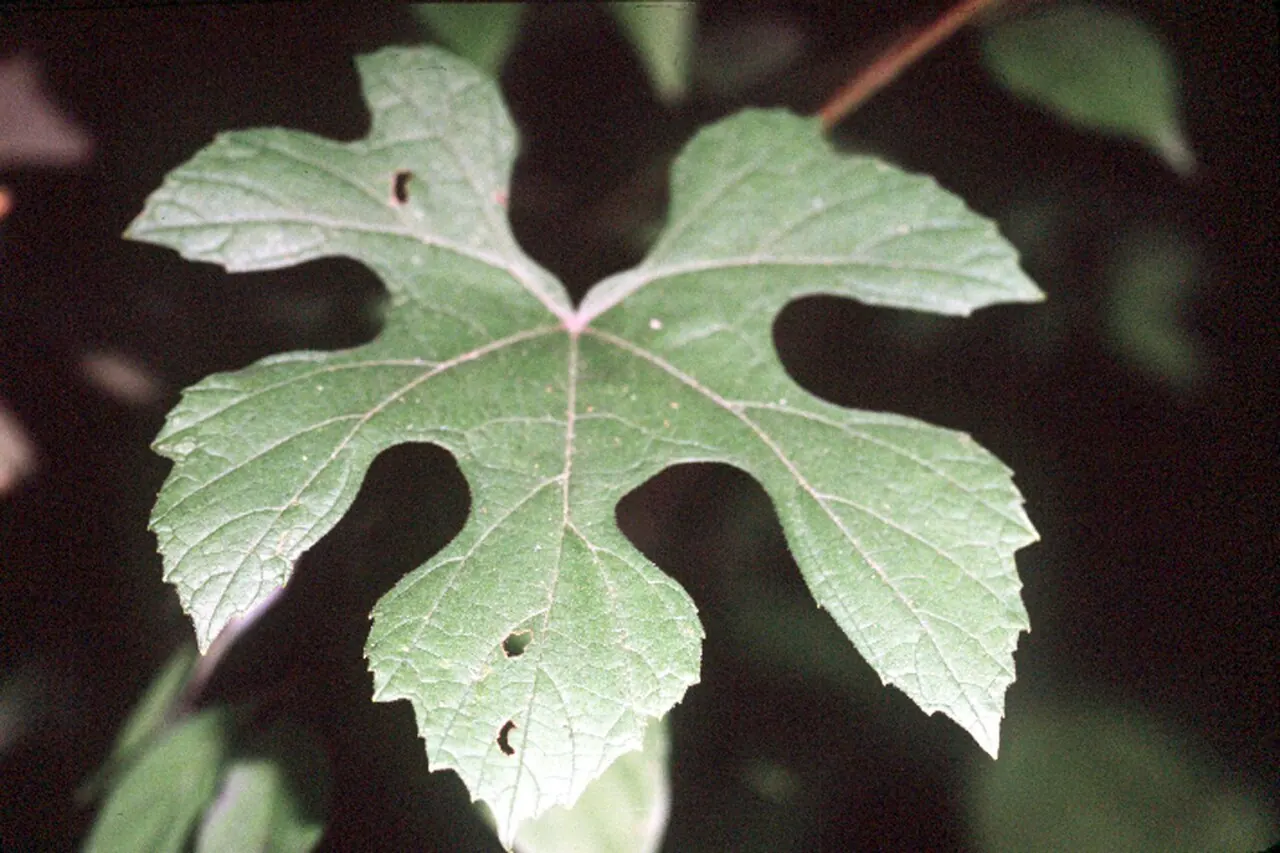
Alternate, simple, large (10–20 cm), broadly ovate to nearly orbicular in outline, palmately 3- to 5-lobed with shallow to deep sinuses and a coarsely toothed margin. Upper surface dark green and smooth at maturity. The diagnostic feature is the underside: densely covered in a rust-colored to bluish felt (tomentum) of branched hairs that does not rub off easily — no other native grape in our region has this rusty wool. Var. bicolor shows a more silvery, glaucous bloom beneath.

Tendrils & Flowers

Tendrils are intermittent — present opposite two leaves in a row, then absent at every third leaf. This skip-a-node pattern separates true grapes (Vitis) from Ampelopsis (peppervine, porcelainberry), whose tendrils are continuous. Flowers are tiny, greenish, fragrant, in branched panicles 7–15 cm long, opening late May–early June. Functionally dioecious in many populations — a male vine nearby improves fruit set on a female.

Fruit

Loose to moderately tight clusters of small (8–12 mm) round berries, glaucous purple-black at maturity in late August through September. Skins are thick, flesh is sparse but intensely flavored — tart-sweet with a distinct musky “foxy” aroma weaker than that of V. labrusca (Concord), and a long, complex finish that explains why Norton/Cynthiana selections make serious wine. Each berry contains 2–4 hard pyriform seeds.

Habitat & Range in NE Oklahoma

Summer Grape is the most frequently encountered native grape across the eastern half of Oklahoma. Look for it draped through fencerow elms and hackberries, climbing into bottomland sycamores and pecans along the Arkansas, Verdigris, Caney and Illinois rivers, and threaded through the post-oak/blackjack canopy of the Cross Timbers. It thrives in the half-shaded woodland edge — gaps, recently disturbed forest, river terraces, and abandoned pastures — rather than in deep interior forest. Its range covers all of the eastern half of the United States; in Oklahoma it drops out west of about the I-35 corridor, where it is replaced by V. mustangensis (Mustang Grape).

On Tulsa-area properties you will find it most often in the rough margin where mowed pasture meets brush, scrambling through Osage orange and elm. Where the surrounding land has been kept open, vines that climbed a young fencerow tree decades ago can now cover the entire crown and produce huge crops in August.

Ecology & Wildlife Value

[ pollinators · larval hosts · seed dispersers · trophic role ]

Pollinators

Flowers are small and unshowy but produce abundant nectar and a sweet fragrance noticeable on still June evenings. Visited primarily by small native bees, syrphid flies and beetles; honeybees work them when little else is in bloom. Wind also moves a portion of the pollen on dioecious vines. Pollination is rarely the limiting factor — presence of a male vine within bee-flight is.

Lepidoptera Hosts

A keystone host for the Sphingidae (sphinx / hawk moths) of eastern North America. Documented larvae include the Pandorus Sphinx (Eumorpha pandorus), Achemon Sphinx (Eumorpha achemon), Virginia Creeper Sphinx (Darapsa myron), Hog Sphinx / Vine Sphinx (Eumorpha vitis, Eumorpha fasciatus), grapeleaf skeletonizer and the eight-spotted forester moth. Adult sphinx moths are the hummingbird-sized pollinators of moonflower, four-o’clocks and many native white tubular flowers. No native grape, no Pandorus Sphinx.

Birds & Mammals

Wild grape is one of the highest-ranked wildlife food plants in eastern North America. The fruit is eaten by over 100 bird species, including wild turkey, ruffed grouse, Northern bobwhite, cedar waxwing, Eastern bluebird, Northern mockingbird, brown thrasher, pileated and red-bellied woodpeckers, gray catbird, Baltimore and orchard orioles, summer tanager, and most thrushes. Mammals include raccoon, opossum, gray and fox squirrel, white-tailed deer, red and gray fox, and black bear. Dense vine tangles provide first-rate nesting and escape cover for songbirds and small mammals.

Pests & Forest Function

The chief insect pest is Japanese beetle (Popillia japonica), which can skeletonize foliage in mid-summer — tolerable on a wild vine, more of a problem on cultivated arbors. Excessively vigorous vines can engulf and shade out small host trees, especially in long-undisturbed fencerows; this is a normal successional dynamic in unmanaged second-growth woods rather than a pathology. In a designed planting it must be controlled.

Why this vine matters: Few native plants in our region carry the wildlife load that a mature wild grape does. The same vine that feeds the Eumorpha sphinx caterpillars in July ripens fruit that supports 100+ bird species in September. And the wine-grape selection from this species — Norton/Cynthiana — remains the only American native to produce a dry red wine of internationally-recognized quality. Heritage worth keeping.

Horticulture & Care

[ siting · arbor · pruning · propagation · pests · cultivars ]

Site selection & structure

Plant in full sun if the goal is fruit; partial shade gives a handsome vine but few clusters. Soil should be deep, well-drained, and on the slightly acid side (pH 5.5–7.0) — the same conditions that suit upland post-oak and hickory. Avoid heavy poorly-drained clay and avoid bottoms that hold standing water. Most importantly, build a real arbor or dedicate a sturdy fence: a mature aestivalis vine is heavy enough to pull down a flimsy trellis after a few seasons. A 4×4 cedar post arbor with galvanized cable or a stout woven-wire fence are appropriate. Do not let it climb fruit trees, oaks, or anything you value — see the warning below.

Planting, water & mulch

Pruning — the make-or-break step

Wild grape fruits on the current season’s shoots, which arise from one-year-old wood. A vine left unpruned reverts in a few seasons to a sprawling green mass with fruit only at the unreachable top. Prune heavily in late winter (February in Tulsa, before sap rise — a pruned vine in March will “bleed” harmlessly but copiously). Two standard systems work:

Either way, expect to remove 80–90% of last year’s wood annually. This looks brutal; the vine doesn’t mind.

Propagation

Pests & diseases

Cultivars & native species comparison

Vitis aestivalis var. bicolor is the parent of two famous selections usually treated as one: 'Norton' (selected by Dr. Daniel Norton of Richmond, Virginia in the 1820s) and 'Cynthiana' (an Arkansas selection long sold under both names). Modern DNA work confirms they are essentially the same vine. Norton/Cynthiana is the state grape of Missouri and was the basis of an antebellum wine industry that, before Prohibition, out-produced California; the wine is dry, deep-purple, tannic and unmistakably American.

Native grape Habitat in OK Diagnostic feature Notes
V. aestivalis (Summer Grape) Eastern half; woodland edge, river terraces Rust felt under leaves; intermittent tendrils; brown nodal diaphragm Norton/Cynthiana wine grape; the workhorse native here.
V. riparia (Riverbank Grape) Stream banks statewide; cooler/northern niche Leaves not tomentose below; thinner; long-pointed lobes Cold-hardy; the rootstock used worldwide against phylloxera.
V. mustangensis (Mustang Grape) Central & SW OK, S to TX Hill Country Heavy white wool below leaves; large clusters; sap caustic to skin The grape of central/west OK; juice burns — wear gloves.
V. vulpina (Frost / Winter Grape) Bottomland woods, eastern OK Glabrous leaves; small black berries that sweeten only after frost Often confused with riparia; ripens latest of all.
V. cinerea (Graybark Grape) Bottomland woods, far E. OK Gray cobwebby pubescence on shoots; small berries Less common locally; ecological role similar to aestivalis.
Caution — structural threat to host trees: A wild Vitis aestivalis left to climb a small or medium tree will, over years, shade the host’s canopy and add enough wind-load to tear out major limbs in ice storms. Site grape on a dedicated arbor or fence; never let it climb fruit trees, young oaks, or specimen trees. If you inherit one growing into a tree you want to save, cut the vine’s base in winter; the dead vine will fall out of the canopy over the next season. Do not pull live vines down by hand — you will pull live limbs with them.
Edible & Cultural Uses

Summer Grape has been used by every culture that lived within its range:

The Norton/Cynthiana story: Missouri made more wine than California in the years before Prohibition, almost entirely from Norton, a seedling of V. aestivalis var. bicolor. Prohibition destroyed the industry; the rootstocks Missouri shipped to France in the 1870s, however, saved the European wine industry from phylloxera. When you plant a summer grape on an arbor in Tulsa you are participating in that lineage.

Photo Reference

Vitis aestivalis foliage — palmately lobed leaves of summer grape
// Foliage · 3–5 palmate lobes · coarse marginal teeth
Wikimedia Commons
Wikimedia Commons
Vitis aestivalis underside of leaf showing rust-colored tomentum
// Leaf underside · rust-colored tomentum (the diagnostic)
Wikimedia Commons
Wikimedia Commons
Botanical illustration of Vitis aestivalis showing leaves, tendrils and fruit cluster
// Botanical plate · leaf · tendril · panicle · cluster
Wikimedia Commons
Wikimedia Commons
Historical 1913 illustration of Vitis aestivalis as the southern wine grape
// 1913 plate — "the southern wine grape" (Norton heritage)
Wikimedia Commons
Wikimedia Commons

Sources & Further Reading

  • USDA NRCS PLANTS Database — Vitis aestivalis: plants.usda.gov/plant-profile/VIAE
  • USDA Forest Service Fire Effects Information System (FEIS) — Vitis: fs.usda.gov/database/feis/plants/vine/vitspp
  • Lady Bird Johnson Wildflower Center — Native Plant Database: wildflower.org — VIAE
  • Missouri Department of Agriculture — Norton, Missouri's State Grape; Missouri Wine & Grape Board historical materials.
  • Reisch, B. I., Owens, C. L., & Cousins, P. S. (2012). Grape. In Fruit Breeding (Springer) — chapter on Norton/Cynthiana ancestry and DNA confirmation.
  • Oklahoma Biological Survey — Atlas of the Vascular Plants of Oklahoma, Vitis distribution maps.
  • Tallamy, D. W. (2007). Bringing Nature HomeVitis ranked among top Lepidoptera-supporting woody genera in the East.
  • Martin, A. C., Zim, H. S., & Nelson, A. L. (1951). American Wildlife and Plants: A Guide to Wildlife Food Habits — documents 100+ bird species using wild grape.
  • Wikipedia — Vitis aestivalis: en.wikipedia.org/wiki/Vitis_aestivalis (CC BY-SA 4.0; portions of the description, ecology and uses sections summarize Wikipedia content).
  • Wikipedia — Norton (grape): en.wikipedia.org/wiki/Norton_(grape).

Photos courtesy of Wikimedia Commons contributors under their respective licenses (linked under each image). Hero photo USDA NRCS PLANTS Database, public domain.

Companion Planting

[ guild · polyculture · cross-layer pairings ]

In a hedgerow or thicket, summer grape pairs naturally with: downy hawthorn (Crataegus mollis), american beautyberry (Callicarpa americana), aromatic aster (Symphyotrichum oblongifolium), cosmos (Cosmos bipinnatus), maypop / passionflower (Passiflora incarnata), and eastern redcedar (Juniperus virginiana).

Train summer grape onto a sturdy host such as a hedgerow shrub or arbor; combine with low groundcovers below.