home/ plants/ downy-hawthorn

// SPECIES PROFILE · TREE · NATIVE

Downy Hawthorn

Crataegus mollis

The most common native hawthorn across NE Oklahoma — and one of the most underused four-season small trees in the Tulsa-region landscape palette. Crataegus mollis (also called Red Haw or Summer Haw) is a 20–40 ft Cross Timbers native that delivers a heavy flush of large white flowers in April, ripens its big red haws earlier than any other native hawthorn (mid-August through early September), feeds 25+ bird species, and finishes the year as a thorny, sculptural winter form holding persistent fruit. Diagnostic feature: the leaf undersides are noticeably downy — soft and pubescent — which is exactly what mollis means.

// QUICK FACTS
Family
Rosaceae (rose family; pome fruit)
Native range
E. North America: SE North Dakota → Nova Scotia, SW to E. Texas & AZ
Status in NE OK
Common native of Cross Timbers edges, bottomland fringes & fence rows
USDA hardiness
Zones 4–8 (Tulsa = 7a/7b)
Mature size
20–40 ft tall · 25–30 ft spread
Habit
Small tree, broad rounded crown, often single-trunked
Thorns
Stout, 1–2 in long — gloves required
Bloom
April (NE OK); among the earliest hawthorns to flower
Flower
White, 5-petaled, ~1 in across, ~20 stamens, in flat clusters
Fruit (haws)
Bright red pomes, up to 1 in diameter, ripe Aug–early Sept
Sun
Full sun → part shade
Soil
Well-drained loam preferred; very adaptable
Wildlife
Heavy bee/butterfly nectar · 25+ bird species eat haws · songbird nesting cover
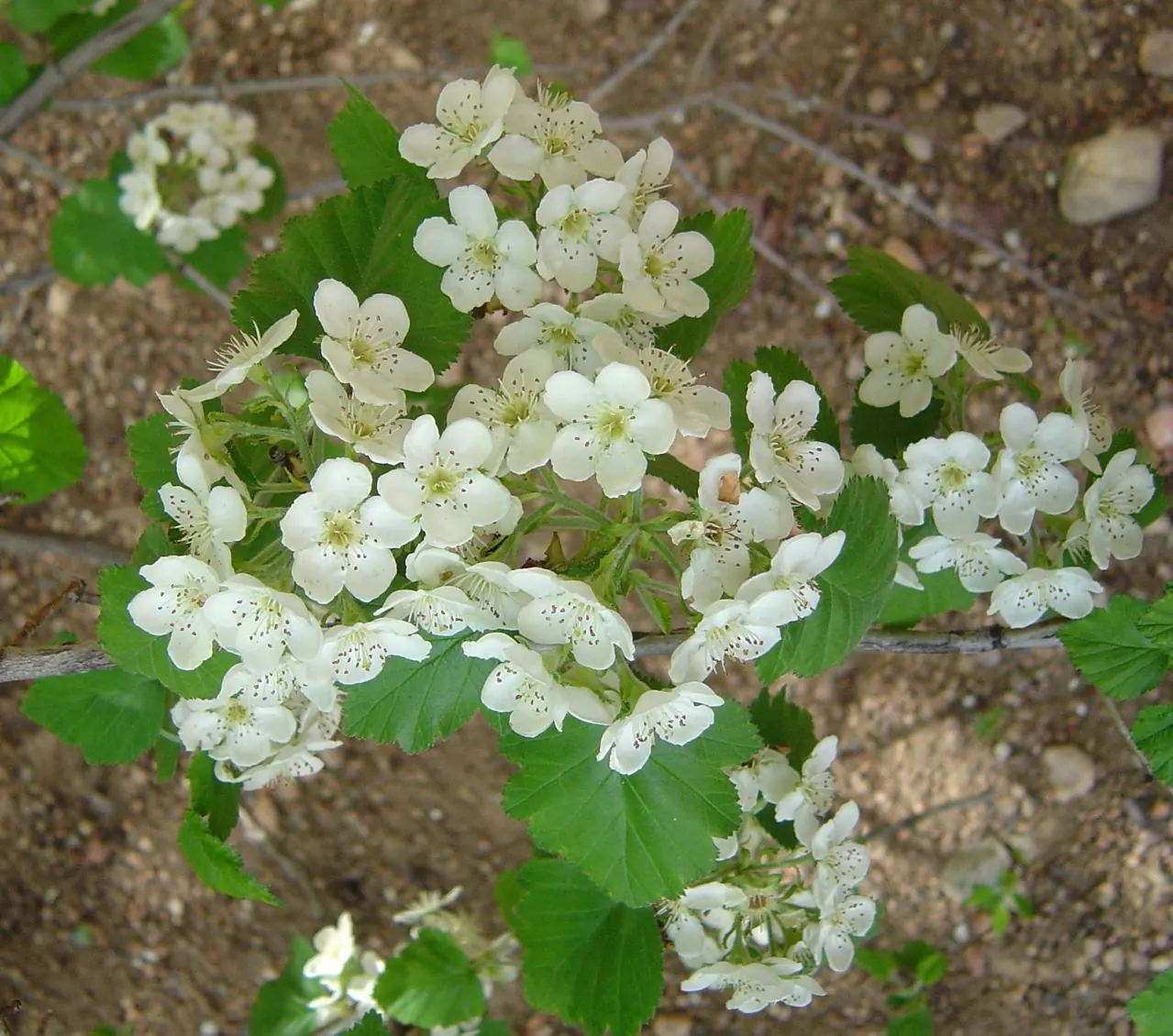
Downy Hawthorn (Crataegus mollis) in full white flower in spring
Crataegus mollis in spring bloom — large white 5-petaled flowers in flat clusters, each with ~20 prominent stamens, a Rosaceae signature. Photo: Wikimedia Commons (Crataegus-mollis-flowers.jpg).

Identification

[ field key — bark · leaf · flower · fruit · habit ]

Habit, Bark & Thorns

Small tree, typically 20–40 ft, with a broad rounded crown on a single short trunk — the most tree-like silhouette of any common native hawthorn. Bark gray to ash-brown, scaly, breaking into small rectangular plates that flake to reveal lighter under-bark. Branches armed with stout, straight thorns 1–2 in long (sometimes longer on vigorous shoots) — sharp, woody, and a serious hazard. Wear leather gloves any time you prune or harvest.

Leaves — the Diagnostic

Alternate, simple, broadly ovate to nearly orbicular, 5–10 cm long, with a coarse, broadly toothed (sometimes shallowly lobed) margin and 4–5 vein pairs. The diagnostic feature is that the undersides are conspicuously downy — soft, white-pubescent when young, less so but still felted at maturity. (Mollis is Latin for "soft.") Often drop in late summer from leaf-rust defoliation; the tree tolerates this annual stripping with little vigor loss.

Flowers

Large white 5-petaled flowers ~1 in across, borne in flat terminal corymbs of 5–15 in mid-April (NE OK) — among the earliest hawthorns to bloom. Each flower carries roughly 20 stamens with pink-to-rose anthers, the key technical character separating C. mollis from the closely related C. submollis (which has ~10 stamens). A heavy nectar / pollen flow visited by native bees, honeybees, syrphid flies, beetles, and early butterflies.

Fruit (Haws)

Large, bright red pomes (haws) up to 1 in across, short-pubescent when young, ripening mid-August through early Septemberthe earliest of any native hawthorn to ripen, and the source of the regional name "Summer Haw." Each haw contains 4–5 hard nutlets. Drops quickly once ripe; what remains after birds finish hangs into early winter on the bare downy undersides of the canopy.

Habitat & Range in NE Oklahoma

Downy Hawthorn ranges across the entire eastern half of the United States — from southeastern North Dakota east to Nova Scotia and southwest to eastern Texas and Arizona — and is the most common native hawthorn throughout E. and central Oklahoma. It inhabits wooded bottomlands, woodland edges, stream banks, the prairie border, and midwest savanna understory, and tolerates a wide range of soils from rich alluvial loam to rocky upland clay.

In NE Oklahoma you find it most reliably in the Cross Timbers transition zones — the brushy edges where post oak / blackjack oak woodland meets tallgrass prairie or bottomland forest — and along the lower terraces of the Arkansas, Verdigris, Caney, and Bird Creek drainages. Old fence rows, abandoned pastures, and the rough margins of pecan bottoms are reliable spots. Despite being so common in the wild, it is almost absent from the local landscape trade, which leans on imported ornamental hawthorns (C. phaenopyrum, C. viridis 'Winter King') instead.

Ecology & Wildlife Value

[ pollinators · larval hosts · birds · structural cover ]

Pollinators

The genus Crataegus is one of the great pollinator genera of eastern North America, and downy hawthorn carries its share. The April bloom is heavily visited by native bees (mining bees, sweat bees, mason bees, bumblebees), honeybees, syrphid flower-flies, soldier beetles, and early-season butterflies. Hawthorns are most effectively pollinated by short-tongued generalists because the open dish-shaped flower presents nectar on an exposed disc around the 20-stamen ring.

Lepidoptera Hosts

Larval host for several native lepidoptera, including the red-spotted purple butterfly (Limenitis arthemis astyanax), multiple hairstreaks (Satyrium spp.), the striped hairstreak and gray hairstreak, the cecropia moth, polyphemus moth, several underwings (Catocala spp.), and incidentally the gypsy moth where it occurs. Tolerate the leaf damage — a hawthorn that defoliates partially in August is doing exactly what it is supposed to do in a working ecosystem.

Birds & Mammals

The big early-ripening haws are eaten by 25+ bird species, among them cedar waxwings, American robins, northern mockingbirds, brown thrashers, eastern bluebirds, ruffed grouse, wild turkey, and several thrushes and sparrows. Fox squirrels, raccoons and white-tailed deer take dropped fruit; deer also browse the foliage lightly. The dense thorny crown is premier nesting cover for shrike, mockingbird, brown thrasher, and many sparrows — the thorns physically exclude most nest predators.

Structural & Successional Role

Mid-successional small tree of woodland edges and old-field reclamation, bridging early shrubland (sumac, plum, elderberry) and the eventual oak-hickory canopy. Functions as a protective nurse plant: the thorns shelter oak and hickory seedlings from deer browse, and the leaf litter is fast-decomposing and near-neutral. In a designed landscape it occupies the same ecological slot as a serviceberry or chickasaw plum — understory layer, wildlife magnet, multi-season interest.

Wildlife & medicinal note: The big red haws of C. mollis are recorded in the diet of 25+ North American bird species, and the genus Crataegus as a whole is one of the most evidence-based herbal medicines in Western practice — Crataegus extracts (leaf, flower and fruit) are widely used as cardiovascular tonics, with multiple controlled trials showing modest benefit for symptoms of mild congestive heart failure (NYHA class II) and supportive effects on blood pressure.

Horticulture & Care

[ planting · soil · water · pruning · pests · cautions ]

Site selection & planting

Downy hawthorn is small enough for a residential lot, transplants well as B&B or container stock, and tolerates a remarkably wide range of soils including the heavy clays common around Tulsa. Best growth is in full sun to part shade on well-drained loam, but it performs acceptably on rocky upland sites and on bottomland clays that occasionally flood. Plant in fall or early spring while dormant.

Water & soil after establishment

Mature trees are notably drought-tolerant in the Tulsa region. Annual late-summer leaf drop from rust is normal and not a watering problem — do not overwater in response to it. One deep soak during prolonged August–September drought keeps fruit set high and reduces stress.

Pruning

Light. Prune in late winter while dormant, before flowering, removing dead, crossing, or rubbing branches and any low branches that interfere with mowing. Maintain a single leader for tree form. Avoid heavy heading cuts — hawthorns respond with congested watersprout regrowth. Make small, clean cuts: large pruning wounds are the typical entry point for fire blight cankers.

Pests & diseases — the rust caution

Propagation

Related & comparable hawthorns for the Tulsa landscape

Species Native? Distinguishing feature Notes for Tulsa
Crataegus mollis (Downy Hawthorn) Yes — common in NE OK Large red haws, downy leaf undersides, ~20 stamens The native default. Earliest haws to ripen; best for wildlife.
C. crus-galli (Cockspur Hawthorn) Yes Glossy unlobed leaves; very long (2–3") thorns Tough urban tree; thornless cv. inermis often planted.
C. viridis 'Winter King' (Green Hawthorn) Yes (species) Few thorns; persistent orange-red fruit through winter Most-planted ornamental hawthorn in OK; rust-resistant.
C. phaenopyrum (Washington Hawthorn) Yes (species) Small lustrous maple-like leaves, small red fruit Common in nurseries; rust-susceptible; later bloom than C. mollis.
C. marshallii (Parsley Hawthorn) Yes (SE U.S.) Deeply dissected parsley-like leaves Smaller, more shrub-like; specimen tree for partial shade.
C. submollis Yes (NE U.S., not OK) Very similar to C. mollis but ~10 stamens vs 20 Allopatric; counts of stamens are the field key.

Companion planting in a food forest or hedgerow

Pairs well with: chickasaw plum and American plum for thicket structure and overlapping early bloom, serviceberry for the same April pollinator window, elderberry and American beautyberry in the shrub layer, and any native warm-season grass / forb mix beneath. Use as a thorny outer-row defender in a wildlife hedgerow — the stout thorns deter deer and shelter songbird nests inside the planting. Avoid siting near eastern redcedar (rust) or near apple, pear or quince orchards (shared fire blight inoculum).
Edible, Medicinal & Cultural Uses

Downy hawthorn is widely considered one of the better-tasting native haws — the fruit is large, fleshy, sweet-tart, and rich in pectin. The genus also has serious documented medicinal use.

Cautions for downy hawthorn in the landscape:
1. Cedar-hawthorn rust: Eastern Redcedar (Juniperus virginiana) is the alternate host. Do not plant downy hawthorn within ~1000 ft of established redcedar if clean foliage matters to you — in NE Oklahoma this is a real planning constraint.
2. Stout thorns 1–2 inches long: A genuine hazard. Wear leather gloves when pruning or harvesting, keep the tree at least 6 ft off pedestrian paths, and do not site over a children's play area.
3. Fire blight susceptible: Like all Rosaceae — avoid heavy nitrogen fertilization and prune only in dry weather with sterilized tools.
4. Medicinal use: Crataegus extracts have real cardiovascular effects and can interact with prescription heart medication. Consult a clinician before therapeutic use.

Photo Reference

Crataegus mollis — flowering habit
// Crataegus mollis — flowering habit
Wikimedia Commons
Crataegus mollis — foliage & form
// Crataegus mollis — foliage & form
Wikimedia Commons
Crataegus mollis — flower detail
// Crataegus mollis — flower detail
Wikimedia Commons
Crataegus mollis — in habitat
// Crataegus mollis — in habitat
Wikimedia Commons
Crataegus mollis — fruit / seed
// Crataegus mollis — fruit / seed
Wikimedia Commons

Sources & Further Reading

  • USDA NRCS PLANTS Database — Crataegus mollis: plants.sc.egov.usda.gov/plant-profile/CRMO2
  • Lady Bird Johnson Wildflower Center — Native Plant Database, Crataegus mollis: wildflower.org — CRMO2
  • Missouri Botanical Garden Plant Finder — Crataegus mollis (Downy Hawthorn).
  • Flora of North America — Crataegus mollis (Phipps, J.B., 2015): efloras.org — FNA treatment
  • Phipps, J.B., O'Kennon, R.J., Lance, R.W. (2003). Hawthorns and Medlars. Royal Horticultural Society / Timber Press — standard taxonomic reference for the genus.
  • Sternberg, G. (2004). Native Trees for North American Landscapes, p. 264. Timber Press.
  • Palmer, E. (1946). "Crataegus in the Northeastern and Central United States and Adjacent Canada." Brittonia 5(5): 471–490.
  • Davis, W. & Rose, R.C. (1912). "The Effect of External Conditions Upon the After-Ripening of the Seeds of Crataegus mollis." Botanical Gazette 54(1): 49–62 — the classic seed-dormancy paper.
  • Pittler, M.H., Guo, R., Ernst, E. (2008). "Hawthorn extract for treating chronic heart failure." Cochrane Database of Systematic Reviews — cardiovascular evidence base for Crataegus extracts.
  • Wikipedia — Crataegus mollis: en.wikipedia.org/wiki/Crataegus_mollis (CC BY-SA 4.0; portions of the description, range and ecology sections summarize Wikipedia content).

Photos courtesy of Wikimedia Commons contributors under their respective licenses (linked under each image). Hero photo: Wikimedia Commons, Crataegus-mollis-flowers.jpg.