Ecology & Wildlife Value
[ pollinators · birds · mammals · soil ]
Pollinators & insects
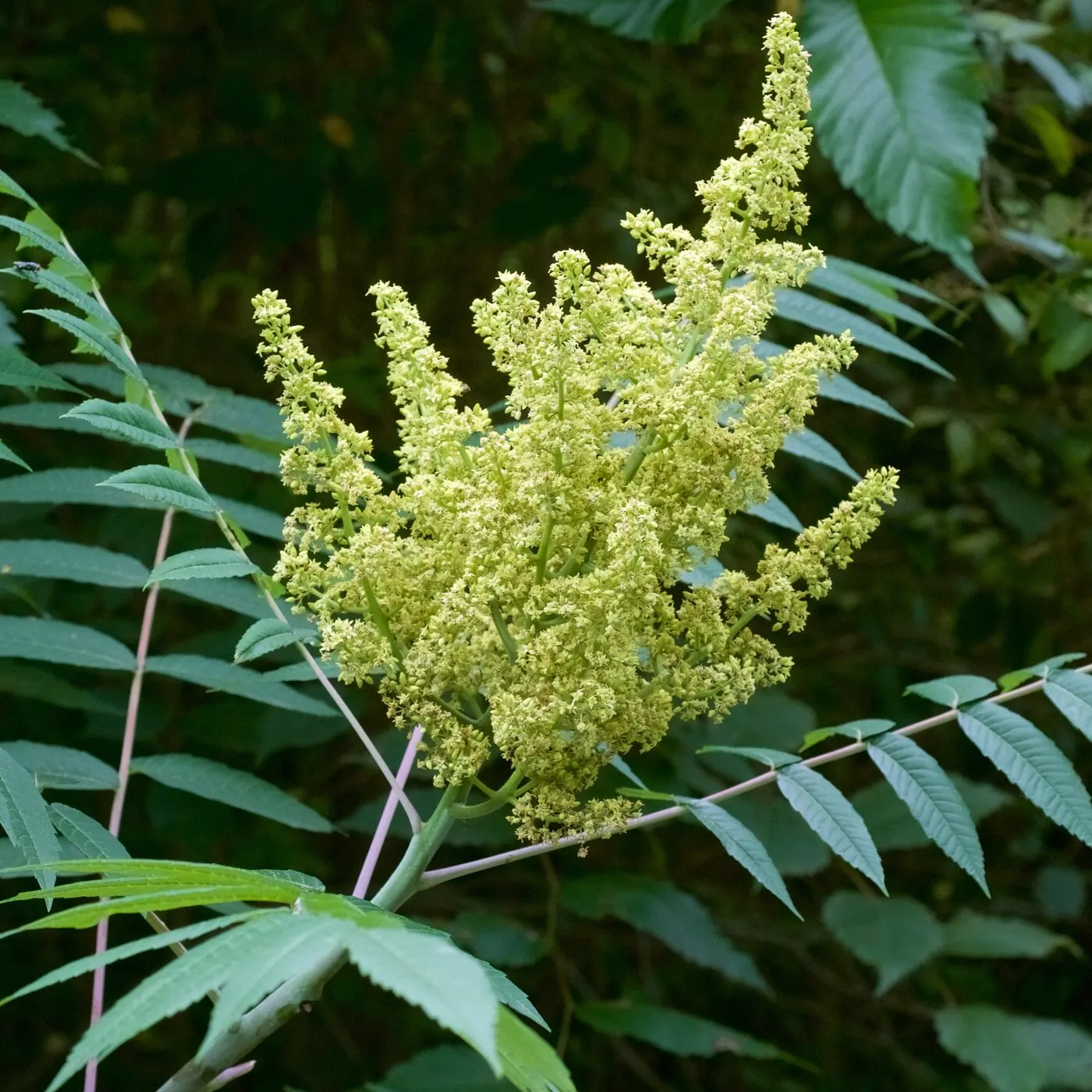
Sumac panicles in June and early July are among the most
densely-visited flowers of any regional native shrub.
Documented visitors include native bees in the genera Andrena
and Lasioglossum, honey bees, syrphid flies, soldier beetles,
longhorned beetles, paper wasps, hoverflies, and many more. Sumac is a
minor but useful nectar/pollen source during the early-summer
pollinator-floral gap between spring tree bloom and late-summer prairie
forb bloom. Rhus glabra is also documented as larval host for
several lepidoptera, including the red-banded hairstreak
(Calycopis cecrops) and various luna and underwing moths.
Birds & mammals
The fruit drupe clusters are an important winter starvation
food for at least 30 bird species in NE Oklahoma, including
eastern bluebird, northern cardinal, robin, mockingbird, brown thrasher,
cedar waxwing, downy and red-bellied woodpecker, ruffed grouse, wild
turkey, and bobwhite quail. Drupes are low in fat and high in tannins
— not a preferred food, but they remain on the plant when little
else does, making them a critical late-winter resource. Cottontail and
white-tailed deer browse twigs and bark in winter; small mammals
nest in the dense thicket cover.
Hedgerow & succession
Sumac is a defining species of the old-field-to-woodland
successional sere in NE Oklahoma. After cropland or pasture
abandonment, sumac and persimmon (Diospyros virginiana) are
typically the first woody species to colonize, forming dense clonal
thickets within 5–15 years. Under continued protection from fire
and grazing, oak and hickory eventually overtop sumac and shade it out
over 30–60 years. The transient sumac thicket stage is critically
important habitat for shrubland-dependent birds (yellow-breasted chat,
bell's vireo, brown thrasher, field sparrow) that have declined as
midwestern field-edge habitat has been lost.
Soil & site recovery
The dense fibrous root system of clonal sumac stands is unusually
effective at stabilizing eroding slopes — road
cuts, washouts, and reclaimed strip-mine spoils across eastern Oklahoma
are commonly stabilized by spontaneous sumac colonies within a decade.
The leaf litter is moderately rich in tannins and decomposes more slowly
than oak; sumac is not a major soil-building species, but the closed
canopy of an established thicket suppresses bare-soil conditions and
initiates soil recovery on extremely degraded sites where almost
nothing else will grow.
Sumac is NOT poison ivy / poison oak / poison sumac:
Rhus glabra, R. copallinum, and R. typhina are all
safe to handle and yield edible drupes. The toxic urushiol-bearing
members of Anacardiaceae are now placed in the separate genus
Toxicodendron: poison ivy (T. radicans), poison oak
(T. pubescens), and poison sumac (T. vernix). The reliable
field rule: red, upright, dry fruit cluster = edible Rhus; white,
drooping, waxy fruit = toxic Toxicodendron.
Clonal aggression: Smooth sumac is one of the more aggressive
clonal shrubs in regional plantings. A single plant can spread 15–20+
ft in a decade via root suckers, and excavating an established colony is
difficult. Site it where its spread is welcome (hedgerow, naturalized edge,
erosion control, screening), or contain it with mowing, root barriers, or
annual cutting of suckers.