home/ plants/ blackjack-oak

// SPECIES PROFILE · TREE · NATIVE

Blackjack Oak

Quercus marilandica

With post oak, blackjack is one of the two definitive trees of the Cross Timbers — the band of ancient, fire-shaped oak savanna that runs straight through northeastern Oklahoma. A gnarled, dark-barked, drought-hardened red oak that rarely tops 40 ft, it specializes in the worst ground in the region: thin sandstone and chert ridges, acidic uplands, droughty south-facing slopes where almost no other tree will grow. Recognize it by the heavy 3-lobed bell-shaped leaves, the almost-black blocky bark, and the dead leaves still hanging in February (marcescence) — the tan-brown silhouette every Tulsa hiker knows from Turkey Mountain and Keystone Ancient Forest.

// QUICK FACTS
Family
Fagaceae (oak / beech)
Section
Quercus sect. Lobatae (red-oak group)
Native range
E. & C. United States: NY & NJ → FL, west to TX, OK, KS, NE
OK variety
var. ashei (western Cross Timbers form)
USDA hardiness
Zones 6–9 (Tulsa = 7a/7b)
Mature size
30–50 ft tall · ~15 in trunk diameter (Cross Timbers)
Growth rate
Slow; long-lived (often 150+ yrs on poor sites)
Sun
Full sun (xeric specialist)
Soil
Poor, dry, acidic sandstone, chert, or sand; pH 4.5–6.5
Water
Low — rots in irrigated lawns
Acorns
Small (12–20 mm), red-oak group, mature in 2nd year
Winter trait
Marcescent — holds dead leaves into spring
Wildlife
Turkey · deer · squirrel · jay mast; many lepidoptera larvae
Mature blackjack oak (Quercus marilandica) showing dark blocky bark and broad irregular crown
Quercus marilandica — the twisted, dark-barked silhouette that defines NE Oklahoma's upland Cross Timbers ridges. Photo: Wikimedia Commons (CC BY 2.0).

Identification

[ field key — bark · leaf · acorn · habit · winter ]

Habit & Bark

A small to medium tree, typically 30–50 ft tall in the Cross Timbers with a stout, often crooked trunk and a low, wide-spreading, irregular crown of heavy, twisting branches. Dead branches persist on the lower trunk for years — a hallmark of the species. Bark is the most diagnostic feature in any season: very dark grey to nearly black, broken into small, hard, rectangular blocky plates separated by narrow orange-brown fissures — distinctly different from the lighter grey, scaly bark of post oak growing right beside it.

Leaves

Alternate, simple, thick and leathery, 7–20 cm long. Shape is unmistakable: a broad, three-lobed bell or wedge — narrow at the petiole, flaring abruptly to a wide, shallowly-3-lobed apex with each lobe tipped by a tiny bristle (the red-oak group signature). Often described as paddle- or club-shaped. Upper surface dark glossy green, underside brown-pubescent. Fall color a dull red-brown to leather-brown, and crucially the leaves remain attached through winter (marcescent) — rattling on the branches into March.

Acorns

Small for an oak: 12–20 mm long, 10–18 mm broad, ovoid to nearly round, light brown often with darker stripes. The cup is deep and bowl-shaped, covering 1/3 to 1/2 of the nut, with loose, reddish, pubescent scales. Like all members of the red-oak group, acorns take 18 months (two growing seasons) to mature — you'll see this year's pinhead acorns and last year's mature acorns on the same twig in summer. Heavy mast crops occur every 2–3 years.

Distinguishing from post oak

Blackjack and Quercus stellata grow intermixed on the same ridges, so learning the pair together is the single most useful skill in NE OK upland botany. Post oak has lighter grey, scaly (not blocky) bark, a 5-lobed cross- or T-shaped leaf with rounded lobes and no bristles (white-oak group), and acorns that mature in one season. Blackjack has black blocky bark, a 3-lobed bristle-tipped bell-shaped leaf, and 2-year acorns. Both are marcescent in winter.

Habitat & Range in NE Oklahoma

Blackjack oak's native range stretches from Long Island and southern New Jersey south to Florida and west across the southern Great Plains to eastern Texas, Oklahoma, southern Kansas, and southeastern Nebraska. Throughout that range it is a specialist of the poorest, driest, most acidic upland sites — sandstone outcrops, chert glades, sand barrens, and shallow rocky soils where more competitive trees can't establish. It is genuinely difficult to find a blackjack growing on rich bottomland; that is post oak's signature, too.

In northeastern Oklahoma blackjack is a co-dominant of the Cross Timbers, the semi-savanna belt of post oak – blackjack forest interspersed with tallgrass prairie that sweeps from southern Kansas through OK into north-central Texas. Oklahoma Forestry Services formally classifies this as the Post Oak–Blackjack Forest type — the largest forest type in the state by area. Locally you can stand inside it on almost any unimproved upland ridge: Turkey Mountain on the west bank of the Arkansas in Tulsa, the Keystone Ancient Forest in Sand Springs (where some post oaks and blackjacks are over 400 years old), the wooded edges of the Tallgrass Prairie Preserve in Osage County, and the entire Osage–Pawnee–Creek county uplands. The western variety found here, var. ashei, is somewhat smaller and even more drought-tolerant than eastern populations.

Ecology & Wildlife Value

[ mast crop · larval hosts · fire ecology · structural role ]

Acorn mast

Despite the small size of individual acorns, a mature blackjack in a good year produces a heavy crop that is critical winter food for wild turkey, white-tailed deer, fox and gray squirrel, blue jay (a key acorn disperser), wood duck, and several woodpeckers. Because red-oak acorns are higher in tannins and can be cached longer than white-oak acorns without sprouting, blackjack mast is disproportionately important as late-winter food — after post oak and white oak acorns have already germinated or been eaten.

Lepidoptera hosts

Like all native oaks, blackjack is a top-tier larval host plant: Doug Tallamy's research credits Quercus as the genus supporting more butterfly and moth species in North America than any other woody plant. Blackjack specifically hosts Banded Hairstreak (Satyrium calanus), Edwards' Hairstreak (S. edwardsii), Horace's Duskywing (Erynnis horatius), Juvenal's Duskywing (E. juvenalis), the imperial moth, polyphemus moth, and many underwings (Catocala spp.) — the food base that ultimately feeds nestling songbirds across the Cross Timbers.

Fire & structural role

The Cross Timbers are a fire-maintained ecosystem. Both post oak and blackjack are exceptionally fire-tolerant once mature: thick bark, deep root systems, and vigorous stump-sprouting after top-kill. Many of the gnarled, multi-trunk blackjacks you see on Tulsa-area ridges are sprout-origin trees on root systems that may be centuries older than the visible trunk. The species' tolerance of fire, drought, and the cattle grazing that replaced fire after settlement is why so much old-growth Cross Timbers forest still exists — it survived because the wood was too crooked to log.

Companions

On NE OK ridges blackjack co-occurs with post oak (Q. stellata), black hickory (Carya texana), winged elm (Ulmus alata), eastern redcedar (where fire has been suppressed), with an understory of fragrant sumac, coralberry, and a rich grass / forb layer dominated by little bluestem (Schizachyrium scoparium) on the open glades. On the Ouachita fringe to the south it associates with shortleaf pine; on the Ozark plateau it forms scrub stands on chert glades.

Restoration role: If you are restoring a NE Oklahoma upland site — especially one with thin rocky soil, southern exposure, or a history of grazing — blackjack belongs there as a companion to post oak. The two are an obligate visual and ecological pair across the Cross Timbers. Plant them together; never separate them in a restoration design.

Horticulture & Care

[ site selection · planting · water · pruning · sourcing ]

Site selection & planting

Blackjack oak is the opposite of a "landscape tree." It will not thrive in an irrigated lawn — rich soil, regular water, and high pH all stress it, and root rot from over-watering is the most common cause of death in cultivation. Think of it as a restoration tree, not a specimen tree: place it on the driest, rockiest, most neglected corner of the property, on a slope or ridge, in full sun, away from sprinkler zones. Acidic, sandy or rocky sandstone soils (pH 4.5–6.5) are ideal. It will tolerate Tulsa's heavy clay only if drainage is excellent and there is no supplemental irrigation.

Sourcing in Oklahoma

Blackjack is rarely produced commercially — nurseries consider it slow, hard to transplant, and unmarketable to the typical lawn customer. For restoration work in the Tulsa region your realistic options are: (1) collect acorns yourself in October from a wild stand on public land where permitted, or from your own property, and direct-sow; (2) source seedlings from native-plant specialty growers or the Oklahoma Forestry Services seedling program when available; (3) preserve and release any volunteers that come up on your land — squirrels and jays plant blackjacks for free.

Pruning

Effectively none required, and not recommended. The crooked, low-branched form with retained dead wood is the species' character; pruning it into a "clean" tree damages both its wildlife value (cavities, dead wood for insects) and its visual identity. Remove only genuine hazards over targets.

Pests & diseases

Wood & cultural use

The wood is extraordinarily dense, hard, and high in heat content but burns with loud popping (silica content), making it a poor open-fireplace wood but an exceptional barbecue / smoke wood. In Oklahoma barbecue tradition, blackjack is a classic smoke wood for brisket and pork — one of very few situations in which this overlooked tree gets cultural respect. Historically used for fence posts, charcoal, and railroad ties because of its rot resistance.

Caution: Blackjack acorns are high in tannins and can cause tannic acid poisoning in cattle (and, rarely, horses) if consumed in quantity, especially during heavy mast years on overgrazed land. Not a problem for wildlife or for fenced residential yards; relevant only to pasture managers.
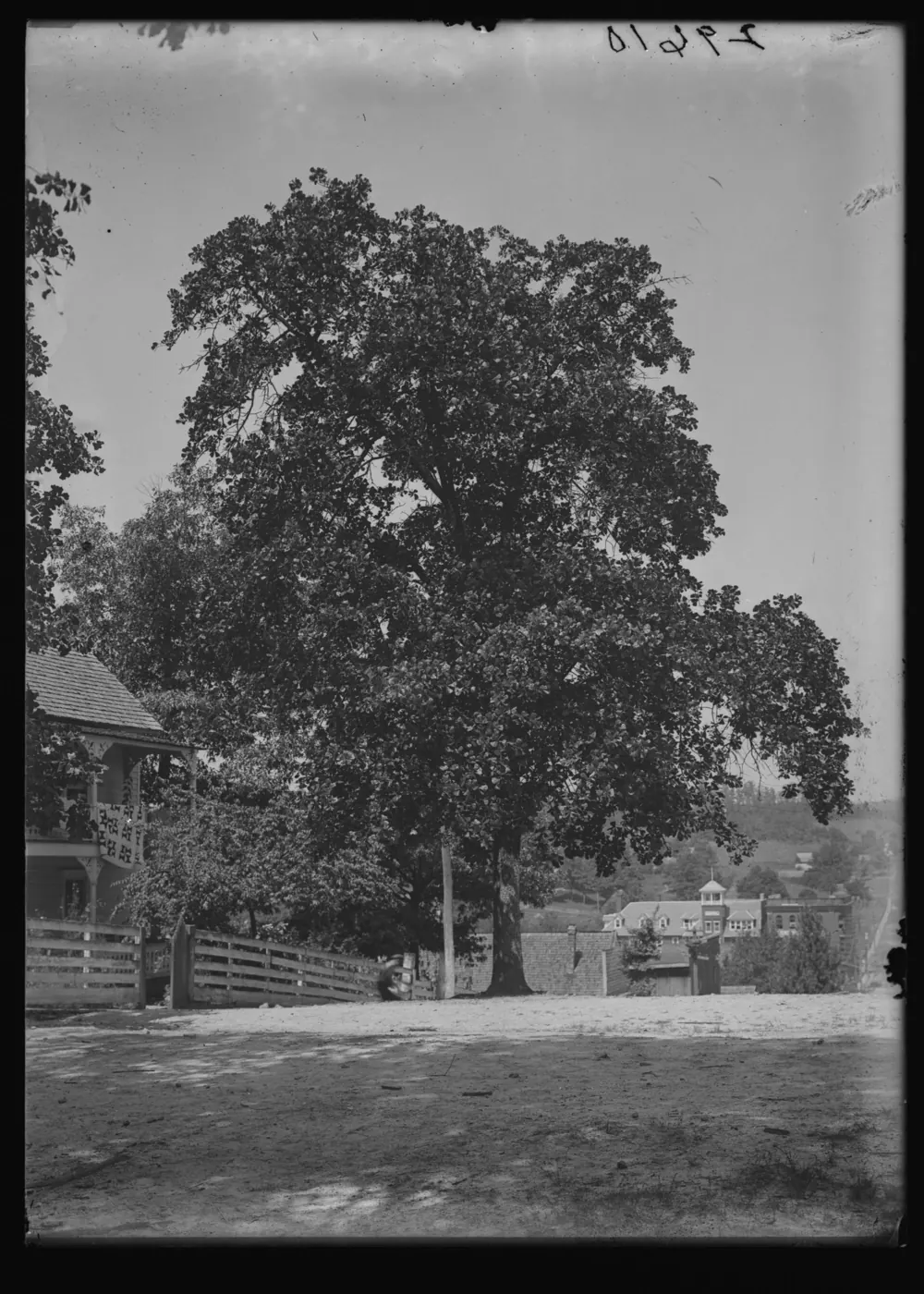
Photo Reference

Quercus marilandica — flowering habit
// Quercus marilandica — flowering habit

Sources & Further Reading

  • USDA NRCS PLANTS Database — Quercus marilandica: plants.usda.gov/plant-profile/QUMA3
  • USDA Forest Service Fire Effects Information System (FEIS) — Q. marilandica: fs.usda.gov/database/feis/plants/tree/quemar
  • Lady Bird Johnson Wildflower Center — Native Plant Database: wildflower.org — QUMA3
  • Oklahoma Forestry Services — Oklahoma's Major Forest Types: Post Oak–Blackjack Forest (forestry.ok.gov).
  • Oklahoma Biological Survey — Ancient Cross Timbers project, University of Oklahoma: biosurvey.ou.edu.
  • Engle, D. M. (1997). Oak ecology. Oklahoma State University, Division of Agricultural Sciences and Natural Resources.
  • Klingaman, G. (2000). Plant of the Week: Blackjack Oak. University of Arkansas Cooperative Extension.
  • Flora of North America — Quercus marilandica (Nixon, K. C., 1997), Vol. 3: efloras.org.
  • Wikipedia — Quercus marilandica: en.wikipedia.org/wiki/Quercus_marilandica (CC BY-SA 4.0; portions of the description, distribution and uses sections summarize Wikipedia content).
  • Tallamy, D. W. (2007 / rev. 2020). Bringing Nature Home — oak as keystone larval host genus.

Photos courtesy of Wikimedia Commons contributors under their respective licenses (linked under each image).