home/ plants/ winter-squash

// SPECIES PROFILE · CROP · DOMESTICATED 8,000+ YRS

Winter Squash

Cucurbita spp.
(C. moschata · C. maxima · C. pepo · C. argyrosperma)

"Winter squash" is not one species — it is four separate domesticated species in the genus Cucurbita, all native to the Americas, all monoecious vines bearing the same kind of fleshy pepo fruit, but with very different pest tolerances, storage life and heat-tolerance. For a Tulsa-region grower the choice between species is not cosmetic: it is the difference between a vine that survives the squash vine borer and one that wilts in late June. Squash was the first crop domesticated in the Americas, predating maize and beans by some 4,000 years, and is the founding member of the Three Sisters companion-planting system practiced at Spiro Mounds and across the Mississippian and Caddoan world.

// QUICK FACTS
Family
Cucurbitaceae (gourd family)
Domesticated species
C. moschata · C. maxima · C. pepo · C. argyrosperma · (C. ficifolia)
Origin
Mesoamerica (4 spp.) & South America (C. maxima)
Earliest evidence
~10,000 BP, Guilá Naquitz cave, Oaxaca (C. pepo)
Habit
Annual herbaceous vine (5–15 m); some bush cultivars
Sex system
Monoecious — separate male & female flowers, same plant
Fruit
A pepo — modified berry with hardened rind
Chromosomes
2n = 40 (all Cucurbita)
USDA hardiness
Grown as warm-season annual, all zones
Tulsa sow date
Direct-sow mid-April through early May (after last frost)
Days to harvest
85–120 days depending on cultivar
Sun
Full sun (8+ hrs)
Soil
Rich, well-drained loam, pH 6.0–7.0; heavy feeder
Water
1–1.5"/week; deep, infrequent
Specialist pollinators
Squash bees: Peponapis pruinosa, Xenoglossa strenua
Winter squash (Cucurbita) fruits cured and ready for storage
Winter squash — the foundational crop of the Americas and the first of the Three Sisters. Photo: Rooted Revival, Tulsa, OK.

Identification

[ field key — vine · leaf · flower · fruit · seed ]

Habit & Vine

Large herbaceous annuals. Most cultivars are sprawling vines 5–15 m long, climbing or trailing on the ground via branched tendrils at each node; a smaller subset of C. pepo and C. maxima cultivars are non-vining "bush" types. Stems are angular, hollow in some species and solid in others — an ID detail that becomes operationally critical (see Care): C. moschata and C. argyrosperma have notably tougher, more solid stems than C. pepo or C. maxima. All above-ground parts are clothed in stiff, often sharp trichomes that can irritate skin during harvest.

Leaves

Alternate, very large (often 20–35 cm wide), with long petioles and palmately 3–5 lobed blades on most species. Useful species clues: C. moschata leaves often show silvery-white spots along the veins; C. argyrosperma leaves are more ovate-cordate (egg-to-heart shaped) with shallower lobes; C. pepo leaves are typically the most deeply cut and most aggressively prickly; C. maxima leaves are the largest and softest, often with a faint mealy bloom.

Flowers (Monoecious)

Large, funnel- to bell-shaped, 5-petalled, bright yellow to orange, 7–15 cm across. Cucurbita is monoecious: the same plant produces separate male (staminate) and female (pistillate) flowers. A young plant typically opens male flowers first for 1–2 weeks, then begins setting females — a normal pattern, not a problem. Female flowers are unmistakable: a small, fully-formed miniature squash (the inferior ovary) sits directly behind the petals. Flowers open at dawn and close by mid-day; pollination must happen in those first few hours.

Fruit (a Pepo) & Seeds

The squash fruit is botanically a pepo: a modified berry derived from an inferior ovary, with a thick, hardened rind enclosing fleshy mesocarp and a hollow seed cavity. Winter squash are cultivars allowed to fully mature on the vine until rind hardens, giving months of storage; summer squash are the same species (C. pepo, mostly) harvested immature with edible skin. Seeds are large, flat, oval, ivory to tan, with a thick papery seed coat — edible roasted as pepitas and high in oil and protein.

The four-species rule: Cucurbits cross within a species but rarely across species. C. moschata × C. maxima and C. pepo × C. argyrosperma can occasionally hybridize, but for seed-saving purposes you can grow one cultivar per species (e.g. one butternut + one Lakota + one acorn + one cushaw) and save true seed from all four. This is why colonial-era and Indigenous gardens routinely held multiple "pumpkins" without genetic chaos.

Adaptation & Cultivation in NE Oklahoma

All cultivated Cucurbita are warm-season annuals intolerant of frost. In the Tulsa region (USDA zone 7a/7b), direct-sow seed mid-April through early May, after soil temperatures hit 65 °F at 4" depth and night lows are reliably above 50 °F. They germinate fast (5–10 days) and grow explosively in our long, hot summers — but they are also greedy plants: each vine wants 10–15 ft of run, full sun all day, deep loamy soil, and steady moisture through fruit set.

The single biggest cultivation question in NE Oklahoma is not soil or water but which species you choose. Two pests — the squash vine borer (Melittia cucurbitae) and the squash bug (Anasa tristis) — are reliable, every-year problems here, and they hit the four species very differently. C. moschata (butternut, Seminole pumpkin, calabaza) and C. argyrosperma (cushaws) have notably solid, tough stems and heavy pubescence that confer real, field-proven resistance to the vine borer. C. pepo (zucchini, acorn, sugar pumpkin) and especially C. maxima (hubbards, kabocha, Atlantic Giants) have hollow, soft stems that the borer destroys without difficulty — and squash bugs preferentially overwinter in their crop debris.

Practical translation: if you only have room for one species, plant C. moschata. A Seminole pumpkin or a Waltham butternut on a strong trellis will out-yield a struggling Atlantic Giant in most Tulsa backyards.

Ecology & Pollinator Partnerships

[ squash bees · pests · disease vectors · co-evolution ]

Squash Bees (Peponapis & Xenoglossa)

Cucurbita has co-evolved with two genera of specialist solitary native bees in the tribe Eucerini — Peponapis pruinosa (the eastern hoary squash bee) and Xenoglossa strenua. These bees feed exclusively on Cucurbita pollen, are active only in the pre-dawn to mid-morning window when squash flowers are open, and nest in the soil directly under squash plants. They are more efficient pollinators than honey bees and often complete pollination before honey bees are even active. Their range expanded into the eastern US along with the spread of cucurbit cultivation.

The Two Cardinal Pests

Squash vine borer (Melittia cucurbitae) — a clearwing moth whose larva tunnels inside the stem at the base of the plant, killing entire C. pepo and C. maxima vines mid-season. Frass at a tiny entry hole low on the stem is the diagnostic. Squash bug (Anasa tristis) — a true bug (Hemiptera) that feeds on phloem and transmits the bacterium causing cucurbit yellow vine decline. Egg masses are bronze-colored and laid in neat clusters on leaf undersides.

Disease Vectors

Striped and spotted cucumber beetles (Acalymma vittatum, Diabrotica undecimpunctata) feed on cotyledons and flowers and are the field vector of bacterial wilt (Erwinia tracheiphila), which kills entire vines within days. Cucurbits are also susceptible to powdery mildew (Erysiphe spp.), which is nearly universal in late summer here, and downy mildew in wetter years. C. moschata shows the best field tolerance to all of these.

Wildlife & Trophic Role

Beyond squash bees, flowers are visited by bumblebees, honey bees, longhorn bees and small carpenter bees. Mature fruit and seeds are eaten by deer, raccoons, opossums, squirrels, and many granivorous birds — the seeds are a calorie-dense fall food. Wild ancestors contained bitter cucurbitacins that deterred mammals; domestication selected for sweet, low-cucurbitacin flesh, which is why a stray "volunteer" squash crossed back to wild stock can occasionally be unsafely bitter.

Squash bee conservation — do not till deep, do not soil-drench insecticides. Because Peponapis pruinosa females dig nest burrows 5–15 cm deep in the soil directly under your squash plants, standard garden practices wipe them out. Avoid deep tillage in cucurbit beds, avoid soil-applied neonicotinoids and other systemic insecticides, and leave undisturbed ground (a no-till strip, a mulched alley) adjacent to your squash patch from year to year. A single backyard with healthy squash bees can pollinate the whole block.

Horticulture & Care

[ planting · soil · water · pest defense · harvest · cure · store ]

Site, soil & planting

Choose the sunniest spot you have and amend it heavily: 2–4" of finished compost worked into the top 8" of soil, plus a balanced organic fertilizer. Squash are heavy feeders and rapid growers, and starvation shows up immediately as small fruit and male-only flowering. Direct-sow 2–3 seeds per hill, 1" deep, then thin to the strongest seedling. Vining types: hills 4–6 ft apart in rows 8–12 ft apart, or trellis vertically on a stout cattle-panel arch (most C. moschata and smaller-fruited C. pepo climb beautifully). Bush types: 2–3 ft apart.

Defending against squash vine borer in OK

For Tulsa-area gardeners, the borer is the central design constraint of the squash patch. Effective tactics, in rough order of leverage:

Harvest, curing & storage

Winter squash are ready to harvest when (1) the rind resists a thumbnail press — you cannot dent it — and (2) the stem and tendril nearest the fruit have dried and turned brown. Cut with 2–4" of stem attached using pruners; never carry a winter squash by its stem (a broken stem invites rot through the wound). Always harvest before a hard frost, though one or two light frosts on the foliage do no harm.

Cure harvested fruit at 80–85 °F with good air movement for 10–14 days — this hardens the rind, seals the stem scar, and converts starches to sugars (kabocha and butternut taste dramatically sweeter after curing). A sunny porch in early September works perfectly in Tulsa. Store cured fruit in a cool, dry, dark place at 50–55 °F and ~50–70% humidity — not a refrigerator, which is too cold and too humid. Storage life by species:

Notable cultivars by species (NE Oklahoma)

Cultivar Species Origin / date Notes for Tulsa
'Seminole Pumpkin' C. moschata FL Seminole heritage, pre-Columbian Top OK choice. SVB-resistant, heat-tolerant, climbs trees, fruit stores 12+ months.
'Waltham Butternut' C. moschata Bob Young, MA, AAS winner 1970 Reliable 4–5 lb tan butternuts; the modern standard for the species.
'Long Island Cheese' C. moschata NY heirloom, pre-1807 Flat, lobed, buff-tan; superb pie pumpkin; excellent storage.
'Dickinson Pumpkin' C. moschata IL/IN, c. 1835 The variety Libby's actually uses for canned "pumpkin." Long tan oval, dense flesh.
'Lakota' C. maxima Lakota Sioux heirloom (re-introduced by U. of Nebraska) Pear-shaped, scarlet with green streaks; sweet, nutty; squash-bug magnet — trellis or use row cover.
'Burgess Buttercup' C. maxima Burgess Seed, IA, 1932 3–5 lb dark green turban; classic dry, sweet flesh; needs SVB protection.
'Blue Hubbard' C. maxima Gregory, MA, 1909 10–15 lb slate-blue; legendary keeper; can be planted as a sacrificial trap crop for SVB & squash bug.
'Jarrahdale' C. maxima Australia, 19th c. Slate-blue ribbed; ornamental + edible; same SVB caveats.
'Delicata' C. pepo Peter Henderson Co., NY, 1894 Cream + green stripe; thin edible skin; eat fresh, short storage.
'Table Queen' (Acorn) C. pepo Iowa Seed Co., 1913 The classic acorn squash. Bush forms exist; SVB-vulnerable.
'Sugar Pie' / 'New England Pie' C. pepo New England heirloom, 19th c. 4–6 lb orange pie pumpkin. Same SVB caveats as all C. pepo.
'Green Striped Cushaw' C. argyrosperma Pre-Columbian Mesoamerica; OK heritage crop Crook-necked, white with green stripes, 10–15 lb. Heat-tolerant, SVB-resistant; the traditional Cherokee Nation pie pumpkin.

Three Sisters companion planting

The original North American polyculture: corn provides a living pole for beans, beans fix nitrogen for next year's corn, and squash sprawls beneath, suppressing weeds with its huge leaves and protecting the soil from sun and rain. The squash's prickly leaves and stems also discourage raccoons from raiding the corn. In a Tulsa-yard implementation, allow ~10 ft×10 ft per "mound": plant 4 corn in a square at center, four pole beans around the corn after it is 6" tall, and 2–3 squash hills around the perimeter. Use C. moschata here — its long vines and SVB resistance match the polyculture's pace.
Culinary & Cultural Uses

Cucurbits are among the oldest domesticated plants in the world: archaeological evidence from the Guilá Naquitz cave in Oaxaca dates C. pepo domestication to roughly 10,000 years before present, predating the domestication of maize and beans in the same region by some 4,000 years. Squash was independently re-domesticated in eastern North America from C. pepo ssp. ovifera, making it one of only a handful of crops domesticated north of Mexico.

The Cherokee cushaw & the Spiro Mounds connection: Cucurbita argyrosperma — the Green Striped Cushaw — is a heritage crop of the Cherokee Nation and the wider Southeast, where it has been grown continuously for centuries. In NE Oklahoma cushaw pie is a traditional holiday dish, often substituted for or blended with sweet potato. Squash, beans and corn together formed the agricultural foundation of the Mississippian and Caddoan world centered at Spiro Mounds in present-day Le Flore County, Oklahoma — a continuity of cultivation that reaches back well over a thousand years on this land.
Bitterness caution: Wild and reverted cucurbits contain cucurbitacins, intensely bitter steroids that can cause severe gastrointestinal toxicity ("toxic squash syndrome"). If a winter squash tastes unmistakably bitter (not just bland or starchy), spit it out and discard the fruit — this is rare in modern cultivars but can occur in seeds saved from gardens that included ornamental gourds, or from accidental crosses with wild C. pepo ssp. texana / ovifera.

Photo Reference

Cucurbita moschata 'Butternut' fruit halved lengthwise showing dense orange flesh
// C. moschata 'Butternut' · the Tulsa workhorse
Wikimedia Commons
Peponapis pruinosa squash bee inside an open female Cucurbita flower
// Peponapis pruinosa · specialist squash-bee pollinator at dawn
Wikimedia Commons
Wikimedia Commons
Cucurbita moschata leaves showing characteristic silvery-white spots near the veins
// C. moschata leaves · silvery vein-spots are a species clue
Wikimedia Commons
Seminole pumpkin (Cucurbita moschata), the Florida Indigenous heritage cultivar
// 'Seminole Pumpkin' (C. moschata) · pre-Columbian, ultra-storable
Wikimedia Commons
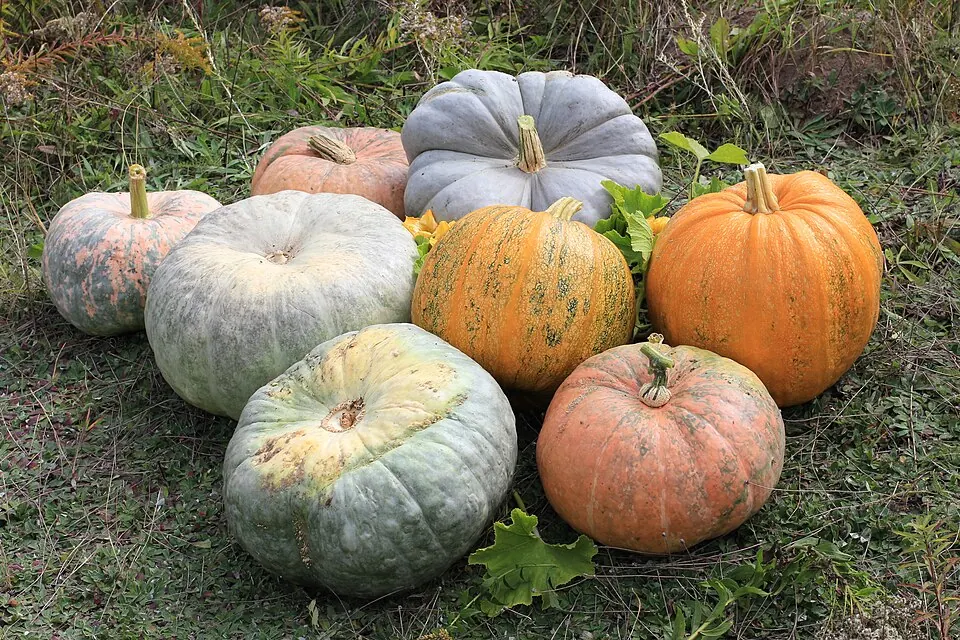
An assortment of Cucurbita pepo and C. maxima fruits in many colors and shapes
// Multi-species assortment · C. pepo + C. maxima
Wikimedia Commons

Sources & Further Reading

  • USDA NRCS PLANTS Database — Cucurbita: plants.usda.gov/plant-profile/CUCUR
  • Oklahoma State University Extension — Squash and Pumpkin Production (HLA-6027) and Squash Bug Management (EPP-7313).
  • Seed Savers Exchange — cultivar histories for Seminole Pumpkin, Waltham Butternut, Lakota, Long Island Cheese, Green Striped Cushaw: seedsavers.org
  • Native Seeds/SEARCH — Indigenous cucurbit cultivars of the Southwest and northern Mexico, including cushaw and Hopi/Tohono O'odham landraces: nativeseeds.org
  • Smith, B. D. (1997). "The Initial Domestication of Cucurbita pepo in the Americas 10,000 Years Ago." Science 276:932–934.
  • Sanjur, O. I. et al. (2002). "Phylogenetic Relationships among Domesticated and Wild Species of Cucurbita Inferred from a Mitochondrial Gene." PNAS 99(1):535–540.
  • Hurd, P. D. & Linsley, E. G. (1971). "Squash and Gourd Bees (Peponapis, Xenoglossa) and the Origin of the Cultivated Cucurbita." Evolution 25(1):218–234.
  • Landon, A. J. (2008). "The 'How' of the Three Sisters: The Origins of Agriculture in Mesoamerica and the Human Niche." Nebraska Anthropologist.
  • University of Florida IFAS — Seminole Pumpkin (Cucurbita moschata) cultural and agronomic notes.
  • Wikipedia — Cucurbita, C. moschata, C. maxima, C. pepo, C. argyrosperma, Squash bee, Squash vine borer, Three Sisters (agriculture). (CC BY-SA 4.0; portions of botany, ecology and history sections summarize Wikipedia content.)

Photos courtesy of Wikimedia Commons contributors under their respective licenses (linked under each image). Hero photo: Rooted Revival.

Companion Planting

[ guild · polyculture · cross-layer pairings ]

In a kitchen-garden polyculture, winter squash pairs naturally with: comfrey (Symphytum officinale), basil (Ocimum basilicum), common sunflower (Helianthus annuus), chile pepper (Capsicum annuum), collard greens (Brassica oleracea), and cosmos (Cosmos bipinnatus).

In a polyculture bed, winter squash pairs with the partners above for pest deterrence, pollination, and soil-building.