Horticulture & Care
[ siting · soil · water · propagation · pruning · pests ]
Site selection & planting
Choose the coolest, shadiest, most reliably moist part of your garden — a
north or east exposure under mature deciduous canopy, ideally with no direct
afternoon sun at any time of year. Maidenhair will tolerate dappled morning sun
but scorches and collapses under western OK afternoon sun. Soil
must be a deep, friable, humus-rich loam with consistent
sub-surface moisture and excellent drainage — standing water rots the
rhizome. pH range 6.0–7.5; tolerates limestone-derived soils despite a mild
preference for slightly acidic conditions.
- Plant in early spring as croziers begin to emerge, or in early fall while soil is still warm.
- Hole: 2× rootball width, just deep enough that the rhizome sits at, not below, the original soil level.
- Backfill: native soil enriched generously with leaf-mold or aged hardwood-leaf compost — never fresh manure.
- Mulch: 2–3" of shredded hardwood leaves annually as a top-dress, kept loose around (not on) the crown. This is the single most important cultural practice.
- Water deeply at planting and keep the soil continuously moist for the first full growing season.
Water & soil after establishment
Even mature plants are not drought-tolerant. During NE Oklahoma's
mid-summer dry spells (late July through early September) supplemental water is
usually required — aim to keep the root zone evenly moist, never sopping and
never bone-dry. An annual top-dress of leaf-mold each fall maintains the humus
layer the rhizomes ride on. No fertilizer is required in soil that receives this
treatment; chemical fertilizers can burn the fine roots.
Pruning & clean-up
Cut spent fronds back to the ground in late winter just before new croziers
emerge. Do not disturb established clumps — maidenhair
resents transplanting and root disturbance, and a happy colony left in peace will
slowly expand for decades. Avoid cultivating, walking on, or stacking heavy mulch
over the rhizome zone.
Propagation
-
Division (recommended): The only practical home method.
Lift an established clump in early spring as croziers are first emerging,
slice the rhizome mat into sections each containing several new fronds and
healthy roots, and replant immediately into prepared, leaf-mold-enriched
holes. Keep divisions continuously moist for the entire first
season. Expect a year of sulking before they look established.
-
Spore (advanced): Collect mature pinnules in late summer when
sori darken; tap spores onto sterile, moist sphagnum or peat-based medium under
a clear cover; gametophytes appear in 6–12 weeks; transplant young
sporophytes once 2–3 fronds form. Slow but rewarding for restoration
work.
-
Wild collection: Do not. NE Oklahoma populations are
small and slow to recover. Source nursery-propagated plants only.
Container culture
Maidenhair grows well in shaded containers provided the medium is kept
consistently cool and moist. Use a wide, shallow pot (the rhizome runs
laterally), a peat-free humus-rich potting mix, and place the container in deep
shade. Move under cover in extreme summer heat; protect from drying winter winds.
A double-pot arrangement (pot inside a slightly larger pot, gap stuffed with damp
sphagnum) buffers temperature and moisture swings.
Pests & diseases
-
Drying out — by far the #1 killer. Once the fronds
wilt and crisp they will not recover that season. Address by
deep-watering immediately and improving mulch; new croziers may emerge.
-
Sun-scorch — bleached, brown-edged pinnules from too
much direct sun. Move or re-shade.
-
Snails & slugs — occasional damage to young croziers; usually cosmetic.
-
Rhizome rot — from poor drainage or buried crown. Replant higher in better-drained medium.
-
Insect pests & disease — essentially none of significance in cultivation.
Related species & cultivars for the Tulsa region
| Taxon / Cultivar |
Type |
Distinguishing feature |
Notes for NE Oklahoma |
| Adiantum pedatum (straight species) |
Native fern |
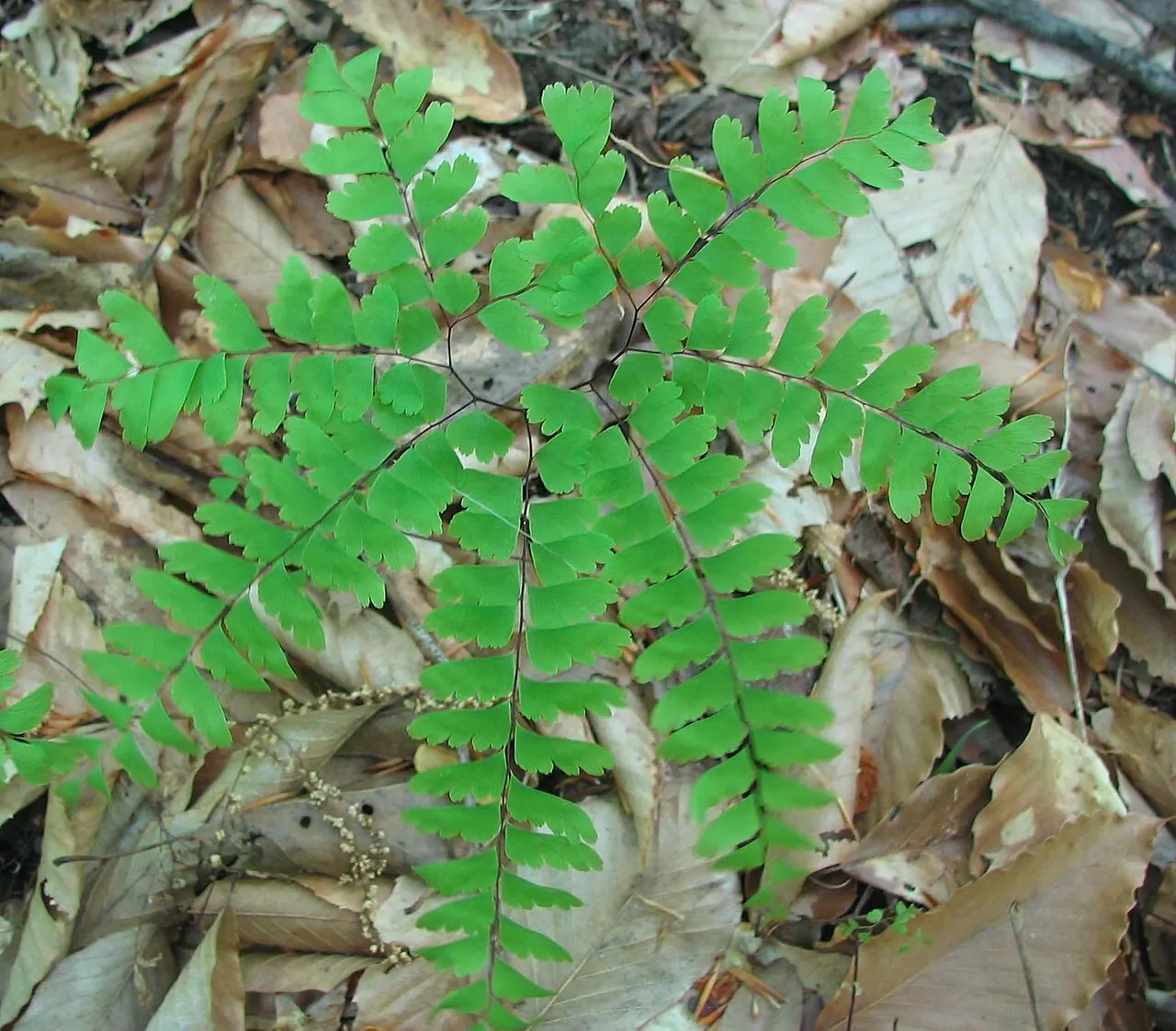
Pedate, horseshoe-shaped frond on a black petiole; 12–24 in tall |
The native of Ozark/Cookson Hills mesic woodland; the only form to plant for restoration. |
| Adiantum capillus-veneris (Southern maidenhair) |
Native fern |
Smaller, lacy, drooping fronds (not pedate); finely divided; black petiole |
Native to OK at Roman Nose State Park seeping limestone ledges and a few scattered locales; needs more moisture and tolerates higher pH than A. pedatum; specialist of dripping calcareous rock. |
| Adiantum pedatum 'Imbricatum' |
Cultivar |
Dwarf, ~6–10 in; overlapping pinnules, denser texture |
Small-space shade gardens; same care as the species. |
| Adiantum aleuticum (Western maidenhair) |
Sister species |
Long-segregated from A. pedatum; western N. America |
Not native to OK; sometimes sold interchangeably. Stick with the eastern species locally. |
| Adiantum venustum (Himalayan maidenhair) |
Non-native ornamental |
Evergreen, low groundcover-forming, fronds 6–9 in |
A useful evergreen shade groundcover, but not a substitute for the native species in habitat plantings. |
Companion planting in a native shade garden
Pairs naturally with: native Heuchera americana and
H. villosa, Christmas fern
(Polystichum acrostichoides), wild ginger
(Asarum canadense), native columbine
(Aquilegia canadensis), Solomon's seal (Polygonatum biflorum),
and woodland phlox (Phlox divaricata). For a complete NE Oklahoma
shade-garden mosaic, layer maidenhair beneath an upper canopy of native
chinkapin oak, sugar maple or
shagbark hickory, with a midstory of
Cercis canadensis, dogwood, or pawpaw.


_-_Gatineau_Park,_Quebec_2013-09-20.jpg)

.jpg)