home/ plants/ heirloom-tomato

// SPECIES PROFILE · CROP · OPEN-POLLINATED

Heirloom Tomato

Solanum lycopersicum

The single most-grown vegetable in American home gardens, and the one that most punishes Oklahoma growers who treat it like a crop from a milder climate. Solanum lycopersicum is a warm-season Andean perennial grown here as an annual; an "heirloom" is simply an open-pollinated cultivar (typically >50 years old) whose seed comes true from year to year — the opposite of a modern F1 hybrid, which must be re-purchased annually. In NE Oklahoma the brutal mid-summer heat shuts down fruit set above ~90 °F, so success depends on early planting (transplants out by ~April 20 in Tulsa), heavy mulch, deep consistent water, and choosing heat-tolerant heirlooms like 'Arkansas Traveler' and 'Cherokee Purple'.

// QUICK FACTS
Family
Solanaceae (nightshade)
Native range
Western South America (Andes); domesticated in southern Mexico
Life cycle
Tender perennial grown as a warm-season annual
USDA hardiness
Annual everywhere in continental US (perennial in zones 10–11)
Habit
Determinate (bush) or indeterminate (vining) — cultivar-dependent
Mature size
Determinate: 3–4 ft · Indeterminate: 6–12+ ft on stakes
Days to harvest
55–90 days from transplant
Sun
Full sun, 8+ hours
Soil
Deep, fertile, well-drained loam; pH 6.2–6.8
Water
1–2 in/week, deep & consistent (irregular = blossom end rot)
Spacing
Determinate 24"; indeterminate 36" caged or 18" staked
OK transplant date
~April 15–20 (Tulsa); after last frost & soil > 60 °F
Pollination
Self-fertile; buzz-pollinated by Bombus bumblebees
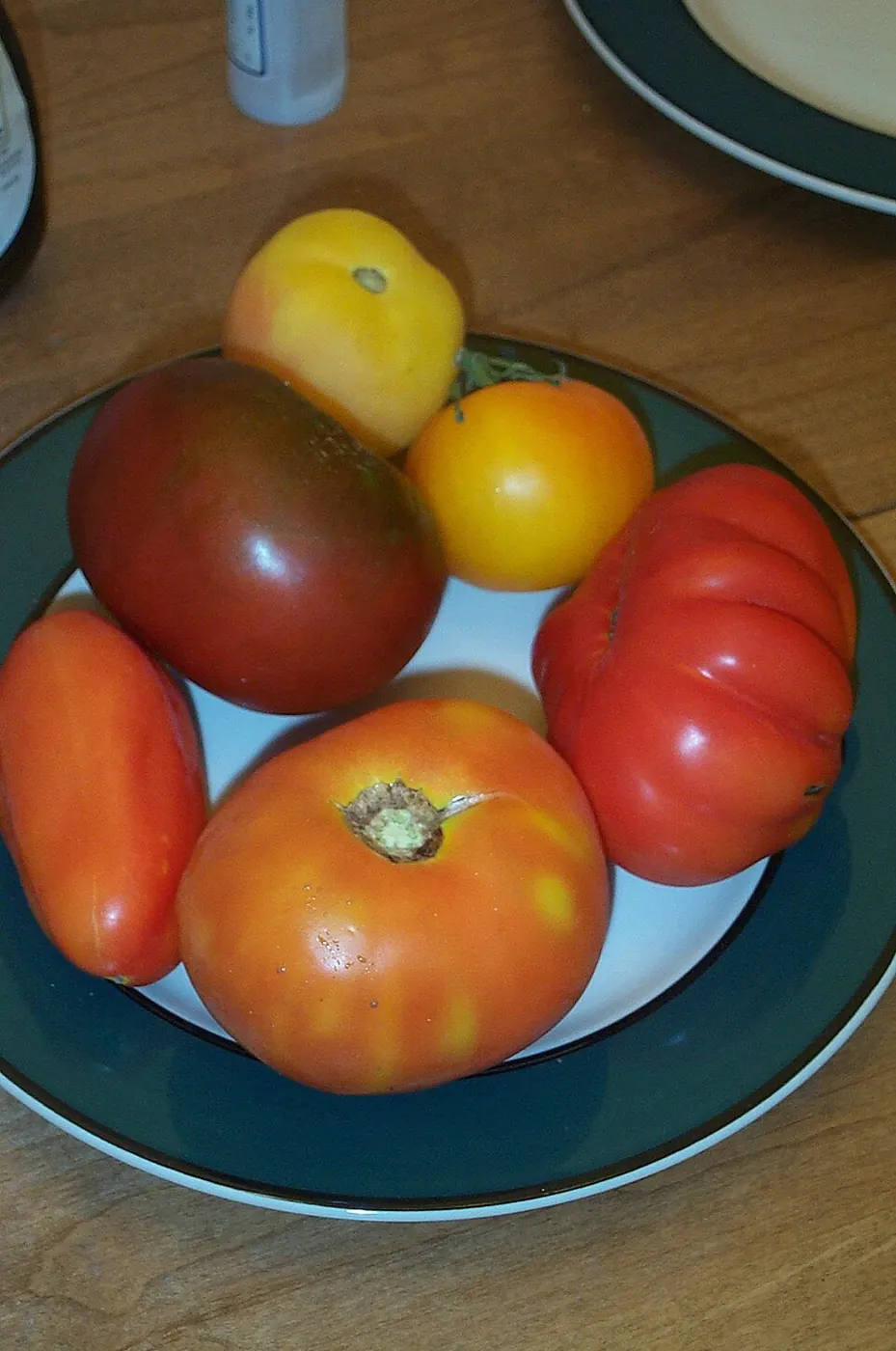
Ripe heirloom tomatoes (Solanum lycopersicum) of varied colors and shapes
Mixed heirloom tomatoes — the color and shape diversity that hybrid breeding largely abandoned in favor of shipping durability. Photo: Rooted Revival.

Identification

[ field key — habit · leaf · flower · fruit ]

Habit & Growth Type

Herbaceous, sprawling to vining plant covered in sticky glandular hairs that give the foliage a distinctive musky scent. Two genetically distinct growth habits, governed largely by the SELF-PRUNING (SP) gene: determinate ("bush") plants terminate every shoot in a flower cluster, top out at 3–4 ft, and ripen most of their crop in a 2–3 week window — ideal for canning. Indeterminate ("vining") plants keep growing from a leader indefinitely, can hit 6–12+ ft on a stake, and crank out fruit until frost. Most heirlooms are indeterminate.

Leaves

Alternate, pinnately compound, 10–25 cm long, with 5–9 deeply lobed leaflets and smaller leaflets interspersed between them (interjected pinnules). Surfaces densely covered with two types of glandular trichomes that exude the characteristic tomato-vine aroma; this smell is largely terpene-based and is the plant's first line of insect defence. "Potato-leaf" cultivars ('Brandywine' for example) carry a recessive allele producing simpler, broader leaflets without the secondary lobing.

Flowers

Small, ~1–2 cm wide, bright yellow, 5-petaled (occasionally 6–7), borne in cymes of 3–12 along the stem. The five anthers fuse into a yellow cone surrounding the style — pollen is released through terminal pores and only shaken loose by vibration. Self-fertile but enormously more productive when bumblebees buzz-pollinate; honey bees cannot do this and contribute almost nothing to tomato pollination.

Fruit

Botanically a berry: a fleshy, multi-seeded fruit derived from a single ovary. Shape, size and color are wildly variable across heirlooms — from 10 g cherry to 1+ kg beefsteaks; from red and pink through yellow, orange, green-when-ripe, purple-black, striped, and bicolored. Color genetics involve a few major loci controlling the skin (yellow vs clear), flesh (red lycopene vs orange beta-carotene vs yellow), and the green-flesh / "black" pigment. Wild-type is small, red, and round; everything else is the result of ~7,000 years of selection.

Habitat & Adaptation in NE Oklahoma

The wild ancestor (Solanum pimpinellifolium) is native to the dry coastal slopes of western South America — northern Peru, southern Ecuador. Domestication probably occurred in southern Mexico, where indigenous Mesoamerican farmers selected the larger-fruited forms encountered by Spanish colonists in the 16th century. The crop reached Europe by the 1540s and was widely feared as poisonous (it is in the same family as deadly nightshade) until the 1700s.

In NE Oklahoma, tomatoes face a narrow productive window. Soil is usually warm enough to transplant by the second or third week of April; flowers then need to set fruit before sustained daytime highs above 90 °F (and especially nighttime lows above ~75 °F) cause pollen sterility and blossom drop. From early July through late August most plants essentially stop setting fruit even when they continue to flower. The classic OK strategy is to plant early, mulch heavily, water deeply, and choose heat-tolerant cultivars — or to put in a second crop in mid-July for a fall flush as nights cool back into the 60s in September.

NE Oklahoma timing & strategy: Average last frost in Tulsa is roughly April 5–15; safe transplant window is April 15–30 once soil temperatures hit 60 °F at 4" deep. Mulch with 3–4" of straw or wood chips immediately after planting to keep soil moisture even. Water deeply 1–2 in/week at the base of the plant, never from overhead. For heat-stress survival pick 'Arkansas Traveler' (developed in NW Arkansas, the single best heat-tolerant heirloom for our climate), 'Cherokee Purple', 'Black Krim', or any modern Solanum habrochaites-derived heat-set hybrid. The Tulsa Garden Center hosts an annual heirloom tomato tasting in July that is the best single regional resource for which varieties actually perform here.

Ecology & Garden Wildlife

[ pollinators · pests · biocontrol · companions ]

Pollinators — Buzz Pollination

Tomato flowers store pollen inside poricidal anthers — tubes that release pollen only when vibrated at roughly the C-natural frequency. Native bumblebees (Bombus spp., notably B. impatiens, B. griseocollis, and B. pensylvanicus in NE OK) grasp the anther cone and decouple their flight muscles from their wings to buzz-pollinatesonication. Honey bees do not buzz-pollinate and contribute almost nothing. Plants will self-pollinate to a degree from wind and their own jostling, but bumblebee visits dramatically increase fruit size and seed set.

Caterpillar Hosts & Hornworms

Larval host for the tomato hornworm (Manduca quinquemaculata) and the much more common tobacco hornworm (Manduca sexta) — the big green caterpillars with the curved tail-horn that can defoliate a plant overnight. Both pupate in the soil and emerge as large hawkmoths (sphinx moths) that hover-pollinate four-o'clocks and moonflowers at dusk. Hand-pick when you find them; but see the biocontrol note below.

Other Pests

Flea beetles shotgun young foliage in spring (mostly cosmetic on established plants); aphids distort new growth and vector viruses; stink bugs and leaf-footed bugs (Leptoglossus phyllopus) puncture ripening fruit, leaving cloudy yellow spots. Soft-bodied pests are largely controlled by lacewings, lady beetles and predatory bugs in spray-free gardens.

Beneficial Insects & Biocontrol

The braconid wasp Cotesia congregata parasitizes hornworms; if you find a hornworm covered in dozens of small white rice-grain cocoons on its back, leave it alone — the wasps are about to emerge and will parasitize the next generation. Lacewings (Chrysoperla spp.) and minute pirate bugs (Orius insidiosus) handle aphids, mites and thrips. A healthy tomato patch is a predator nursery; broad-spectrum insecticides break the entire system.

Companion planting: Classic and well-supported companions are basil (repels some pests, may improve flavor), marigold (Tagetes patula; root exudates suppress root-knot nematodes), borage (attracts pollinators and predatory wasps), parsley and carrots. Avoid planting tomatoes near brassicas (compete heavily), fennel (allelopathic to most vegetables), or under black walnut (juglone-sensitive).

Horticulture & Care

[ planting · soil · water · staking · pests · diseases ]

Site selection & planting

Choose the sunniest spot in the garden — 8+ hours of direct sun. Tomatoes are heavy feeders and need deep, fertile, well-drained soil amended with 2–4" of finished compost worked in before planting. Slightly acidic soil (pH 6.2–6.8) is ideal; Tulsa-area clay benefits from gypsum and organic matter to improve structure. Rotate the tomato bed on a 3–4 year cycle to break Solanaceae-specific soil disease pressure (early blight, Verticillium, Fusarium); never plant tomatoes where peppers, eggplant or potatoes grew the previous year.

Determinate vs Indeterminate — the rule that decides everything

Determinate cultivars are bush-form, top out around 3–4 ft, and produce nearly all of their fruit in a single concentrated 2–3 week window. They need only modest support (a small cage), should not be heavily pruned (every removed sucker = lost fruit), and are ideal if you want a single big harvest for canning — classic determinate cultivars include 'Roma', 'Celebrity', 'Rutgers' and most modern paste tomatoes.

Indeterminate cultivars vine indefinitely, will exceed 6–12 ft on a stake by August, and produce continuously until frost. They require strong support (heavy cages, Florida weave, or single stakes with weekly tying), benefit from removing suckers (the shoot in the leaf axil) on the lower 2–3 stems for airflow, and are the better choice for a long fresh-eating season. Most heirlooms are indeterminate, including 'Cherokee Purple', 'Brandywine', 'Black Krim' and 'Arkansas Traveler'.

Water & blossom end rot

Tomatoes need 1–2 inches of water per week, applied deeply and consistently at the base of the plant. Drip or soaker hose is ideal; overhead watering wets foliage and accelerates leaf disease. Irregular watering — deep soak / drought / deep soak — is the leading cause of blossom end rot, the dark sunken patch on the bottom of the fruit. BER is not usually a calcium deficiency in the soil; Oklahoma soils contain abundant calcium. It is a calcium uptake failure caused by inconsistent water (the plant can't transport calcium in the xylem fast enough during a growth spurt). The fix is even moisture and mulch, not adding lime or eggshells.

Diseases & integrated management

Notable heirloom & classic cultivars for NE Oklahoma

Cultivar Type Origin / breeder & year Notes for Tulsa
'Arkansas Traveler' Indeterminate · pink · ~80 days Ozarks, late 1800s; popularized by Univ. of Arkansas pre-1968 Top OK heirloom. Heat-set, crack- & disease-tolerant; 6–8 oz pink fruit. Built for our climate.
'Cherokee Purple' Indeterminate · purple-black · 80–90 days Tennessee, said to originate with the Cherokee ~1890; named & introduced by Craig LeHoullier 1990 The SE-US heirloom standout; legendary smoky-sweet flavor; reasonably heat-tolerant for an heirloom.
'Brandywine' (Sudduth's strain) Indeterminate · pink · 90–100 days · potato-leaf Pennsylvania Amish, documented 1885 The classic flavor benchmark, but late and heat-stressed in OK; site with afternoon shade and mulch heavily.
'Black Krim' Indeterminate · dark purple-brown · 75–90 days Crimean Peninsula, pre-1990 Heat- and drought-tolerant; rich flavor with a saline note; good OK performer.
'Mortgage Lifter' Indeterminate · pink · 85 days M.C. "Radiator Charlie" Byles, Logan WV, 1930s 1–2 lb pink fruit; Byles famously sold seedlings for $1 each in the Depression and paid off his $6,000 mortgage.
'Roma' Determinate · red paste · 75 days USDA, 1955 (open-pollinated, often considered heirloom) The standard paste tomato; low-juice, meaty, ideal for sauce & canning.
'Pink Berkeley Tie-Dye' Indeterminate · pink/green striped · 75 days Brad Gates / Wild Boar Farms, dehybridized ~2010 Modern "neo-heirloom" — a stable open-pollinated line bred from a hybrid; striking fruit, complex flavor.
'Better Boy' (F1 hybrid — not heirloom) Indeterminate · red · 70–75 days Petoseed, 1975 Listed for comparison: classic VFN-resistant hybrid, very productive in OK, but seed will not come true.
'Sungold' (F1 hybrid — not heirloom) Indeterminate · gold cherry · 60 days Tokita Seed, Japan, 1992 The benchmark cherry tomato — tropical-fruit sweetness; F1 only, save seed and you'll get something else.

Heirloom vs F1 Hybrid — what the labels mean

An heirloom is an open-pollinated cultivar — its seed, planted next year, will produce plants essentially identical to its parent. There is no firm cutoff, but most seed-saving organizations use ~50 years old as a rough boundary. An F1 hybrid is the first-generation cross between two distinct inbred parent lines; F1 plants are uniform and often vigorous (hybrid vigor), but their saved seed (F2) segregates into a wild mix of grandparent traits. F1s often carry useful disease-resistance genes that heirlooms lack — the trade-off is flavor depth and seed sovereignty. Both have a place; serious seed savers grow heirlooms.
Culinary, Cultural & Seed-Saving Uses

Tomato is the culinary backbone of dozens of world cuisines — Italian, Mexican, Spanish, Indian, Middle Eastern, Cajun — despite being unknown to any of them before ~1550. Indigenous Mesoamerican peoples were the first domesticators, and the Nahuatl tomatl is the root of the modern name.

Caution — foliage is toxic: All green parts of the tomato plant (leaves, stems, unripe fruit, sprouts) contain the steroidal glycoalkaloids tomatine and trace solanine, characteristic of the Solanaceae family. Never eat the foliage. Ripe red, pink, yellow, orange, purple, or fully-ripe green-when-ripe ('Green Zebra') fruit is safe and the alkaloid drops to negligible levels at ripeness. Truly unripe (green) tomatoes contain higher levels but are generally safe in normal culinary quantities once cooked (fried green tomatoes, chow-chow, salsa verde); pregnant individuals and small children should limit large servings of unripe fruit. Tomato foliage is mildly toxic to dogs, cats and livestock if eaten in quantity.

Photo Reference

Cross-section of a ripe red tomato (Solanum lycopersicum) showing locules and seeds in gel
// Berry fruit · locules & seed gel
Wikimedia Commons
Yellow 5-petaled flower of Solanum lycopersicum with central anther cone
// Yellow flower · fused poricidal anther cone
Wikimedia Commons
Mixed heirloom tomatoes showing varied colors, shapes and sizes
// Heirloom diversity — what F1 breeding gave up
Wikimedia Commons

Sources & Further Reading

  • Oklahoma State University Extension — Oklahoma Garden Planting Guide, HLA-6004 / HLA-6012: extension.okstate.edu — canonical regional planting dates and cultivar recommendations.
  • OSU Extension — Home Garden Tomatoes (HLA-6012); cultivar trial results for Oklahoma.
  • Seed Savers Exchange — heirloom variety database and seed-saving guides: seedsavers.org.
  • Craig LeHoullier (2014), Epic Tomatoes: How to Select and Grow the Best Varieties of All Time, Storey Publishing — the modern reference on heirlooms; LeHoullier named and introduced 'Cherokee Purple'.
  • Carolyn Male (1999), 100 Heirloom Tomatoes for the American Garden, Workman Publishing.
  • Wikipedia — Solanum lycopersicum: en.wikipedia.org/wiki/Tomato and Heirloom tomato: en.wikipedia.org/wiki/Heirloom_tomato (CC BY-SA 4.0; portions of the description, history, and cultivar sections summarize Wikipedia content).
  • USDA National Center for Home Food Preservation (NCHFP) — safe canning guidelines for tomatoes: nchfp.uga.edu.
  • Brad Gates / Wild Boar Farms — modern dehybridized "neo-heirloom" lines: wildboarfarms.com.
  • Tulsa Garden Center — annual heirloom tomato tasting (Woodward Park): tulsagardencenter.org.

Hero photo: Rooted Revival. Strip photos courtesy of Wikimedia Commons contributors under their respective licenses (linked under each image).

Companion Planting

[ guild · polyculture · cross-layer pairings ]

In a kitchen-garden polyculture, heirloom tomato pairs naturally with: comfrey (Symphytum officinale), basil (Ocimum basilicum), common sunflower (Helianthus annuus), chile pepper (Capsicum annuum), collard greens (Brassica oleracea), and cosmos (Cosmos bipinnatus).

In a polyculture bed, heirloom tomato pairs with the partners above for pest deterrence, pollination, and soil-building.